IAA: Brussels Bets on ‘Buy EU’ Tenders and Faster Permits to Rebuild Heavy Industry
On 4 March 2026, the European Commission tabled the Industrial Accelerator Act (IAA), a proposed Regulation designed to pull more manufacturing capacity back into Europe and accelerate industrial decarbonisation in strategic sectors: public money should do more than subsidise transition costs. It should also create demand for European-made, low-carbon products and shorten the timelines that […] IAA: Brussels Bets on ‘Buy EU’ Tenders and Faster Permits to Rebuild Heavy Industry published on The HeavyQuip Magazine.
 machineryasia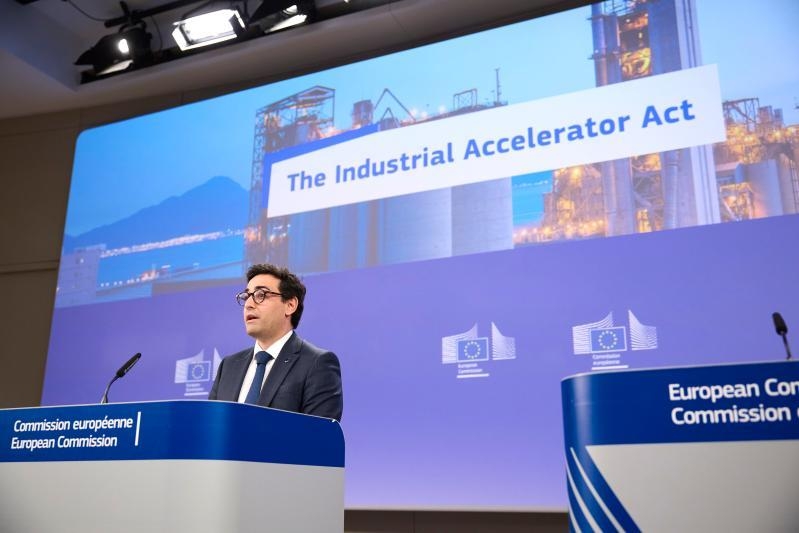
On 4 March 2026, the European Commission tabled the Industrial Accelerator Act (IAA), a proposed Regulation designed to pull more manufacturing capacity back into Europe and accelerate industrial decarbonisation in strategic sectors: public money should do more than subsidise transition costs. It should also create demand for European-made, low-carbon products and shorten the timelines that keep industrial projects stuck in permitting loops.
For construction and equipment markets, this is not a distant policy debate: the Act explicitly targets the materials that sit inside almost every machine and every project: steel, concrete, and aluminium. It also links them to the clean tech supply chains that are reshaping jobsites, from batteries and photovoltaics to wind, heat pumps, and nuclear components. 
What the Commission is proposing
The IAA is built around three levers:
First, it introduces targeted “Made in EU” and/or low-carbon requirements in public procurement and public support schemes for selected strategic sectors, notably steel, cement, aluminium, cars, and net-zero technologies. The Commission presents this as a way to boost demand for European industrial output and give investors clearer signals on where future markets will sit. 
Today marks a major step in the renewal of the European economic doctrine so the Union is fit for the 21st century, as recommended by the Draghi report. Facing unprecedented global uncertainty and unfair competition, European industry can count on the provisions of this Act to boost demand and guarantee resilient supply chains in strategic sectors. It will create jobs by directing taxpayers’ money to European production, decreasing our dependencies and enhancing our economic security and sovereignty.
Stéphane Séjourné, Executive Vice-President for Prosperity and Industrial Strategy, says
Second, it requires Member States to set up a single digital permitting process, framed as a one-stop shop to speed up industrial manufacturing projects. The Commission also highlights the principle of tacit approval at intermediate stages in permitting for energy-intensive decarbonisation projects, aiming to reduce delays that often kill investment decisions long before they reach the construction phase. 
Third, it adds economic security conditions around large foreign direct investments in strategic sectors. For major investments exceeding EUR 100 million, where a single third country controls more than 40 percent of global manufacturing capacity, the proposal sets conditions linked to job quality, value creation, technology and knowledge transfer, and a minimum level of European employment. 
The Commission also anchors the proposal to an explicit reindustrialisation target: manufacturing represented 14.3 percent of EU GDP in 2024, and the Act sets a goal to raise manufacturing’s share to 20 percent by 2035. 
Why this matters to construction, contractors, and OEMs
The IAA is not written for the jobsite, but its impact would show up there.
Steel, cement, and aluminium determine the economics of equipment production and infrastructure delivery. When these supply chains tighten, OEMs feel it through component lead times and pricing. Contractors feel it through tender risk, renegotiations, and schedule uncertainty. A policy that changes procurement criteria for these materials can influence demand patterns and investment timing upstream, which can stabilise or destabilise downstream markets depending on how it is implemented. 
The IAA also pushes a broader clustering logic through Industrial Acceleration Areas, designed to enable industrial symbiosis and clean manufacturing project clusters, supported by energy infrastructure and skills development. For contractors and rental markets, clustering tends to concentrate project pipelines geographically. For OEMs, it concentrates service demand, parts logistics, and demo opportunities near expanding industrial nodes. 
Our verdict: more interventionist than previous EU industrial strategy, with uncertain growth impact.
From an OEM and construction perspective, the IAA is a meaningful shift in method. It is less about setting direction and more about changing the mechanics of demand.
If public procurement and public support begin to consistently favour EU-origin and low-carbon materials and technologies, producers gain a more predictable business case for decarbonisation investments. Over time, that can expand European capacity and reduce exposure to external supply shocks in strategic sectors. 
The second disruptive element is permitting, if it works. Faster permitting for industrial projects would translate into real equipment demand because it pulls forward the physical build-out: site prep, foundations, heavy lifts, concrete works, and energy infrastructure. This is the part that can move the market sooner than procurement criteria, because project starts are visible and measurable. 
However, the Act can still land as “green and bureaucratic” if three practical issues are not solved.
1) Cost premiums and contract structures
Low-carbon materials can carry a premium today, and the Act does not remove underlying cost drivers such as energy prices and capital intensity. If public clients tighten carbon and origin requirements without adjusting budgets and contract models, the stress lands on contractors through higher input costs, documentation obligations, and disputes in fixed-price environments. 
2) Definitions, verification, and exemptions
Procurement rules only change markets when they are precise and enforceable. Questions are already surfacing around how “low-carbon” is defined and verified in sectors like steel, and whether the approach risks inconsistent application across Member States and contracting authorities. If exemptions become routine, the result is compliance friction without investment traction. 
3) Implementation discipline across Member States
The Commission can propose a one-stop shop. The real test is whether permitting authorities deliver shorter timelines in practice, and whether digitalisation becomes a simplification rather than a second interface layered on top of existing procedures. This is where EU initiatives often lose momentum. 
The IAA is a great attempt to turn procurement into industrial policy. It can become a growth enhancer if tender rules are strict, verification is credible, and permitting reform is enforced. If not, the sector will mainly experience added tender complexity and more administrative load with limited change in capacity or resilience. 
IAA: Brussels Bets on ‘Buy EU’ Tenders and Faster Permits to Rebuild Heavy Industry published on The HeavyQuip Magazine.