Embedded Intelligence for Construction Robotics
ACTIA is participating in the European ROBOCONS project together with IKERLAN and other industrial and academic partners to develop robotic architectures with embedded artificial intelligence for construction environments. www.actia.com As part of the collaborative European ROBOCONS project, ACTIA is contributing to the development of robotic solutions designed for construction-site applications and complex industrial environments. The three-year research program brings together a consortium composed of robot manufacturers, construction-sector companies, research centers and embedded systems specialists. The project aims to develop more autonomous robotic platforms capable of operating in dynamic and unstructured environments. The work focuses particularly on integrating artificial intelligence directly into embedded computing systems to improve robot availability, predictive maintenance and real-time analysis of operational conditions. Embedded Architecture and Distributed Artificial Intelligence One of the project’s technical objectives is to implement advanced diagnostic and monitoring functions without relying on cloud infrastructure or high-performance computing systems. To achieve this, the consortium is exploring approaches based on Tiny Machine Learning (Tiny ML), enabling machine learning algorithms to run on low-power embedded devices. This architecture is intended to increase robot autonomy while meeting the latency, energy-consumption and robustness requirements associated with construction and industrial environments. Within the project, ACTIA acts as a provider of technological and methodological building blocks. The company is developing a software environment dedicated to embedded artificial intelligence engineering, along with a predictive maintenance application deployed on a mobile robot supplied by IKERLAN. Software Tools and Predictive Maintenance The software environment developed by ACTIA enables engineers to select, compare and simulate different machine learning models on specific embedded platforms. This allows evaluation of memory usage, latency and processing-resource requirements before deployment on the final hardware target. At the same time, a predictive maintenance application is being used as a technological demonstrator within the project. Installed on a robot equipped with an articulated arm, the solution allows Tiny ML models to identify degraded operating conditions and anticipate specific failures without requiring external infrastructure. According to the project partners, this approach contributes to reducing unplanned downtime and improving the operational availability of robots used in industrial and construction applications. Open Innovation and Technological Convergence The ROBOCONS project is part of ACTIA’s open innovation strategy, based on cooperation between industrial companies, research centers and end users to develop reusable technologies for multiple sectors. Beyond construction robotics, the technologies explored within the project also present potential applications in mobility, industrial vehicles, agricultural machinery and autonomous embedded systems. Through its participation in ROBOCONS, ACTIA continues to develop solutions combining embedded systems, artificial intelligence and predictive monitoring for future generations of industrial autonomous systems. Edited by Maria Brueva, Induportals editor – adapted by AI. www.actia.com Powered by Induportals Media Publishing
 machineryasia
ACTIA is participating in the European ROBOCONS project together with IKERLAN and other industrial and academic partners to develop robotic architectures with embedded artificial intelligence for construction environments.
www.actia.com
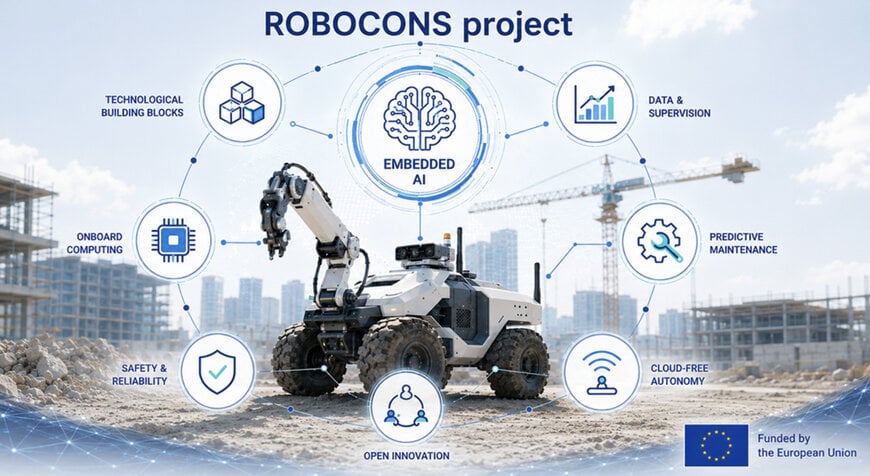
As part of the collaborative European ROBOCONS project, ACTIA is contributing to the development of robotic solutions designed for construction-site applications and complex industrial environments. The three-year research program brings together a consortium composed of robot manufacturers, construction-sector companies, research centers and embedded systems specialists.
The project aims to develop more autonomous robotic platforms capable of operating in dynamic and unstructured environments. The work focuses particularly on integrating artificial intelligence directly into embedded computing systems to improve robot availability, predictive maintenance and real-time analysis of operational conditions.
Embedded Architecture and Distributed Artificial Intelligence
One of the project’s technical objectives is to implement advanced diagnostic and monitoring functions without relying on cloud infrastructure or high-performance computing systems. To achieve this, the consortium is exploring approaches based on Tiny Machine Learning (Tiny ML), enabling machine learning algorithms to run on low-power embedded devices.
This architecture is intended to increase robot autonomy while meeting the latency, energy-consumption and robustness requirements associated with construction and industrial environments.
Within the project, ACTIA acts as a provider of technological and methodological building blocks. The company is developing a software environment dedicated to embedded artificial intelligence engineering, along with a predictive maintenance application deployed on a mobile robot supplied by IKERLAN.
Software Tools and Predictive Maintenance
The software environment developed by ACTIA enables engineers to select, compare and simulate different machine learning models on specific embedded platforms. This allows evaluation of memory usage, latency and processing-resource requirements before deployment on the final hardware target.
At the same time, a predictive maintenance application is being used as a technological demonstrator within the project. Installed on a robot equipped with an articulated arm, the solution allows Tiny ML models to identify degraded operating conditions and anticipate specific failures without requiring external infrastructure.
According to the project partners, this approach contributes to reducing unplanned downtime and improving the operational availability of robots used in industrial and construction applications.
Open Innovation and Technological Convergence
The ROBOCONS project is part of ACTIA’s open innovation strategy, based on cooperation between industrial companies, research centers and end users to develop reusable technologies for multiple sectors. Beyond construction robotics, the technologies explored within the project also present potential applications in mobility, industrial vehicles, agricultural machinery and autonomous embedded systems.
Through its participation in ROBOCONS, ACTIA continues to develop solutions combining embedded systems, artificial intelligence and predictive monitoring for future generations of industrial autonomous systems.
Edited by Maria Brueva, Induportals editor – adapted by AI.
www.actia.com
Powered by
Induportals Media Publishing