Why Cleaning Your Air Filter Could Be the Single Most Cost-Effective Maintenance Act on a Construction Site ?
A clogged air filter increases fuel consumption by 5–10% and starves the turbocharger. Costs nothing to check. Yet it's one of the most neglected daily tasks on most sites.
 machineryasia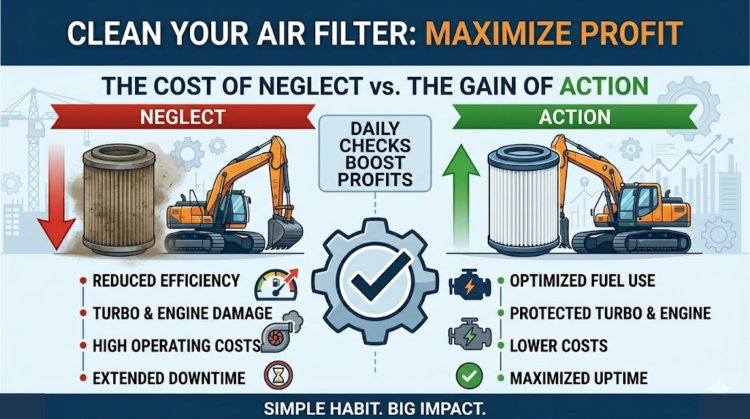
Cleaning Your Air Filter: Probably the Single Most Cost Effective Maintenance Act on a Construction Site
Takes five minutes. No one has to pay for it. And if you let it, it can quietly bleed thousands of dollars out of your fuel budget every single month. The air filter is one of the most overlooked, yet most consequential components on a construction site.
What an Air Filter Really Does ?
Essentially, all diesel engines on a construction site are air pumps. It takes around 15,000 litres of clean air to burn one litre of diesel. That air is compressed, mixed with fuel and ignited to create the power that runs your hydraulics, your tracks, your bucket.
The first step is the air filter. Its job is to stop the dust, the silica, the concrete particles and the fine grit that construction sites generate in huge quantities – before any of it can get to the turbocharger and combustion chamber.
That filter works a lot more on a construction site than it does in any car or truck. Dust levels on an active earthmoving site can be 10 to 50 times higher than on a public road. In a quarry or demolition environment a filter that might last 12 months in a normal vehicle could need attention every few weeks.
What Happens When It Gets Clogged ?

This blocks the air filter and the engine is not able to pull in enough air for combustion. The air/fuel ratio changes. The engine is becoming fuel rich and air starved.
The effects are immediate and quantifiable:
Fuel consumption increases 5-10% immediately. The engine has to work harder pulling air through a restricted intake , burning more diesel for the same output . That means 0.75 to 2 liters of diesel lost every hour on a mid-size excavator burning 15-20 liters per hour, with no productive gain at all.
Engine power loss. The turbocharger can't work at its design capacity, because it depends on the density of the compressed air to boost power. Operators complain of lack of digging power. Normally, this is blamed on hydraulic or engine degradation when the real culprit is a neglected filter.
The turbocharger takes the brunt. Restricted airflow alters the pressure balance across the turbo. This will cause the turbine to operate outside its design parameters over time, leading to increased bearing wear. A clogged air filter can cause turbocharger failures that can cost between $3,000 and $8,000 to repair.
The emission is getting worse. Incomplete combustion results in more particulate matter and black smoke — a problem for emissions compliance and a visible sign that something is wrong.
Real Cost Estimation
Let's do the numbers for one machine:
When going full steam ahead, a 20 tonne excavator will burn about 16 litres of diesel an hour. That is 19.20 dollars an hour on fuel at 1.20 dollars a litre.
A clogged filter that increases fuel consumption by 5% adds $0.96 per hour to your cost. That’s $9.60 per day, for a 10-hour shift. If you look at a 250 day working year, one single neglected filter can cost $2,400 in wasted fuel on one machine alone.
10 excavators together? $24,000 annually. In wasted fuel. From a maintenance task that takes 5 minutes and costs nothing.
A good maintenance program can boost overall fuel efficiency by up to 10% with a well-maintained machine fleet. For a fleet that uses 30,000 gallons a year, that’s 1,500–3,000 gallons saved per year.
Why Air Filters Are Ignored on Construction Sites ?
Environments are not created equal. A wheat harvester in open farmland will choke its air filter at a vastly different rate than an excavator in crushed concrete.
There are three types of particulate generated at construction sites that are especially harmful:
Concrete cutting, rock drilling and sandy excavation creates fine silica dust. Silica particles are sharp and abrasive – if they get past a filter they don’t just clog it, they damage it.
Dust of cement and lime from demolition and civil construction. Hygroscopic – they absorb moisture and can lodge hard inside a filter element and turn a cleanable filter into a replacement job.
Carbon and exhaust particulate from nearby diesel equipment in use. If you have several machines in a confined area, the air quality degrades quickly.
So smart operators will do visual checks every 50 hours no matter what the maintenance schedule says – because site conditions vary enormously and the schedule can’t cater for every environment.
How to Properly Service an Air Filter ?

The cleaning method depends on the type of contamination:
Blow compressed air out from the clean side (never inward — you’ll just force particles deeper into the element) to remove dust and dry debris. Do not allow the air gun to come closer than 25mm to the element surface or the filter media may be damaged.
Filters contaminated with oil: compressed air alone will not do the job. Oil particles bind dust to the filter media. These require degreasing agents and a careful hot water rinse, or replacement.
Replace filter immediately if visible damage, cracks or collapsed media are detected. A compromised filter is no protection whatsoever. The cost of the replacement element ($50–$150) is nothing compared to the cost of fine particles getting into your turbocharger or combustion chamber.
Another rule of thumb: never tap a filter element to shake off dust. The impact can cause micro-fractures in the filter media that are invisible to the eye but will allow fine particles to pass through.
The indicator you can trust always
Most modern construction equipment has an air filter restriction indicator, a small gauge or sensor on the intake system that measures vacuum pressure. When the needle goes into the red zone it is time to start worrying about the filter. No guessing needed.
The mistake that most operators make is that they only check it during scheduled maintenance. But on a dusty site, restriction can develop in days. Add the restriction indicator to the daily walk-around inspection. Three seconds."
Conclusion
Of all the construction site maintenance tasks, the air filter check is one of the highest return-on-time activities there is. Five minutes' inspection. Free if you clean it properly. “Every machine saves thousands a year.
The engine can't tell you the car has a flat Eventually the fuel bill will be paid – but by that time the turbocharger may already be damaged.