Why Swinging a Heavy Bucket Sideways Is Silently Destroying Your Excavator's Most Expensive Bearing
Lateral loading on the slewing ring during side swings creates stress concentrations far beyond its design load. Operator habit — not machine age — is the primary cause of premature ring gear failure.
 machineryasia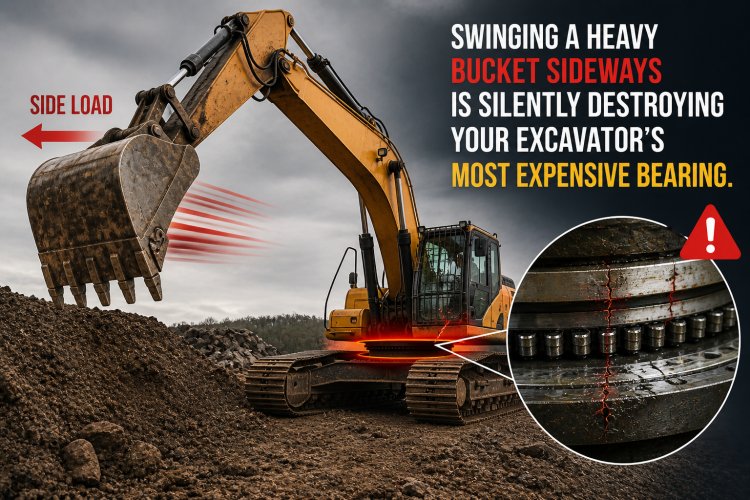
It happens on every construction site, dozens of times a day. The bucket is loaded. The operator needs to move material to the side — not in front, not behind, but at an angle. Instead of repositioning the machine, they simply swing the loaded arm sideways while the bucket stays full.
It is faster. It feels harmless. And it is one of the most destructive habits in excavation.
Meet the Component Nobody Talks About
Between the upper structure of an excavator — the cab, engine, boom, and hydraulics — and the lower undercarriage sits a single rotating component that carries the entire weight of everything above it.
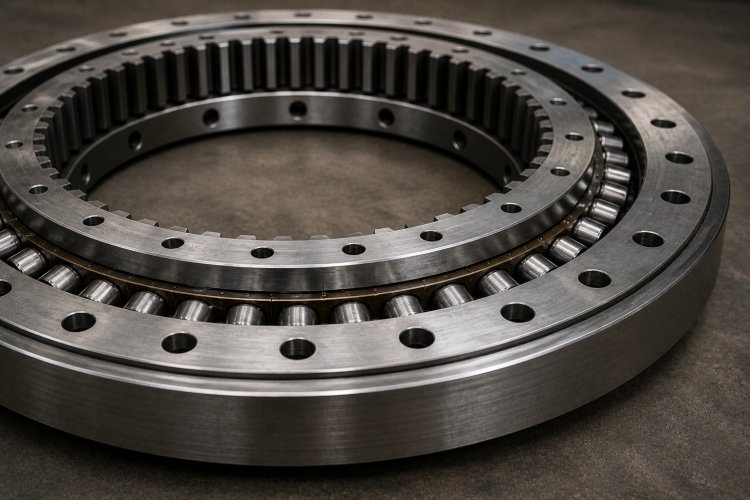
The slewing ring. Also called the swing bearing, slew bearing, or turntable bearing.
It is a large-diameter bearing, typically 1–2 metres across on a mid-size machine, built from hardened steel with precision-ground raceways and an integrated gear ring that meshes with the swing motor's drive pinion. When the operator rotates the upper body, the slewing ring is what makes that rotation smooth, controlled, and load-bearing.
It is also one of the most expensive single components on the machine. Replacement on a mid-size excavator runs $5,000–$30,000 depending on the model, plus labour for a job that requires a crane, specialist tools, and significant downtime.
And it is designed for specific load directions — which lateral swinging completely violates.
How the Slewing Ring Is Designed to Handle Load
The slewing ring is engineered to carry three types of force simultaneously:
Axial load — the vertical weight of the upper structure pressing down through the bearing.
Radial load — horizontal forces from side-ground reaction during digging.
Overturning moment — the rotational force created when the boom extends and the bucket digs, which tries to tip the upper structure forward.
The bearing geometry — its raceway angles, ball or roller arrangement, contact angles — is precisely calculated to handle these three forces within defined limits. The design assumes that heavy loads are carried while the arm faces the front or rear of the machine, and that swing movements happen either unloaded or with moderate loads.
What it is not designed for is a full, heavy bucket being swung laterally at speed.
What Lateral Loading Actually Does to the Bearing
When an operator swings a loaded bucket sideways — especially at the end of a long arm reach — the physics change dramatically.
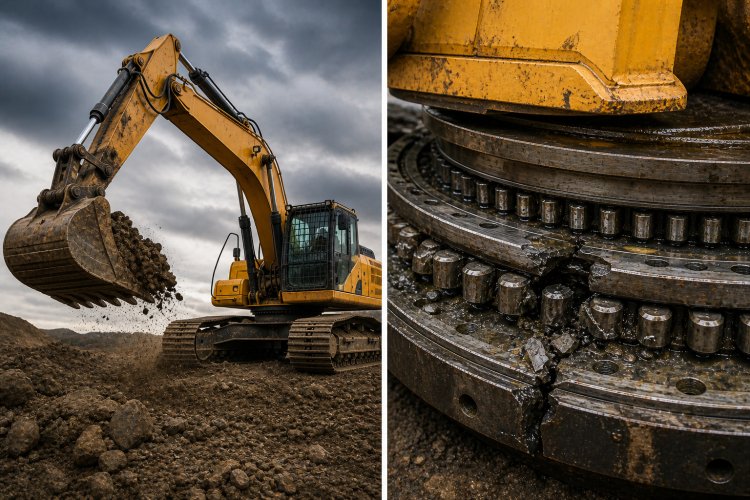
The overturning moment does not reduce. But now it is applied at an angle that the bearing geometry is least equipped to handle. The contact stress concentrates on a small section of the raceway. Ball or roller elements that should be sharing load evenly are now carrying unequal stress. The gear teeth on one side of the ring engage under loads they were never rated for.
This creates three accelerating damage mechanisms:
Raceway collapse: Repeated high-stress contact on the same raceway zones causes micro-pitting, then spalling — material breaking away from the hardened surface. Once a raceway starts spalling, it accelerates. Metal debris from the spalling acts as an abrasive, grinding the remaining raceway faster with every rotation.
Ring gear tooth fracture: The integrated gear ring is hardened but not infinitely tough. Lateral loading combined with the impact of a heavy bucket creates sudden load spikes on individual gear teeth. Over time, teeth crack, chip, or fracture entirely. A fractured tooth means the swing motion becomes uncontrolled — a serious safety hazard.
Seal failure and contamination: The mechanical stress of lateral overloading compresses and distorts the rubber seals that keep grease in and contamination out. Once a seal fails, soil, water, and sand enter the raceway. These act as abrasives, and combined with the already-stressed surfaces, accelerate failure dramatically.
The critical insight: none of this is immediately visible. The machine keeps working. The operator feels nothing unusual. The damage accumulates silently, week after week, until a grinding noise appears — and by then, the bearing is already significantly compromised.
The Warning Signs You Must Never Ignore
The slewing ring communicates its distress in specific, recognisable ways:
A clicking or grinding sound during rotation — particularly noticeable during slow swings or when changing direction. This is metal-on-metal contact inside the raceway. It means internal damage is already present.
Excessive play or wobble in the upper structure. With the machine on flat ground and the boom extended at working length, there should be minimal visible movement. If the cab rocks or wobbles during swing reversal, the bearing clearances have degraded beyond specification.
Shiny metal particles in the grease. During routine greasing, if the old grease pushed out contains silver-grey metallic flakes, the raceways or gear teeth are generating wear debris. This is a serious warning requiring immediate professional inspection.
A visible gap between the cab and the chassis at any point around the circumference. The upper and lower structures should maintain consistent separation. A gap indicates the bearing has lost structural integrity.
If any of these signs appear, stop all operations immediately. Continued operation risks ring gear fracture, which can cause complete loss of swing control — with the upper structure potentially separating from the chassis. This is not a maintenance issue. It is a safety emergency.
The Operator Habits That Kill Slewing Rings Prematurely
Beyond lateral loading, several common operator behaviours accelerate slewing ring wear:
Dragging loads sideways: Using the swing motion to drag a bucket through material rather than lifting first generates massive lateral stress concentrations — far beyond rated capacity.
Exceeding rated lift capacity: The slewing ring load ratings are calculated for the machine's rated lifting capacity. Attempting to lift beyond this does not just risk tipping — it also applies overturning moments the bearing cannot safely carry.
High-speed swing reversals under load: Abruptly reversing swing direction while the bucket is loaded sends shock loads through the ring gear and raceways. Smooth, controlled reversals are not just good practice — they are bearing protection.
Digging from the side: Positioning the machine so that primary digging force is applied at 90 degrees to the centre line places cross-tension on the undercarriage and high lateral stress on the slewing interface.
The One Habit That Extends Slewing Ring Life More Than Anything Else
Reposition the machine.
It takes 30 seconds to swing the undercarriage to face the direction of heavy digging or loading. Those 30 seconds, repeated consistently throughout the day, can double or triple the life of the slewing ring.
The engineering reason: when the upper structure faces the direction of load, the overturning moment is absorbed by the bearing geometry as designed. The raceways carry load evenly. The gear teeth engage symmetrically. Everything works as the engineers intended.
When the operator swings the loaded bucket sideways instead of repositioning, they are trading 30 seconds of machine movement for accelerated wear on a $5,000–$30,000 component.
That is not a good trade.
Final Thought
The slewing ring is the most expensive wearing component on an excavator that most operators have never heard of. It works invisibly, carries enormous loads every day, and fails silently until the symptoms are already serious.
Understanding the engineering behind what damages it — and developing the discipline to reposition the machine rather than swing heavy loads sideways — is one of the highest-value skills an excavator operator can develop.
The bearing cannot speak. But the grinding noise it eventually makes is the most expensive sound in construction.

![[Job Story] Eight Potain Cranes at Work to Build Milan’s New CityWave Building](https://www.heavyquipmag.com/wp-content/uploads/2024/10/Potain-cranes-CityWave-2.jpg)