Grease Every 50 Hours or Lose $30,000 — The Unforgiving Maintenance Schedule of Excavator Swing Bearings
Slewing bearings must be greased on a strict 50-hour cycle until grease visibly leaks from the seal. Skipping even a few cycles allows contamination that accelerates wear exponentially. High stakes, simple solution.
 machineryasia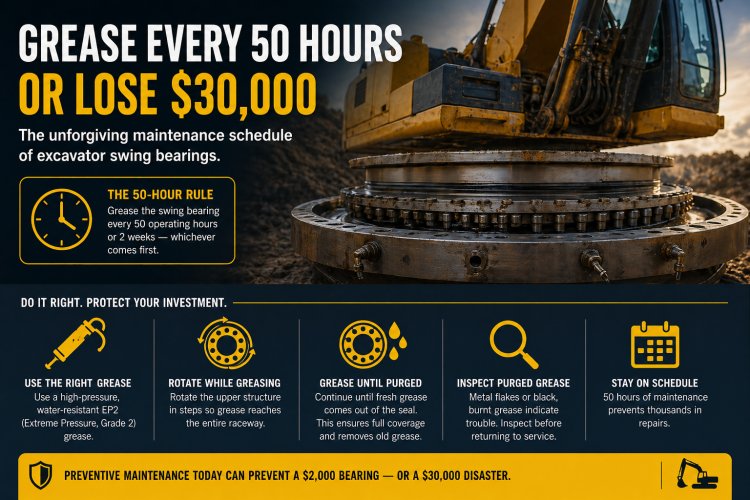
Grease Every 50 Hours or Lose $30,000 — The Unforgiving Maintenance Schedule of Excavator Swing Bearings
A 50-cent nylon grease fitting. A cracked line nobody noticed. A bearing that wasn't getting lubricated for months. The result? A $2,000 slewing bearing of a excavator — destroyed. The owner only discovered the problem when the grinding started.
This is not an unusual story. It happens on construction sites and in equipment yards constantly, for one reason: the slewing ring has one of the most unforgiving maintenance schedules in all of heavy equipment — and it is one of the least followed.
Why Lubrication Is the Entire Battle
The slewing ring is a large precision bearing running under constant load. Its steel raceways — the grooved surfaces that the ball or roller elements roll along — are hardened, ground to tight tolerances, and separated from the outside world by rubber seals.
The only thing that prevents metal-to-metal contact inside those raceways is grease. Grease does three things inside a slewing ring simultaneously.
It lubricates the rolling elements so they glide rather than grind. It forms a protective film on the raceway surfaces that prevents direct contact under load. And it acts as a barrier, preventing contaminants — soil, water, concrete dust, fine silica — from entering the raceway.
When grease is fresh and present in adequate quantity, the bearing can handle enormous loads with minimal wear. When grease degrades, thins out, or is absent, the raceways are essentially running dry under loads that can exceed several hundred tonnes of combined axial, radial, and overturning force. The consequences are not slow or gentle.
The 50-Hour Rule — and Why It Exists
Every major excavator manufacturer specifies grease intervals for the slewing ring. The standard is 50 operating hours or 2 weeks — whichever comes first. This is not an arbitrary number. It reflects the rate at which grease degrades inside a working slewing ring under construction conditions.
Several mechanisms degrade grease faster than most people expect:
Heat cycling: The working excavator engine creates plenty of heat. The slewing ring heats up during operation. It cools down while shut down. This thermal cycling causes the base oil in the grease to separate from the thickener, which reduces its lubricating properties over time. After about 50 hours of this, the grease film no longer adequately protects the raceways;
Mechanical shear: The rolling elements are constantly working their way through the grease as the bearing is in operation. Mechanical shearing breaks down the structure of the grease, thinning it and lowering its film strength.
Contamination ingress: Even intact seals allow microscopic amounts of contamination into the raceway over time. Once contaminated, grease loses effectiveness rapidly and the contaminating particles become abrasives that are distributed across the raceway by the rolling elements.
Washout: On sites with water exposure — river works, rain, washing down equipment — water infiltrates the raceway and emulsifies the grease, stripping it of its lubricating properties.
At 50 hours, the grease is still functional but degraded enough that replacement is warranted. At 100 hours without service, the protection is significantly compromised.
At 200 hours without service, you are running a precision bearing with degraded or absent lubrication under massive load — and the damage is accumulating with every operating hour.
How to Grease It Correctly
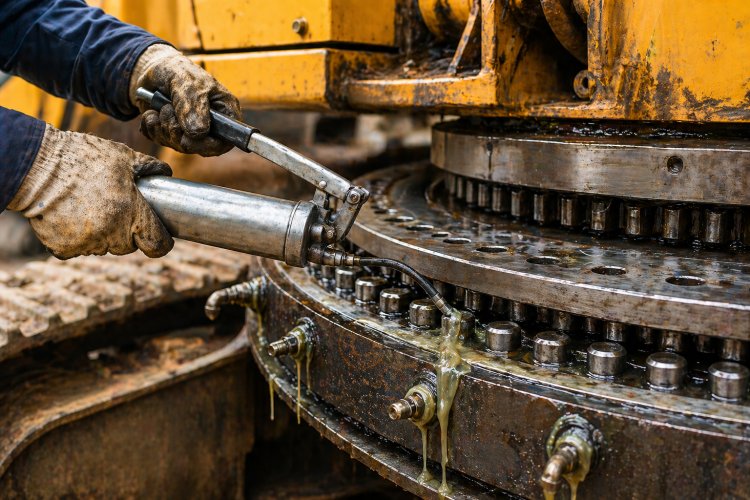
Greasing a slewing ring is not simply pushing grease in until the gun stiffens. There is a specific method that ensures full raceway coverage:
Use the right grease: Slewing rings require a specific high-pressure, water-resistant grease — typically an EP2 (Extreme Pressure, Grade 2) lithium complex grease, or the specific formulation recommended by the machine manufacturer. Using general-purpose grease is inadequate — it lacks the film strength and adhesion properties needed for a bearing under this type of load.
Rotate the bearing during greasing: The raceway runs the full 360-degree circumference of the bearing. Grease injected at one point will not reach the full circuit unless the upper body is rotated while greasing.
The correct procedure: inject grease, rotate the upper body approximately 90 degrees, inject again, rotate again, and continue until you have completed the full circle. This ensures every section of the raceway receives fresh grease.
Grease until old grease purges from the seal: The correct volume is not a fixed number of pumps. It is however much grease is required until fresh grease is visibly emerging from the seal around the bearing perimeter. This confirms the raceway is fully packed and old, contaminated grease has been displaced.
Service the gear ring separately: The gear ring — the toothed outer ring that meshes with the swing motor pinion — has its own lubrication requirement. It needs grease on the tooth faces, applied while the upper body rotates slowly so all teeth receive coverage.
Inspect the purged grease: The old grease emerging from the seal tells a diagnostic story. Normal colour is grey or brown. Silver or metallic flakes indicate raceway or gear tooth wear. Black colour indicates heat damage or severe contamination. Either of these findings requires professional inspection before resuming normal operation.
The Hidden Failure: Grease Fittings That Aren't Delivering
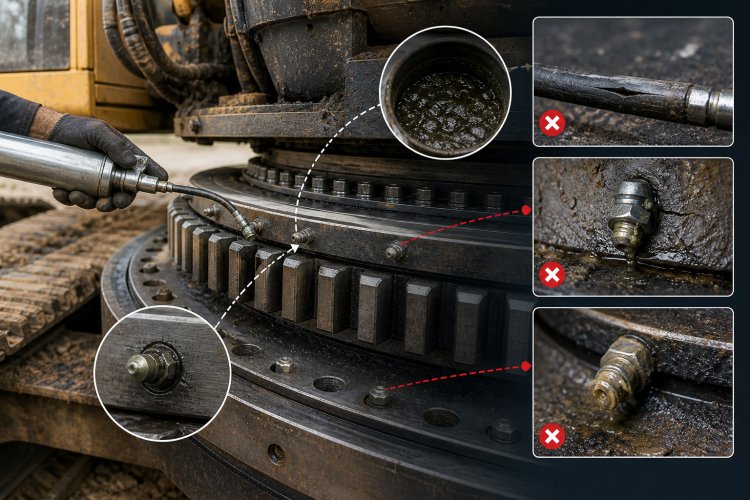
One of the most common and expensive slewing ring failures has nothing to do with neglect by the operator — it involves a grease fitting, line, or zerk that is damaged, blocked, or bypassed.
The operator follows the schedule. The grease gun is applied. The needle pressure builds. But the grease is not reaching the raceway — it is accumulating somewhere in the line, or escaping through a damaged nipple, or backing up against a blocked passage.
This failure is invisible. The maintenance log shows the service was done. The bearing is running dry. Prevention requires a two-step verification on every service: confirm that grease is entering the fitting under normal pressure (not spiking, which indicates blockage), and confirm that grease is visibly emerging from the bearing seal, proving the raceway is being reached.
If grease pressure is unusually high and no purge occurs at the seal, stop immediately and inspect the entire lubrication path before assuming the service is complete.
What Replacement Actually Costs
When a slewing ring fails from inadequate lubrication, the outcome is almost always full replacement. The component cannot be repaired once raceways have spalled or gear teeth have fractured.
Replacement parts alone range from $2,000 for a small mini excavator to over $30,000 for a large machine. Labour adds significantly — the process requires the upper and lower structures to be separated, which needs a crane, specialist tools, and typically 1–2 days of skilled labour. On-site replacement on a working project adds the cost of machine downtime and potential project delay.
The total cost of a preventable slewing ring failure on a mid-size machine, including parts, labour, and downtime, typically exceeds $15,000–$25,000. The cost of the grease that would have prevented it: a few dollars per service.
Conclusion
The slewing ring maintenance schedule is not a suggestion. It is a precise engineering requirement derived from how grease degrades inside a bearing under real operating conditions.
Fifty hours. Full raceway rotation during application. Grease until the old purges from the seal. Inspect the purged grease. Verify the fitting is actually delivering.
These are five minutes of work, every 50 hours. The alternative — a bearing failure that stops the machine for days and costs tens of thousands to repair — is always more expensive, always more disruptive, and always preventable.