[Job Story] Bobcat Excavators Work Below Amsterdam Canal Houses During Foundation Repairs
Amsterdam’s canal houses are undergoing some of the city’s most delicate underground works, and at one of the current sites contractor Dijkboom BV is using Bobcat excavators to dig beneath historic buildings for foundation repairs and new basements. The project sits in a tough setting: narrow streets, constant traffic, soft peat soils and structures still […] [Job Story] Bobcat Excavators Work Below Amsterdam Canal Houses During Foundation Repairs published on The HeavyQuip Magazine.
 machineryasia
 ![[Job Story] Bobcat Excavators Work Below Amsterdam Canal Houses During Foundation Repairs](https://www.heavyquipmag.com/wp-content/uploads/2026/04/Dijkboom-Bobcat-E55-mini-excavator.jpg)
Amsterdam’s canal houses are undergoing some of the city’s most delicate underground works, and at one of the current sites contractor Dijkboom BV is using Bobcat excavators to dig beneath historic buildings for foundation repairs and new basements.
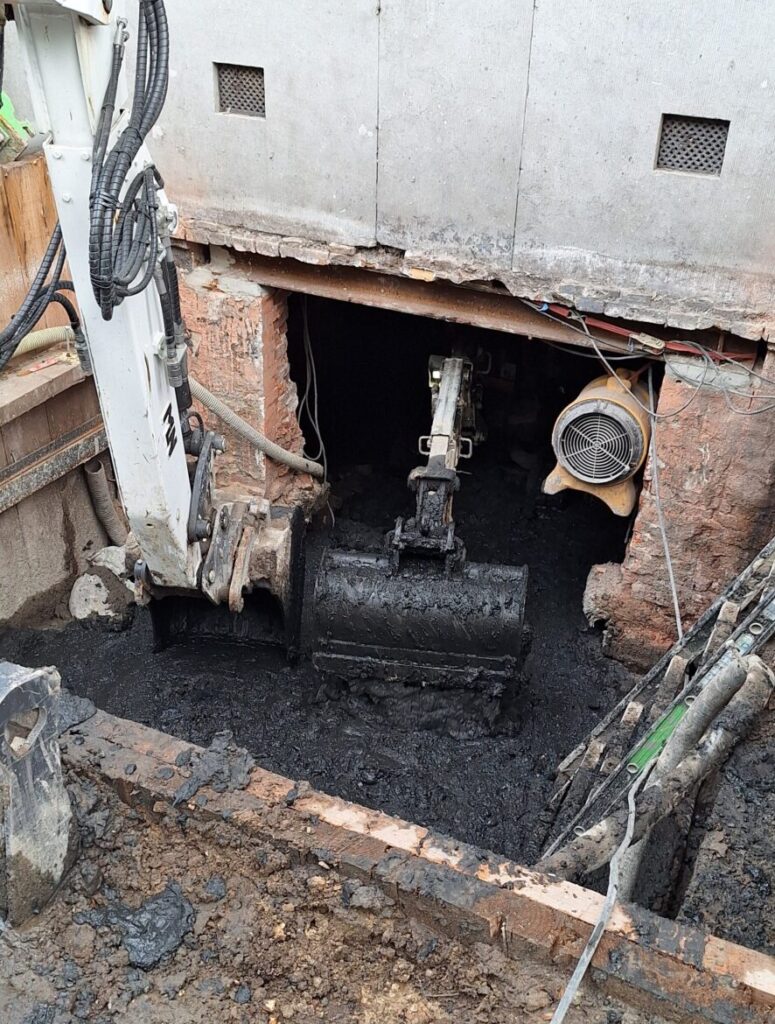
The project sits in a tough setting: narrow streets, constant traffic, soft peat soils and structures still resting on centuries-old timber piles. Access starts with a small opening, roughly 1 by 2 metres, cut in a garden, pavement or even the roadway. Crews then create a passage through the exterior foundation wall or facade and shore it up with sheet piles and steel beams. A compact Bobcat mini excavator is then lowered into the pit to start removing soil under the house, moving it back through the access point where it is loaded into containers for disposal. Output is typically 15 to 25 cubic metres per day, depending on soil conditions and the room available to manoeuvre.
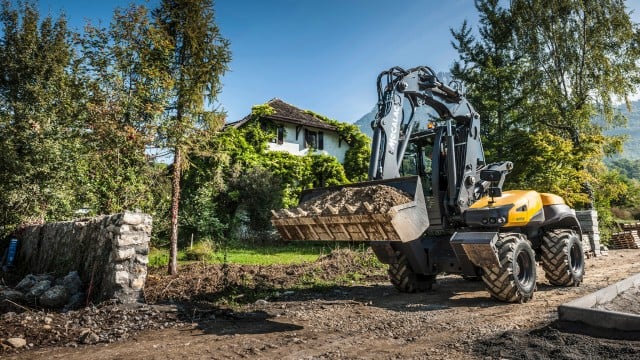
To handle spoil from the access pit beside the Amsterdam townhouse, Dijkboom uses a recently delivered Bobcat E55 excavator. Its boom includes a 60 cm extendable section, giving the operator extra reach to dig deeper and work from the street into the space beneath the building.
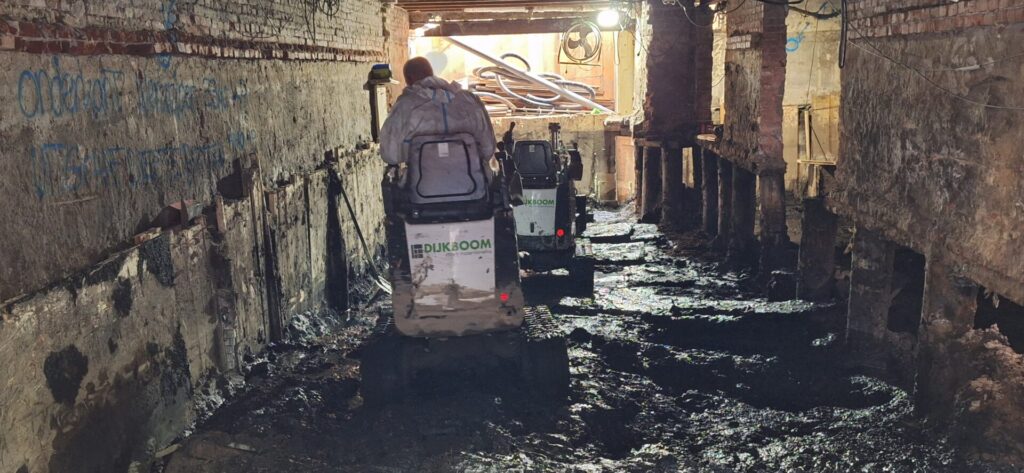
Moving material under the house depends on site conditions. Dijkboom alternates between conveyor belts and Bobcat E10 excavators, with the E10 typically chosen for wetter, swampy ground where a thin layer of mud builds up quickly. The company says it operates five E10 units in its fleet, including diesel machines and one electric E10e, used mainly where the confined space under the house is hard to ventilate. A range of attachments is deployed on these jobs, including breakers, grapples and different bucket types, with a custom stainless-steel bucket used to reduce mud and sludge sticking during excavation.
Where required, demolition and targeted modifications are also carried out to strengthen or adapt the existing foundation before the basement fit-out is completed by a contractor. Like many older buildings in Amsterdam, the house stands on timber piles beneath the foundation. The piles are described as roughly 30 centimetres in diameter and can reach lengths of up to 14 metres, terminating in a more stable sand layer.
Before work starts, soil and foundation surveys are used to judge whether a basement is feasible. Facades are also monitored before and during construction to check for movement, and in some parts of the city archaeological checks may run alongside the excavation.
Johan Eikelenboom, co-owner of Dijkboom, describes the Amsterdam project as typical of the company’s workload in Amsterdam and Rotterdam, where older foundations are a recurring issue. He notes that this site is less constrained than many because the house has a small front garden and sits next to a parking area, allowing space for the access opening, spoil containers and support equipment. In tighter streets, he says, the access point sometimes has to be created inside the building, which can require residents to move out during the works.
Basement projects often begin as foundation repairs, but demand for extra living space is increasingly driving the decision to dig down. Eikelenboom says the company has worked on high-end basement conversions, including features such as pools, garages and home cinemas.
[Job Story] Bobcat Excavators Work Below Amsterdam Canal Houses During Foundation Repairs published on The HeavyQuip Magazine.