Heavy crawler crane dismantles Ulm bridge
Emil Egger AG deployed a heavy crawler crane to remove a deteriorated road bridge in Ulm, enabling safe dismantling above active railway lines. www.liebherr.com The Swiss heavy-lift and logistics company Emil Egger AG carried out the dismantling of a deteriorated federal road bridge in Ulm, southern Germany. The two-lane prestressed-concrete structure crossed a rail corridor more than 100 meters wide, including overhead power lines, which ruled out conventional demolition methods such as blasting or excavator-based dismantling. To avoid disruptions and ensure structural control during the operation, the bridge was divided into individual segments and removed by crane. The objective was to complete the demolition within a limited railway closure window while maintaining high safety standards for workers and rail infrastructure. Heavy lifting technology selected for high loads For the project, Emil Egger AG deployed a large crawler crane with a lifting capacity of up to 510 tonnes, capable of removing entire bridge segments after they had been cut from the structure. The dismantling concept was developed in collaboration with the construction and logistics company Max Wild. The solution relied on controlled lifting operations rather than destructive demolition. Each bridge section was first secured to the crane hook before being separated using diamond wire saws. Once the cutting process was completed, the crane lifted the segment away and positioned it on the ground for further processing by demolition excavators. This approach enabled the safe removal of large structural elements without impacting the railway infrastructure below. Configuration adapted to lifting phases The crane operation was carried out in two phases to accommodate the varying distances between the lifting point and the crane position. For the initial lifts, which involved the heaviest segments and shorter lifting distances, the crane was equipped with an 84-meter lattice boom configuration. In a second phase, the boom length was extended to 128 meters to reach bridge segments located further away from the crane position. To achieve the required lifting capacity, the crane operated with up to 750 tonnes of ballast, including 450 tonnes of derrick ballast mounted on a hydraulically adjustable frame system. This configuration allowed operators to adapt the counterweight radius depending on the lifting conditions. Precise weight calculations ensure safe lifts Accurate weight estimation of each bridge segment was essential to the success of the operation. The prestressed-concrete sections measured around 17 meters in width and more than two meters in height, and their exact mass had to be determined before each cut. Michael Egger, Managing Director of Emil Egger AG, explained the importance of this step: “A key challenge in this infrastructure project was the segmentation of the bridge elements. Precise weight determination was essential so we could compensate for the expected load using the movable derrick ballast and safely lift the component once it was completely cut.” After the crane had taken the load, concrete cutting specialists operated diamond-coated wire saws for approximately five hours to separate each section from the structure. Crane features simplify complex lifting tasks The crane’s adjustable counterweight system helped simplify the operation, particularly when retrieving segments located further away from the crane. According to Egger: “The hydraulically adjustable V-Frame and the split derrick ballast system significantly simplified the work. When retrieving segments from greater distances and placing them close to the crane, we could maintain lifting performance without time-consuming reballasting operations.” The adjustable counterweight radius allowed operators to adapt the crane configuration during lifts while maintaining stability and lifting capacity. Additional crane supports ramp dismantling A mobile crane was also deployed on the opposite side of the railway tracks. Initially used to assist with the assembly of the crawler crane, it later handled the dismantling of an access ramp connected to the bridge. Ramp sections weighing up to 110 tonnes were similarly secured to the crane hook, cut from the structure, and removed in individual pieces. Continuous operation completes demolition within a week Once the crane had been assembled on site requiring around 40 heavy transport deliveries and four days of installation the dismantling process ran continuously in shift operations. Over the course of roughly one week, the bridge was cut into 52 individual sections and completely removed. The controlled lifting approach enabled safe dismantling above the active rail corridor while maintaining the required project schedule. A new bridge is scheduled for completion at the same location in autumn of the following year. Afterward, similar dismantling operations are planned for the opposite carriageway. Ed
 machineryasia
Emil Egger AG deployed a heavy crawler crane to remove a deteriorated road bridge in Ulm, enabling safe dismantling above active railway lines.
www.liebherr.com
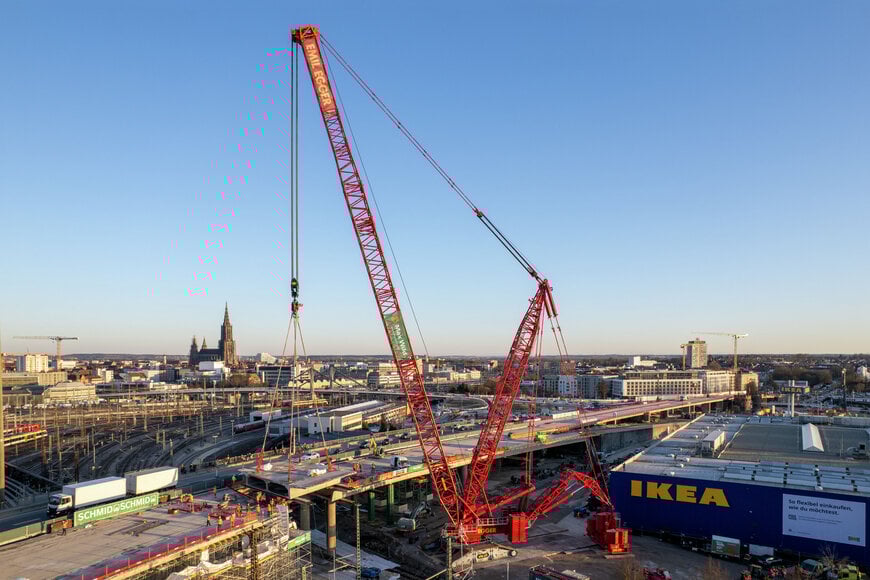
The Swiss heavy-lift and logistics company Emil Egger AG carried out the dismantling of a deteriorated federal road bridge in Ulm, southern Germany. The two-lane prestressed-concrete structure crossed a rail corridor more than 100 meters wide, including overhead power lines, which ruled out conventional demolition methods such as blasting or excavator-based dismantling.
To avoid disruptions and ensure structural control during the operation, the bridge was divided into individual segments and removed by crane. The objective was to complete the demolition within a limited railway closure window while maintaining high safety standards for workers and rail infrastructure.
Heavy lifting technology selected for high loads
For the project, Emil Egger AG deployed a large crawler crane with a lifting capacity of up to 510 tonnes, capable of removing entire bridge segments after they had been cut from the structure.
The dismantling concept was developed in collaboration with the construction and logistics company Max Wild. The solution relied on controlled lifting operations rather than destructive demolition. Each bridge section was first secured to the crane hook before being separated using diamond wire saws. Once the cutting process was completed, the crane lifted the segment away and positioned it on the ground for further processing by demolition excavators.
This approach enabled the safe removal of large structural elements without impacting the railway infrastructure below.
Configuration adapted to lifting phases
The crane operation was carried out in two phases to accommodate the varying distances between the lifting point and the crane position.
For the initial lifts, which involved the heaviest segments and shorter lifting distances, the crane was equipped with an 84-meter lattice boom configuration. In a second phase, the boom length was extended to 128 meters to reach bridge segments located further away from the crane position.
To achieve the required lifting capacity, the crane operated with up to 750 tonnes of ballast, including 450 tonnes of derrick ballast mounted on a hydraulically adjustable frame system. This configuration allowed operators to adapt the counterweight radius depending on the lifting conditions.
Precise weight calculations ensure safe lifts
Accurate weight estimation of each bridge segment was essential to the success of the operation. The prestressed-concrete sections measured around 17 meters in width and more than two meters in height, and their exact mass had to be determined before each cut.
Michael Egger, Managing Director of Emil Egger AG, explained the importance of this step:
“A key challenge in this infrastructure project was the segmentation of the bridge elements. Precise weight determination was essential so we could compensate for the expected load using the movable derrick ballast and safely lift the component once it was completely cut.”
After the crane had taken the load, concrete cutting specialists operated diamond-coated wire saws for approximately five hours to separate each section from the structure.
Crane features simplify complex lifting tasks
The crane’s adjustable counterweight system helped simplify the operation, particularly when retrieving segments located further away from the crane.
According to Egger:
“The hydraulically adjustable V-Frame and the split derrick ballast system significantly simplified the work. When retrieving segments from greater distances and placing them close to the crane, we could maintain lifting performance without time-consuming reballasting operations.”
The adjustable counterweight radius allowed operators to adapt the crane configuration during lifts while maintaining stability and lifting capacity.
Additional crane supports ramp dismantling
A mobile crane was also deployed on the opposite side of the railway tracks. Initially used to assist with the assembly of the crawler crane, it later handled the dismantling of an access ramp connected to the bridge.
Ramp sections weighing up to 110 tonnes were similarly secured to the crane hook, cut from the structure, and removed in individual pieces.
Continuous operation completes demolition within a week
Once the crane had been assembled on site requiring around 40 heavy transport deliveries and four days of installation the dismantling process ran continuously in shift operations.
Over the course of roughly one week, the bridge was cut into 52 individual sections and completely removed. The controlled lifting approach enabled safe dismantling above the active rail corridor while maintaining the required project schedule.
A new bridge is scheduled for completion at the same location in autumn of the following year. Afterward, similar dismantling operations are planned for the opposite carriageway.
Edited by an industrial journalist, Sucithra Mani — AI-powered.
www.liebherr.com
Powered by
Induportals Media Publishing