Topcon Highlights Connected Construction Technologies at CONEXPO 2026
At CONEXPO-CON/AGG 2026 in Las Vegas, Topcon Positioning Systems introduced a range of new technologies for machine control, jobsite safety, load weighing, cloud connectivity, and geomatics, reinforcing a strategy built around connected workflows and more accessible precision on site. The new releases span several stages of the construction cycle, from excavation and grading to layout, […] Topcon Highlights Connected Construction Technologies at CONEXPO 2026 published on The HeavyQuip Magazine.
 machineryasia
At CONEXPO-CON/AGG 2026 in Las Vegas, Topcon Positioning Systems introduced a range of new technologies for machine control, jobsite safety, load weighing, cloud connectivity, and geomatics, reinforcing a strategy built around connected workflows and more accessible precision on site.
The new releases span several stages of the construction cycle, from excavation and grading to layout, surveying, and material handling. The common thread is the attempt to bring equipment, data, and field operations into a more unified platform, at a time when contractors are facing tighter margins, growing performance expectations, and increasing pressure to improve efficiency.
Among the main launches was 3D-MC Edge, a new configuration within Topcon’s 3D machine control environment designed for grading applications such as wheel tractor-scrapers, tow-behind scrapers, box blades, and push dozers. Positioned as a more economical solution, it is intended to offer a simpler entry point into 3D control for smaller contractors and municipalities that have not yet adopted full machine control systems.
Topcon also expanded its excavator capabilities with new functions aimed at productivity and ease of use. Slope Control automatically adjusts bucket tilt and rotation angles based on the digital design surface, helping operators perform complex grading tasks with greater consistency. The system is designed to work with tiltrotators and is particularly suited to applications such as drainage work, steep slopes, sports fields, and other jobs where bucket orientation plays a critical role in finish quality.
Another important addition is Hybrid Lock, a feature that automatically switches between robotic total station tracking and GNSS positioning. The system is designed to maintain machine guidance when line of sight is interrupted or when satellite positioning is less reliable, such as under dense canopy, in urban corridors, mountainous terrain, or tunnel environments. The goal is to reduce downtime and keep excavation or grading work moving without interruption.
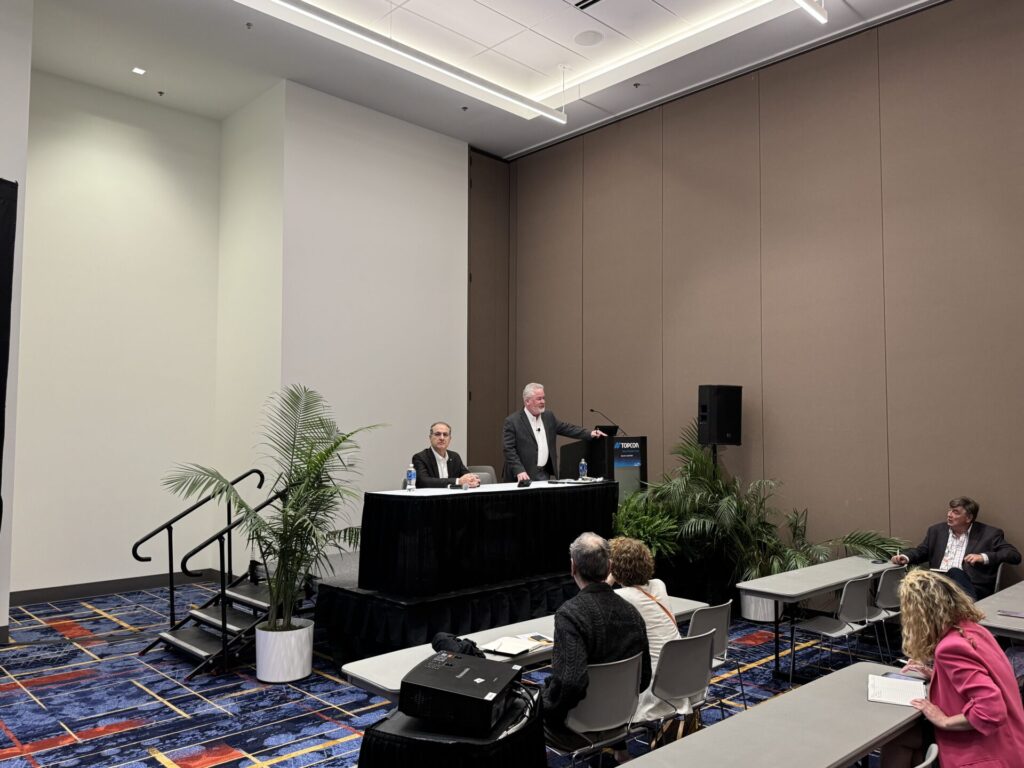
Supporting that approach is the new GTS-M1 robotic total station, developed specifically for machine control applications. The instrument tracks a prism mounted on heavy equipment and is aimed at precision-intensive work including fine grading, milling, and paving. It also plays a key role in the Hybrid Lock workflow, especially in situations where optical positioning offers a more practical solution than GNSS alone.
Payload management and material tracking were also part of the announcement. New onboard weighing options for excavators allow material to be weighed during lifting or loading, with the aim of preventing overloading, improving load distribution, and reducing unnecessary wear on trucks and trailers. In parallel, Topcon presented the LM-1000 load weighing system for aggregate handlers and loaders, designed to support safer and more efficient loading operations while feeding load and stockpile data into digital reporting workflows.
On the software side, Topcon Site Manager was introduced as a cloud-based management platform for machine control and weighing solutions. The system enables design data transfer, remote access, work order creation, and productivity reporting, while also supporting mixed fleets. The broader idea is to improve the flow of information between the office and the jobsite, and to give contractors a more detailed view of production and completed work.
Safety was another focus area. The new Topcon Awareness System uses AI-powered cameras mounted around construction vehicles to detect people, movement, or obstructions in blind spots and defined risk zones. Alerts are sent to the operator and stored in the cloud, adding both real-time warning capability and a record for later review and analysis.
In geomatics, Topcon introduced Origo, a new interior spatial-positioning solution for building layout. The handheld system uses sensor fusion and spatial reference mapping to provide real-time positioning without requiring conventional line of sight, tripod setup, or leveling. Presented as a new approach to layout in complex indoor environments, Origo reflects a broader direction within the company: making high-accuracy positioning tools easier to use in real site conditions.
That point was emphasized during the press event, where Topcon linked future growth in construction technology adoption not only to precision, but also to usability. As digital workflows expand, the challenge is no longer just collecting data, but ensuring that the data is accurate, integrated, and simple enough to use across increasingly complex jobsites.
Taken together, the launches at CONEXPO 2026 show Topcon pushing further toward a connected construction model, where machine control, site monitoring, weighing, layout, and cloud-based coordination are treated as parts of the same operational ecosystem rather than separate tools.
Topcon Highlights Connected Construction Technologies at CONEXPO 2026 published on The HeavyQuip Magazine.