Potain MCT 385 cranes support bridge construction in China
Guizhou Shengyongsheng deploys two Potain tower cranes for the main pylon construction of the Zhoushan Taoyaomen road-rail bridge. www.manitowoc.com The Zhoushan Taoyaomen Bridge in China serves as a critical link in the Ningbo-Zhoushan Railway, which is part of the national high-speed rail network. This infrastructure project connects Fuchi Island and Cezi Island via a road-rail, cable-stayed hybrid-girder bridge. Upon completion, the structure will feature a 666-meter main span, making it one of the longest bridges of its type. The project requires heavy lifting capabilities to facilitate the construction of the primary pylons. Technical Challenges in Marine Environments The China Railway Construction Bridge Engineering Bureau Group (CRBBG) faced significant technical hurdles due to the marine environment where the bridge is located. High-altitude lifting operations require equipment that maintains stability under variable wind conditions and provides high load capacities. Furthermore, the complexity of the pylon construction demanded a lifting solution that could minimize structural interference and simplify the installation process to manage overall project costs and timelines. Technical Solution Selection To address these requirements, two Potain MCT 385 topless tower cranes were selected for the project. These cranes were chosen for their design, which allows for efficient assembly and disassembly on-site. The topless configuration is particularly useful in complex construction environments as it reduces the overhead space required for crane operations. The MCT 385 model provides the structural rigidity necessary for precise load handling, which is essential when positioning heavy steel and concrete components for bridge pylons. Implementation and Deployment The cranes, owned by Guizhou Shengyongsheng, were deployed at the bridge site where pylon construction commenced in January 2025. Technical support and parts for the machinery are provided by the manufacturer’s facility in Zhangjiagang, China, ensuring operational continuity. The MCT 385 cranes have been utilized previously on other high-rise infrastructure projects, such as the Huajiang Canyon Bridge, establishing a baseline for their performance in large-scale bridge engineering applications. The pylon work is scheduled to continue through August 2026. Operational Results and Benefits The use of the MCT 385 cranes has contributed to site efficiency by reducing the number of structural ties required for the cranes during the ascent of the pylons. This technical advantage speeds up the construction cycle and reduces the mechanical load on the emerging bridge structure. The stability of the cranes ensures that heavy materials are handled with the precision required for cable-stayed engineering. By streamlining the assembly and operational phases, the cranes assist in maintaining the project schedule for this large-scale rail and road link. Edited by an industrial journalist, Lekshman Ramdas, with AI assistance. www.manitowoc.com Powered by Induportals Media Publishing
 machineryasia
Guizhou Shengyongsheng deploys two Potain tower cranes for the main pylon construction of the Zhoushan Taoyaomen road-rail bridge.
www.manitowoc.com
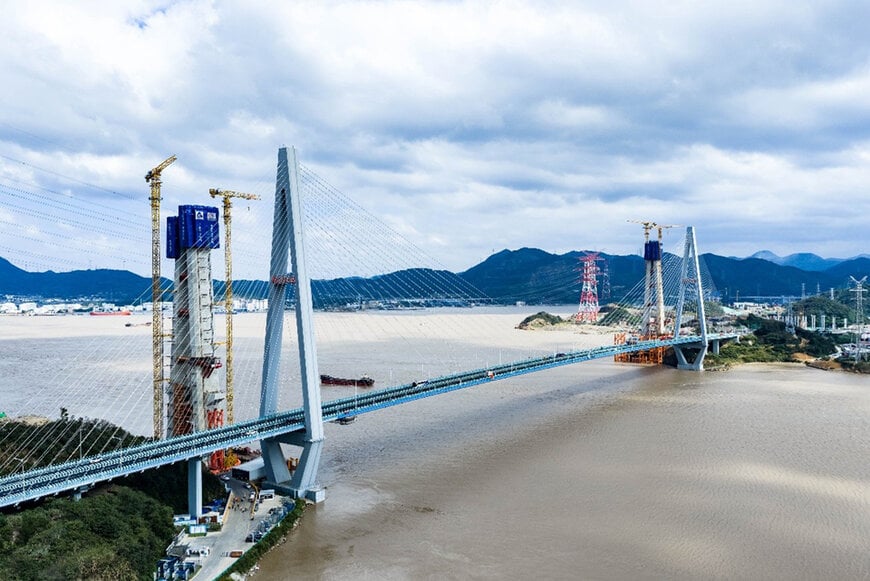
The Zhoushan Taoyaomen Bridge in China serves as a critical link in the Ningbo-Zhoushan Railway, which is part of the national high-speed rail network. This infrastructure project connects Fuchi Island and Cezi Island via a road-rail, cable-stayed hybrid-girder bridge. Upon completion, the structure will feature a 666-meter main span, making it one of the longest bridges of its type. The project requires heavy lifting capabilities to facilitate the construction of the primary pylons.
Technical Challenges in Marine Environments
The China Railway Construction Bridge Engineering Bureau Group (CRBBG) faced significant technical hurdles due to the marine environment where the bridge is located. High-altitude lifting operations require equipment that maintains stability under variable wind conditions and provides high load capacities. Furthermore, the complexity of the pylon construction demanded a lifting solution that could minimize structural interference and simplify the installation process to manage overall project costs and timelines.
Technical Solution Selection
To address these requirements, two Potain MCT 385 topless tower cranes were selected for the project. These cranes were chosen for their design, which allows for efficient assembly and disassembly on-site. The topless configuration is particularly useful in complex construction environments as it reduces the overhead space required for crane operations. The MCT 385 model provides the structural rigidity necessary for precise load handling, which is essential when positioning heavy steel and concrete components for bridge pylons.
Implementation and Deployment
The cranes, owned by Guizhou Shengyongsheng, were deployed at the bridge site where pylon construction commenced in January 2025. Technical support and parts for the machinery are provided by the manufacturer’s facility in Zhangjiagang, China, ensuring operational continuity. The MCT 385 cranes have been utilized previously on other high-rise infrastructure projects, such as the Huajiang Canyon Bridge, establishing a baseline for their performance in large-scale bridge engineering applications. The pylon work is scheduled to continue through August 2026.
Operational Results and Benefits
The use of the MCT 385 cranes has contributed to site efficiency by reducing the number of structural ties required for the cranes during the ascent of the pylons. This technical advantage speeds up the construction cycle and reduces the mechanical load on the emerging bridge structure. The stability of the cranes ensures that heavy materials are handled with the precision required for cable-stayed engineering. By streamlining the assembly and operational phases, the cranes assist in maintaining the project schedule for this large-scale rail and road link.
Edited by an industrial journalist, Lekshman Ramdas, with AI assistance.
www.manitowoc.com
Powered by
Induportals Media Publishing