High-Performance Duty Cycle Crawler Crane for Deep Foundations
Liebherr introduces the HS 8100.2 duty cycle crawler crane for heavy-duty foundation engineering, dragline work, and soil compaction applications. www.liebherr.com Liebherr has presented the HS 8100.2 duty cycle crawler crane, a new generation machine designed for deep foundation engineering and heavy lifting applications. The model integrates increased engine power, higher winch performance, and improved service accessibility to enhance operational efficiency on construction and infrastructure sites. Enhanced Power and Performance The HS 8100.2 represents a technical development of Liebherr’s duty cycle crawler crane series, focusing on higher operating capacity and improved mechanical performance. The machine delivers 15% more engine power than its predecessor, enabling greater operational output in demanding foundation engineering tasks. The crane’s maximum winch line pull reaches 2 × 295 kN (2 × 66,319 lbf), representing an increase of approximately 9% compared with earlier models. This increase in pulling force enables the crane to operate heavier slurry wall grabs, both hydraulic and mechanical, which are commonly used in diaphragm wall construction and other deep excavation projects. In dragline operations, the increased engine power translates into higher digging forces, improving excavation performance in soil removal tasks. For dynamic soil compaction, the additional power allows the drop weight to be raised more quickly, increasing cycle frequency and overall productivity on site. The HS 8100.2 also introduces a new rope-lock system on the winches, simplifying and accelerating rope replacement during maintenance operations. In addition, the machine maintains compatibility with booms from earlier Liebherr models, including the HS 8070.1, HS 8100.1, and HS 8100.2 dual power. This compatibility allows operators and contractors to reuse existing components and adapt configurations to different construction requirements. Design for User Safety and Service Efficiency The crane’s design prioritizes operator safety and ease of maintenance. Liebherr adopted the walkway concept used in the latest HS-series machines, integrating railings and platforms that remain attached to the uppercarriage during transport. The roof access ladder is also integrated into the uppercarriage, reducing installation time on site. Transport logistics were also considered in the design. With a compact width of 3.5 m (11.48 ft) and an uppercarriage weight of approximately 60 t (132,277 lb), the crane’s uppercarriage and undercarriage can be transported together as a single unit. This configuration reduces assembly time and allows faster deployment on construction projects. For servicing, the fuel tank neck has been repositioned to provide access directly from the uppercarriage platforms, eliminating the need to climb onto the machine’s roof. The operator interface also displays fill-level indicators for all main drives, allowing maintenance checks to be performed through the machine’s monitoring system. To improve safety in low-light conditions, operators can remotely activate lighting for the cab access area, ensuring safe entry during nighttime or early-morning operations. Applications in Foundation Engineering The HS 8100.2 is designed primarily for deep foundation engineering, where equipment must handle high loads and continuous operational cycles. Typical applications include: Diaphragm wall construction using slurry wall grabs Dragline excavation in earthmoving projects Dynamic soil compaction for ground improvement These applications are common in infrastructure projects such as bridges, tunnels, ports, and large building foundations, where specialized cranes support heavy-duty excavation and ground stabilization tasks. Through increased mechanical performance and improvements in safety and service accessibility, the HS 8100.2 aims to improve operational efficiency in demanding construction environments. www.liebherr.com Powered by Induportals Media Publishing
 machineryasia
Liebherr introduces the HS 8100.2 duty cycle crawler crane for heavy-duty foundation engineering, dragline work, and soil compaction applications.
www.liebherr.com
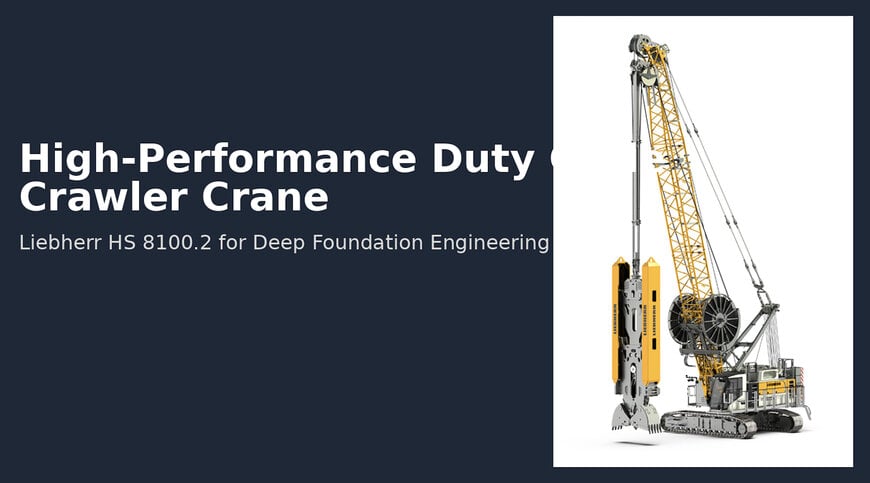
Liebherr has presented the HS 8100.2 duty cycle crawler crane, a new generation machine designed for deep foundation engineering and heavy lifting applications. The model integrates increased engine power, higher winch performance, and improved service accessibility to enhance operational efficiency on construction and infrastructure sites.
Enhanced Power and Performance
The HS 8100.2 represents a technical development of Liebherr’s duty cycle crawler crane series, focusing on higher operating capacity and improved mechanical performance. The machine delivers 15% more engine power than its predecessor, enabling greater operational output in demanding foundation engineering tasks.
The crane’s maximum winch line pull reaches 2 × 295 kN (2 × 66,319 lbf), representing an increase of approximately 9% compared with earlier models. This increase in pulling force enables the crane to operate heavier slurry wall grabs, both hydraulic and mechanical, which are commonly used in diaphragm wall construction and other deep excavation projects.
In dragline operations, the increased engine power translates into higher digging forces, improving excavation performance in soil removal tasks. For dynamic soil compaction, the additional power allows the drop weight to be raised more quickly, increasing cycle frequency and overall productivity on site.
The HS 8100.2 also introduces a new rope-lock system on the winches, simplifying and accelerating rope replacement during maintenance operations. In addition, the machine maintains compatibility with booms from earlier Liebherr models, including the HS 8070.1, HS 8100.1, and HS 8100.2 dual power. This compatibility allows operators and contractors to reuse existing components and adapt configurations to different construction requirements.
Design for User Safety and Service Efficiency
The crane’s design prioritizes operator safety and ease of maintenance. Liebherr adopted the walkway concept used in the latest HS-series machines, integrating railings and platforms that remain attached to the uppercarriage during transport. The roof access ladder is also integrated into the uppercarriage, reducing installation time on site.
Transport logistics were also considered in the design. With a compact width of 3.5 m (11.48 ft) and an uppercarriage weight of approximately 60 t (132,277 lb), the crane’s uppercarriage and undercarriage can be transported together as a single unit. This configuration reduces assembly time and allows faster deployment on construction projects.
For servicing, the fuel tank neck has been repositioned to provide access directly from the uppercarriage platforms, eliminating the need to climb onto the machine’s roof. The operator interface also displays fill-level indicators for all main drives, allowing maintenance checks to be performed through the machine’s monitoring system.
To improve safety in low-light conditions, operators can remotely activate lighting for the cab access area, ensuring safe entry during nighttime or early-morning operations.
Applications in Foundation Engineering
The HS 8100.2 is designed primarily for deep foundation engineering, where equipment must handle high loads and continuous operational cycles. Typical applications include:
- Diaphragm wall construction using slurry wall grabs
- Dragline excavation in earthmoving projects
- Dynamic soil compaction for ground improvement
These applications are common in infrastructure projects such as bridges, tunnels, ports, and large building foundations, where specialized cranes support heavy-duty excavation and ground stabilization tasks.
Through increased mechanical performance and improvements in safety and service accessibility, the HS 8100.2 aims to improve operational efficiency in demanding construction environments.
www.liebherr.com
Through increased mechanical performance and improvements in safety and service accessibility, the HS 8100.2 aims to improve operational efficiency in demanding construction environments.
www.liebherr.com
Powered by
Induportals Media Publishing