PR 716 G8 Crawler Dozer for Precision Earthmoving
Liebherr supplies Delson Contracts with a compact hydrostatic crawler dozer to improve grading accuracy, fuel efficiency and machine control integration on UK construction projects. www.liebherr.com At a mixed-use development in Kirriemuir, Scotland, Delson Contracts has integrated the PR 716 G8 crawler dozer into its earthmoving fleet to support bulk material handling and precision grading across housing and industrial construction applications. Application Context in Civil Engineering Founded in 1990, Delson Contracts operates in recycled aggregates, civil engineering, demolition and design-build construction. Its portfolio includes projects such as the Digital Media Park at Ninewells in Dundee and coastal protection works at Broughty Ferry. The Kirriemuir development requires coordinated site clearance, ground level adjustment and final formation grading. These tasks demand machines capable of both sustained drawbar performance and controlled finishing accuracy. The PR 716 G8 is deployed to spread material and raise ground levels before final construction phases. Machine Configuration and Technical Specifications Liebherr positions the PR 716 G8 as the smallest model in its Generation 8 crawler dozer range. Operating weight ranges from 13.3 t to 15.8 t depending on configuration. The machine is powered by a 4.5-litre, four-cylinder diesel engine rated at 145 hp (107 kW), paired with a hydrostatic travel drive. Unlike torque-converter drivetrains, hydrostatic systems provide continuously variable speed control and independent track drive, enabling precise modulation during grading. Average fuel consumption is reported at 9.3 litres per hour under typical operating conditions, an indicator of efficiency in medium-duty earthmoving applications. High drawbar pull, enabled by the hydrostatic drivetrain, supports bulk pushing tasks despite the compact footprint. The PR 716 G8 can be specified with: XL or LGP (low ground pressure) undercarriage Six-way power-angle-tilt (PAT) blade Optional hinged blade corners to reduce transport width Rear three-shank ripper or towbar Delson Contracts selected the LGP configuration with 711 mm track pads and a standard PAT blade to improve traction and ground load distribution on mixed soil conditions. Integration with Digital Construction Workflows A central consideration in the machine’s specification was compatibility with machine control systems. The PR 716 G8 is delivered pre-configured for straightforward installation of 2D or 3D grading systems, including factory-installed brackets, wiring and interface provisions. Delson Contracts prepared the machine for Trimble Earthworks integration, aligning it with the company’s wider digital construction workflow. Receiver modules are mounted on the cab roof rather than blade masts, preserving forward visibility while supporting automated grade control. Two onboard assistance systems are available as standard: Free Grade, which stabilises the blade to maintain flat planes, ramps or embankments Definition Grade, which enables basic 2D surface modelling with automatic blade control to a predefined inclination These features contribute to reduced rework, consistent grading tolerances and lower dependency on manual staking, supporting broader adoption of digital construction practices. Operator Environment and Ergonomics The cab design emphasises visibility and layout efficiency. Large glazed surfaces improve peripheral awareness, while blade edges remain clearly visible from the seated position. A centrally mounted touchscreen allows configuration of machine parameters. The dedicated bracket for the machine control display places grade data directly within the operator’s natural sightline. This layout reduces head movement and supports sustained precision during trimming operations. Hydraulic components are housed in a separate sound-insulated compartment beneath the tilting cab, contributing to reduced in-cab noise levels. Serviceability and Long-Term Ownership Delson Contracts follows a long-term ownership strategy, prioritising reliability and availability. Service access on the PR 716 G8 includes wide-opening engine bay doors for daily inspection and grouped fuel and AdBlue filling points at the rear. The tilting cab provides direct access to hydraulic components for maintenance. Such design elements support reduced service time and improved uptime, factors critical for contractors operating across demolition, aggregates processing and civil works. Role Within the Fleet The PR 716 G8 complements a fleet that includes wheeled and crawler excavators from Liebherr, forming part of a standardized equipment strategy. While not required continuously, the crawler dozer provides dedicated pushing and grading capability when site conditions demand controlled material movement or accurate formation levels. By combining hydrostatic drive efficiency, low ground pressure configuration and machine control readiness, the
 machineryasia
Liebherr supplies Delson Contracts with a compact hydrostatic crawler dozer to improve grading accuracy, fuel efficiency and machine control integration on UK construction projects.
www.liebherr.com

At a mixed-use development in Kirriemuir, Scotland, Delson Contracts has integrated the PR 716 G8 crawler dozer into its earthmoving fleet to support bulk material handling and precision grading across housing and industrial construction applications.
Application Context in Civil Engineering
Founded in 1990, Delson Contracts operates in recycled aggregates, civil engineering, demolition and design-build construction. Its portfolio includes projects such as the Digital Media Park at Ninewells in Dundee and coastal protection works at Broughty Ferry.
The Kirriemuir development requires coordinated site clearance, ground level adjustment and final formation grading. These tasks demand machines capable of both sustained drawbar performance and controlled finishing accuracy. The PR 716 G8 is deployed to spread material and raise ground levels before final construction phases.
Machine Configuration and Technical Specifications
Liebherr positions the PR 716 G8 as the smallest model in its Generation 8 crawler dozer range. Operating weight ranges from 13.3 t to 15.8 t depending on configuration.
The machine is powered by a 4.5-litre, four-cylinder diesel engine rated at 145 hp (107 kW), paired with a hydrostatic travel drive. Unlike torque-converter drivetrains, hydrostatic systems provide continuously variable speed control and independent track drive, enabling precise modulation during grading.
Average fuel consumption is reported at 9.3 litres per hour under typical operating conditions, an indicator of efficiency in medium-duty earthmoving applications. High drawbar pull, enabled by the hydrostatic drivetrain, supports bulk pushing tasks despite the compact footprint.
The PR 716 G8 can be specified with:
- XL or LGP (low ground pressure) undercarriage
- Six-way power-angle-tilt (PAT) blade
- Optional hinged blade corners to reduce transport width
- Rear three-shank ripper or towbar
Delson Contracts selected the LGP configuration with 711 mm track pads and a standard PAT blade to improve traction and ground load distribution on mixed soil conditions.
Integration with Digital Construction Workflows
A central consideration in the machine’s specification was compatibility with machine control systems. The PR 716 G8 is delivered pre-configured for straightforward installation of 2D or 3D grading systems, including factory-installed brackets, wiring and interface provisions.
Delson Contracts prepared the machine for Trimble Earthworks integration, aligning it with the company’s wider digital construction workflow. Receiver modules are mounted on the cab roof rather than blade masts, preserving forward visibility while supporting automated grade control.
Two onboard assistance systems are available as standard:
Integration with Digital Construction Workflows
A central consideration in the machine’s specification was compatibility with machine control systems. The PR 716 G8 is delivered pre-configured for straightforward installation of 2D or 3D grading systems, including factory-installed brackets, wiring and interface provisions.
Delson Contracts prepared the machine for Trimble Earthworks integration, aligning it with the company’s wider digital construction workflow. Receiver modules are mounted on the cab roof rather than blade masts, preserving forward visibility while supporting automated grade control.
Two onboard assistance systems are available as standard:
- Free Grade, which stabilises the blade to maintain flat planes, ramps or embankments
- Definition Grade, which enables basic 2D surface modelling with automatic blade control to a predefined inclination
These features contribute to reduced rework, consistent grading tolerances and lower dependency on manual staking, supporting broader adoption of digital construction practices.
Operator Environment and Ergonomics
The cab design emphasises visibility and layout efficiency. Large glazed surfaces improve peripheral awareness, while blade edges remain clearly visible from the seated position.
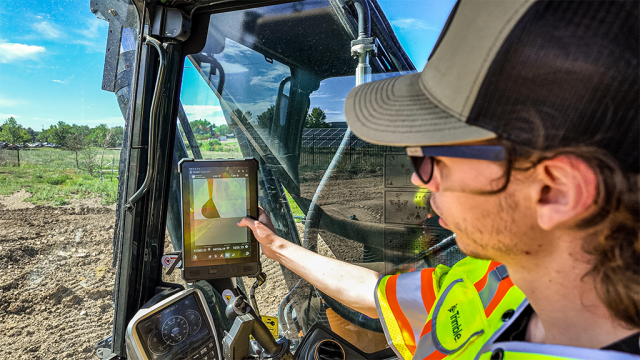
A centrally mounted touchscreen allows configuration of machine parameters. The dedicated bracket for the machine control display places grade data directly within the operator’s natural sightline. This layout reduces head movement and supports sustained precision during trimming operations.
Hydraulic components are housed in a separate sound-insulated compartment beneath the tilting cab, contributing to reduced in-cab noise levels.
Serviceability and Long-Term Ownership
Delson Contracts follows a long-term ownership strategy, prioritising reliability and availability. Service access on the PR 716 G8 includes wide-opening engine bay doors for daily inspection and grouped fuel and AdBlue filling points at the rear. The tilting cab provides direct access to hydraulic components for maintenance.
Such design elements support reduced service time and improved uptime, factors critical for contractors operating across demolition, aggregates processing and civil works.
Role Within the Fleet
The PR 716 G8 complements a fleet that includes wheeled and crawler excavators from Liebherr, forming part of a standardized equipment strategy. While not required continuously, the crawler dozer provides dedicated pushing and grading capability when site conditions demand controlled material movement or accurate formation levels.
By combining hydrostatic drive efficiency, low ground pressure configuration and machine control readiness, the PR 716 G8 addresses the operational requirements of medium-scale civil engineering projects where both productivity and surface accuracy are required.
www.liebherr.com
Operator Environment and Ergonomics
The cab design emphasises visibility and layout efficiency. Large glazed surfaces improve peripheral awareness, while blade edges remain clearly visible from the seated position.
A centrally mounted touchscreen allows configuration of machine parameters. The dedicated bracket for the machine control display places grade data directly within the operator’s natural sightline. This layout reduces head movement and supports sustained precision during trimming operations.
Hydraulic components are housed in a separate sound-insulated compartment beneath the tilting cab, contributing to reduced in-cab noise levels.
Serviceability and Long-Term Ownership
Delson Contracts follows a long-term ownership strategy, prioritising reliability and availability. Service access on the PR 716 G8 includes wide-opening engine bay doors for daily inspection and grouped fuel and AdBlue filling points at the rear. The tilting cab provides direct access to hydraulic components for maintenance.
Such design elements support reduced service time and improved uptime, factors critical for contractors operating across demolition, aggregates processing and civil works.
Role Within the Fleet
The PR 716 G8 complements a fleet that includes wheeled and crawler excavators from Liebherr, forming part of a standardized equipment strategy. While not required continuously, the crawler dozer provides dedicated pushing and grading capability when site conditions demand controlled material movement or accurate formation levels.
By combining hydrostatic drive efficiency, low ground pressure configuration and machine control readiness, the PR 716 G8 addresses the operational requirements of medium-scale civil engineering projects where both productivity and surface accuracy are required.
www.liebherr.com
Powered by
Induportals Media Publishing