[Job Story] Three 800-Tonne Liebherr Cranes Support Nordex N175 Installation at Mahlsdorf
Liebherr played a key role in the installation of ten Nordex N175/6.X turbines in the Mahlsdorf wind farm at the end of 2025. For this operation, the main lifting fleet combined one LG 1800-1.0 operated by Nolte and one LR 1800-1.0 each from Neeb and Hofmann. Large rotor diameters, high hub heights, and heavy components were […] [Job Story] Three 800-Tonne Liebherr Cranes Support Nordex N175 Installation at Mahlsdorf published on The HeavyQuip Magazine.
 machineryasia
 ![[Job Story] Three 800-Tonne Liebherr Cranes Support Nordex N175 Installation at Mahlsdorf](https://www.heavyquipmag.com/wp-content/uploads/2026/02/liebherr-lg1800-1-0-nolte-liftra-300dpi.jpg)
Liebherr played a key role in the installation of ten Nordex N175/6.X turbines in the Mahlsdorf wind farm at the end of 2025. For this operation, the main lifting fleet combined one LG 1800-1.0 operated by Nolte and one LR 1800-1.0 each from Neeb and Hofmann. Large rotor diameters, high hub heights, and heavy components were handled using the HSL4 boom system, VarioTray, and V-Frame.
Bigger rotor diameters on wind turbines deliver higher energy yields, especially in low-wind regions. Added hub height also boosts output, as the rotor operates higher above the ground where wind speeds are typically stronger. Against this backdrop, the Nordex Group has launched a new wind turbine, N175/6.X, within its Delta4000 series, featuring a 175 m rotor diameter. At Mahlsdorf in Brandenburg, UKA and Nordex built the first wind farm with ten of these turbines, each with a capacity of 6.8 MW. With hub heights reaching 179 m, the machines rank among the tallest onshore turbines in the world.
Crane requirements
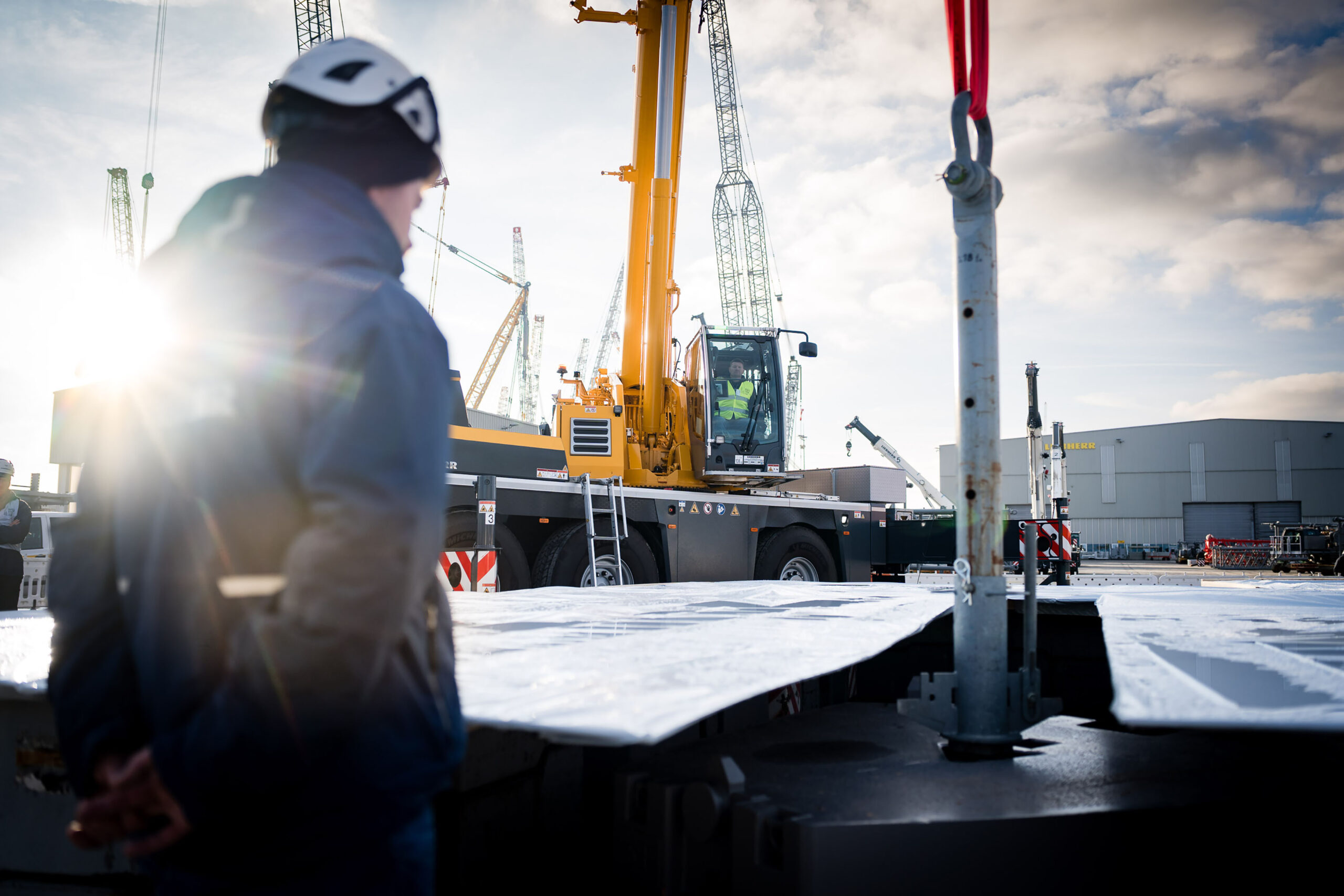
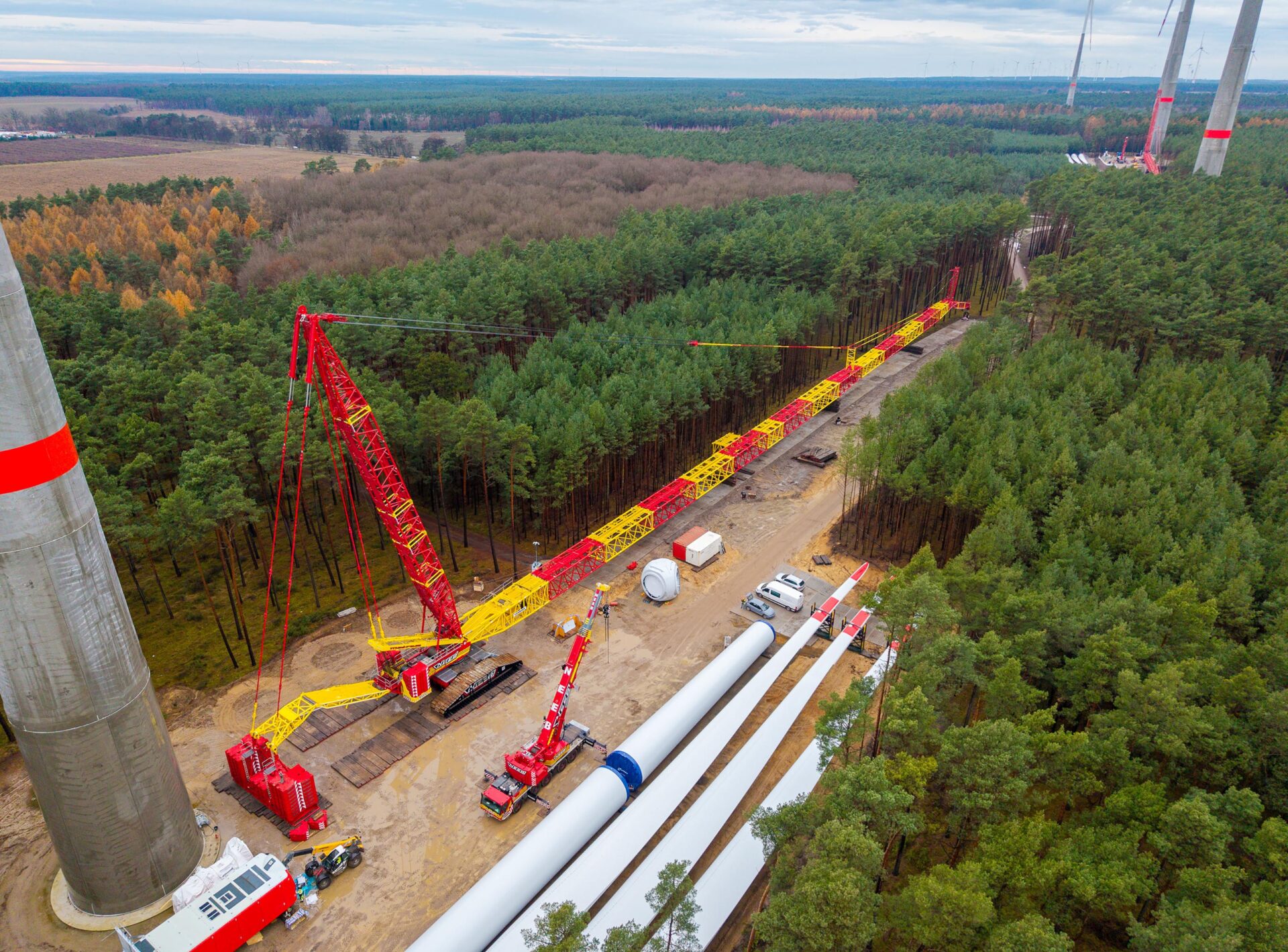
At the end of 2025, three 800-tonne Liebherr cranes were deployed on site: an LG 1800-1.0 operated by Nolte and two LR 1800-1.0 crawler cranes from Hofmann and Neeb. Supporting lifts were also carried out with Liebherr machines, bringing the total fleet on site to nine cranes from Liebherr’s Ehingen plant working in tandem.
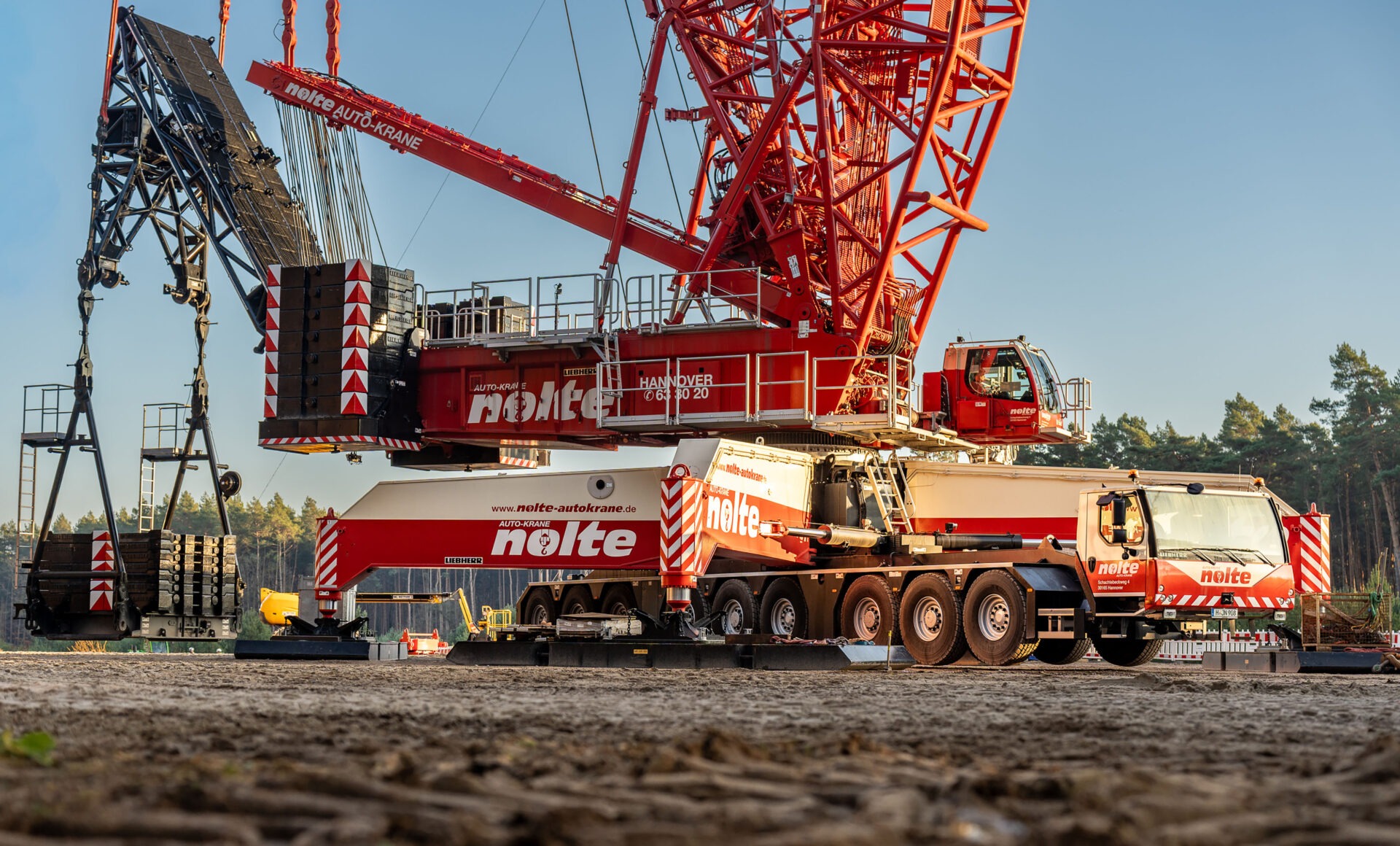
For turbines in this size range, 800-tonne cranes are effectively the minimum class that can still meet the required hook heights and component weights. The gearbox was the heaviest single lift, at 83 tonnes net. To cover the necessary height and radius, all three main cranes were configured with Liebherr’s HSL4 boom system, pairing a 174 m main boom with an 18 m fixed jib. Ballast was set at 170 tonnes on the uppercarriage, complemented by 100 tonnes of suspended ballast for the critical lifts.
Flexible ballast handling
Mast erection required around 400 tonnes of suspended ballast. Using VarioTray, crews could split the 300-tonne ballast pallet from the remaining 100-tonne section and set it down within minutes, cutting the time and effort needed for ballast changes during assembly and demobilisation. At Mahlsdorf, that flexibility helped the team capitalise on a weather window of just two days. The V-Frame also saves time, because rotor blades stored further from the crane could be picked with a larger ballast radius and then installed at a smaller radius without re-stacking ballast, reducing changeover time between blade handling and final mounting.
Minimising conversion time and simplifying transport
Keeping crane conversion times short is a major lever for reducing construction costs, both when moving between different wind farms. To avoid completely dismantling the crane, Hofmann used SPMTs. For example, the base unit (without tracks) and the entire counter-jib were transported as a single unit.
“the crane was moved within seven days, including dismantling and reassembly. And that despite the fact that the crane had previously been in use in the Black Forest, some 850 km away from Mahlsdorf. This achievement was only possible thanks to an excellently coordinated team and a well-thought-out assembly and transport concept.”
Explained Ingo Klees, a member of the technical field service team.
Quick response, minimal downtime
With cranes working at high utilisation, technical issues are sometimes unavoidable; what matters is how quickly the machine is back in operation. On this job, one of the crawlers had problems with a hydraulic pump. Liebherr Service was on site within a few hours, and the problem was resolved together with colleagues from the crane company.
The issue did not become a scheduling obstacle. Thanks to an additional night shift and the use of a bad-weather day to complete crane erection, tower segment installation stayed aligned with the second crawler working on the neighbouring turbine.
“The excellent and fast service is one of the main reasons why we always choose Liebherr cranes.”
Confirmed Rainer Schlesner, crane operator at Nolte.
Ready for what comes next
“The LR 1800-1.0 is ideal for assembling the next generation of wind turbines with increasing hub heights and higher masses. The crane is strong enough to be able to work at wind speeds of up to 30 km/h based on the wind load tables.”
Said Erik Piper, crane operator and SPMT operator at Hofmann.
Mahlsdorf underlines the new reality of onshore wind: taller towers and heavier components demand not only capacity, but fast reconfiguration, smart ballast handling and dependable service to stay productive in narrow wind windows.
[Job Story] Three 800-Tonne Liebherr Cranes Support Nordex N175 Installation at Mahlsdorf published on The HeavyQuip Magazine.