Husco at CONEXPO-CON/AGG 2026: GenSteer Brings Fail-Functional Steer-by-wire Closer to Mainstream Machines
Steer-by-wire has been “almost there” in off-highway for years. Plenty of machines already layer electronics on top of hydraulics, adding return-to-center, steering assist, and automation-ready functions. But most still keep a physical link between the operator and the steering axle, whether that link is mechanical, hydraulic, or electro-hydraulic. Breaking that link completely has typically meant […] Husco at CONEXPO-CON/AGG 2026: GenSteer Brings Fail-Functional Steer-by-wire Closer to Mainstream Machines published on The HeavyQuip Magazine.
 machineryasia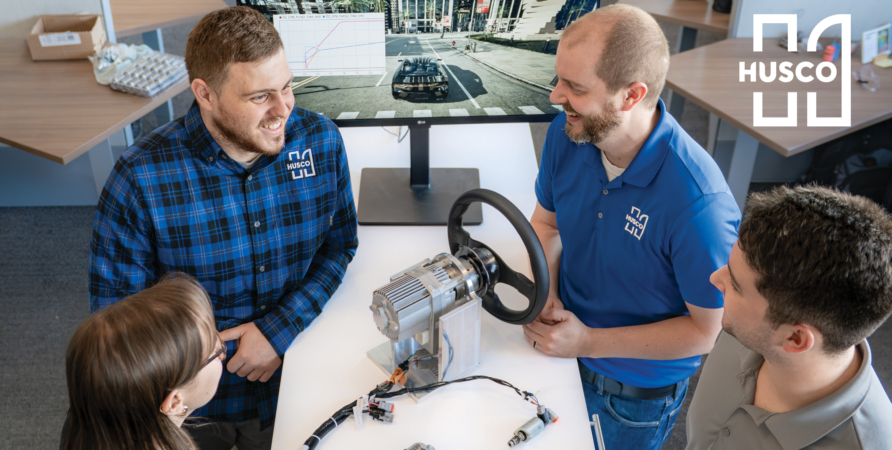
Steer-by-wire has been “almost there” in off-highway for years. Plenty of machines already layer electronics on top of hydraulics, adding return-to-center, steering assist, and automation-ready functions. But most still keep a physical link between the operator and the steering axle, whether that link is mechanical, hydraulic, or electro-hydraulic. Breaking that link completely has typically meant piling on redundant controllers, batteries, wiring, and networks to satisfy safety requirements. That complexity drives cost, packaging headaches, and integration risk.
At CONEXPO-CON/AGG 2026 in Las Vegas, Husco put a stake in the ground with GenSteer, a steer-by-wire platform built around a different safety and redundancy concept. The company presented GenSteer as a fail-functional system that aims to deliver redundancy without duplicating major electronic subsystems, positioning it as a way to make steer-by-wire practical for a wider slice of off-highway equipment.
What GenSteer is, and why Husco says the architecture matters
The heart of Husco’s argument is that the industry has treated steer-by-wire safety like aerospace: if something can fail, replicate it. That mindset works when the cost of redundancy is a rounding error compared to the aircraft, but it becomes harder to justify on industrial vehicles where every extra controller and battery lands on the bill of materials and in the packaging envelope.
GenSteer takes another route. In normal operation, the system delivers force feedback through an in-cab unit so the operator still gets “wheel feel” and can tune response characteristics digitally. In a fault condition, the same motor that provides force feedback can switch roles and act as a generator. Husco’s framing is simple: the operator’s steering input becomes a source of usable energy, which can then be directed to maintain steering control through the electro-hydraulic system even if a portion of the electronics stack fails.
That approach is why Husco keeps repeating the phrase “redundancy without replication.” The company is not saying there is no redundancy. It is saying redundancy is achieved through system behavior and energy flow rather than through duplicate batteries and multiple extra controllers.
A steer-by-wire backup that does not rely on extra batteries
One of the clearest differentiators Husco pushed at the show was the removal of backup batteries and duplicated electronics commonly associated with steer-by-wire proposals. GenSteer’s fail-functional mode is based on converting operator input into electrical power, then using that power to control the hydraulic valve and keep the wheels steerable. Husco describes this as maintaining steering during an electrical fault, not simply shutting the machine down in a fail-safe state.
This is an important nuance for machines intended for road use, where the ability to maintain control long enough to maneuver matters more than simply stopping. Husco repeatedly tied its safety story to fail-functional expectations, especially in faster applications where losing steering is not an acceptable outcome.
Software-less directional control as a safety lever
Another technical detail Husco highlighted is how GenSteer determines steering direction in a failure scenario. Instead of depending entirely on a conventional processor and software stack, the system’s “generator” circuitry can condition and directionalize the operator-generated energy so the system knows whether input is left or right. The point here is resilience: if software is corrupted or a control unit is compromised, the core steering function still has a pathway to remain operable.
In off-highway product planning terms, this is Husco signaling that GenSteer is meant to reduce the amount of “must be perfect” electronics required to preserve basic steerability.
What steer-by-wire unlocks once the physical link is gone
Husco’s CONEXPO message was not only about safety. It was also about what OEMs can do once the cabin is no longer constrained by a heavy steering column, hydraulic plumbing, and the packaging compromises that come with them.
The company tied steer-by-wire to a long list of practical outcomes:
- Cab freedom and ergonomics: more flexibility in cockpit layout, smaller steering interfaces, and fewer hydraulic components in the operator environment.
- Tunable steering behavior: speed-dependent steering ratios, selectable modes, and more consistent precision in tight work zones.
- Automation readiness: a steering system that automation providers can interface with more cleanly, because the control platform is already designed for electronic integration rather than retrofitted with additional valves and sensors.
Husco also pointed to real use cases where steering demand is high or where automation business cases are clearer, including wheel loaders (repetitive cycles), telehandlers (often higher technology content), and mining applications where remote or autonomous operation can keep people out of hazardous areas.
Cost positioning: aiming at the “high-spec” steering tier first
Husco did not present GenSteer as an immediate replacement for the lowest-cost, simplest orbital-based steering solutions common in basic rental or low-utilization machines. Instead, the cost claim is more targeted: GenSteer is intended to be roughly cost-neutral versus higher-spec steering architectures that already add sensors and electronic features on top of conventional systems, particularly in segments like agriculture that have adopted assist and guidance features earlier.
That is a practical go-to-market stance. It acknowledges the price compression achieved by decades of orbital steering optimization, while arguing there is a large middle band of machines where operators and owners want better comfort, better control, and more advanced features without stepping up to the typical cost and complexity of full steer-by-wire.
Show floor presence and industry validation
Husco built the GenSteer launch around interactive demos and technical walk-throughs at CONEXPO-CON/AGG 2026, exhibiting in South Hall, Level 2, Booth S81415.
GenSteer also collected visibility through the show’s Next Level Awards program. CONEXPO-CON/AGG announced GenSteer as the Contractors’ Choice for best equipment in its Next Level Awards results, giving Husco a strong third-party headline to pair with the technology debut.
Timing: prototypes now, production programs next
Husco presented GenSteer as beyond concept stage, with multiple prototype iterations already built and functional safety work underway with third-party assessors. The stated development path centres on OEM co-development and validation for global functional safety expectations, with commercialisation targeting the next couple of years for full production programs.
For OEMs, the key takeaway is that GenSteer is being pitched as a platform: hardware that stays broadly consistent while software, sensors, and feature sets evolve by machine, market, and application.
Husco at CONEXPO-CON/AGG 2026: GenSteer Brings Fail-Functional Steer-by-wire Closer to Mainstream Machines published on The HeavyQuip Magazine.