Wirtgen Group Pioneers Smarter Asphalt Paving
Vögele’s InLine Pave and SprayJet technologies enable faster road projects with up to 50% less surface material, lower CO₂ emissions, and improved long-term durability. www.wirtgen-group.com Road construction schedules are tight, especially when it comes to the construction or renovation of busy arterial roads. At the same time, tendering authorities demand the highest paving quality. Additional pressure comes from stricter environmental regulations and the call for resource-conserving construction methods – while road construction companies struggle with rising material and labor costs. The InLine Pave and SprayJet technologies from Vögele are designed to precisely meet these requirements. The two paving methods are suitable for different applications, have been tried and tested for years, and are used worldwide. InLine Pave: binder and wearing courses placed in a single pass The InLine Pave concept is particularly suitable for the construction and renovation of highways and expressways – and wherever roads need to be opened to traffic as soon as possible. The name says it all, three machines work “in line” one after the other: the material feeder picks up the delivered binder course or surface course mix and conveys it to the binder course paver SUPER 2100-3(i) IP. With its AB 600 TP2 Plus Vögele high compaction screed, it is the heart of the train. The binder course is compacted during paving with values of up to 98%, so high that the subsequent paver can already drive over it. The binder course paver also has a special transfer module that transports the surface course material directly into the receiving hopper of the third machine – a SUPER 1800 of the Dash 3 or Dash 5 generation, which then paves the surface course. InLine Pave: less material, greater stability With the InLine Pave method, expensive, binder-rich surface course material can be saved in favor of the cheaper and stiffer binder course mix. Due to the higher proportion of stable binder layer, the flooring is more stable. Compared to conventional paving, there is also no need for spraying with bitumen emulsion as a bonding bridge – this also saves material, working time, and CO₂ emissions. “Hot on hot” in a single operation: At InLine Pave, the binder course and the surface course are laid in one operation. Durable and high-quality flooring with fewer emissions “Hot-on-hot” paving has several advantages: The binder course and surface course interlock optimally, which increases the quality and service life of the surface course. The proportion of surface course relative to binder course can also be reduced. That improves the stability of the pavement thanks to the higher proportion of stable binder course, which prevents deformation of the road. On the other hand, less expensive top layer material is required. In an InLine-Pave train, standard machines that are only slightly modified are used, apart from the binder paver. This simplifies operation by the crew, and the contractor can better utilize the machine fleet. Both the material feeder and the paver can be used any time for conventional construction work without having to be converted, and the transfer module of the binder course paver SUPER 2100-3(i) IP can also be attached and removed depending on the application. SUPER 2100-3i IP The heart of the InLine Pave paving train is the SUPER 2100-3i IP. The SUPER 2100-3i, for placing binder course, is a modified machine of standard design fitted with a special transfer module for the surface course mix. The transfer module can be attached and detached – so the machine can also be used for normal applications. SprayJet technology for thin-film paving If a surface course needs to be renewed, the paving of thin overlays by hot paving on sealant is an interesting technology: it is cost-effective, efficient, and resource-saving. With the SUPER 1800-3(i) SprayJet, Vögele has a special spray paver in its range that has already proven itself in projects all over the world. In a single operation, it sprays a bitumen emulsion onto the old pavement and lays the new surface course. The five spray bars with a total of 24 nozzles enable seamless emulsion application across varying pave widths of up to 6 meters. The SprayJet module is a self-contained functional unit, meaning that the SUPER 1800-3i SprayJet can also be used as a classic road paver. The module is easy to maintain and consistently integrated into the ErgoPlus 3 Vögele operating concept. Operators will therefore also find their familiar working environment with this machine, which saves on lengthy training sessions. Broad range: The SUPER 1800-3(i) SprayJet from Vögele is a globally unique spray paver for paving thin overlays and conventional surface as well as binder courses. Three to five times faster, less material consumption The SprayJet technology is generally suitable for all traffic areas and is particularly efficient. The paving speed is often significantly higher tha
 machineryasia
Vögele’s InLine Pave and SprayJet technologies enable faster road projects with up to 50% less surface material, lower CO₂ emissions, and improved long-term durability.
www.wirtgen-group.com
Road construction schedules are tight, especially when it comes to the construction or renovation of busy arterial roads. At the same time, tendering authorities demand the highest paving quality. Additional pressure comes from stricter environmental regulations and the call for resource-conserving construction methods – while road construction companies struggle with rising material and labor costs. The InLine Pave and SprayJet technologies from Vögele are designed to precisely meet these requirements. The two paving methods are suitable for different applications, have been tried and tested for years, and are used worldwide.
InLine Pave: binder and wearing courses placed in a single pass
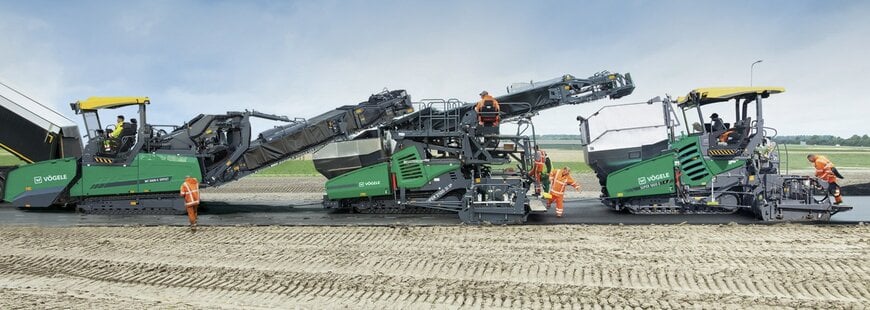
The InLine Pave concept is particularly suitable for the construction and renovation of highways and expressways – and wherever roads need to be opened to traffic as soon as possible. The name says it all, three machines work “in line” one after the other: the material feeder picks up the delivered binder course or surface course mix and conveys it to the binder course paver SUPER 2100-3(i) IP. With its AB 600 TP2 Plus Vögele high compaction screed, it is the heart of the train. The binder course is compacted during paving with values of up to 98%, so high that the subsequent paver can already drive over it. The binder course paver also has a special transfer module that transports the surface course material directly into the receiving hopper of the third machine – a SUPER 1800 of the Dash 3 or Dash 5 generation, which then paves the surface course.
InLine Pave: less material, greater stability
With the InLine Pave method, expensive, binder-rich surface course material can be saved in favor of the cheaper and stiffer binder course mix. Due to the higher proportion of stable binder layer, the flooring is more stable. Compared to conventional paving, there is also no need for spraying with bitumen emulsion as a bonding bridge – this also saves material, working time, and CO₂ emissions.
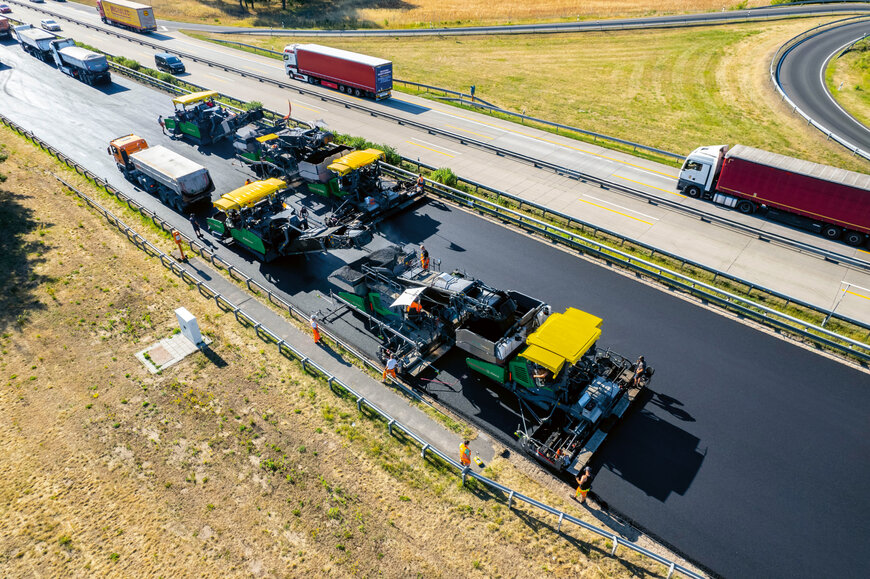
“Hot on hot” in a single operation: At InLine Pave, the binder course and the surface course are laid in one operation.
Durable and high-quality flooring with fewer emissions
“Hot-on-hot” paving has several advantages: The binder course and surface course interlock optimally, which increases the quality and service life of the surface course. The proportion of surface course relative to binder course can also be reduced. That improves the stability of the pavement thanks to the higher proportion of stable binder course, which prevents deformation of the road. On the other hand, less expensive top layer material is required.
In an InLine-Pave train, standard machines that are only slightly modified are used, apart from the binder paver. This simplifies operation by the crew, and the contractor can better utilize the machine fleet. Both the material feeder and the paver can be used any time for conventional construction work without having to be converted, and the transfer module of the binder course paver SUPER 2100-3(i) IP can also be attached and removed depending on the application.
SUPER 2100-3i IP
The heart of the InLine Pave paving train is the SUPER 2100-3i IP. The SUPER 2100-3i, for placing binder course, is a modified machine of standard design fitted with a special transfer module for the surface course mix. The transfer module can be attached and detached – so the machine can also be used for normal applications.
SprayJet technology for thin-film paving
If a surface course needs to be renewed, the paving of thin overlays by hot paving on sealant is an interesting technology: it is cost-effective, efficient, and resource-saving. With the SUPER 1800-3(i) SprayJet, Vögele has a special spray paver in its range that has already proven itself in projects all over the world. In a single operation, it sprays a bitumen emulsion onto the old pavement and lays the new surface course.
The five spray bars with a total of 24 nozzles enable seamless emulsion application across varying pave widths of up to 6 meters. The SprayJet module is a self-contained functional unit, meaning that the SUPER 1800-3i SprayJet can also be used as a classic road paver. The module is easy to maintain and consistently integrated into the ErgoPlus 3 Vögele operating concept. Operators will therefore also find their familiar working environment with this machine, which saves on lengthy training sessions.
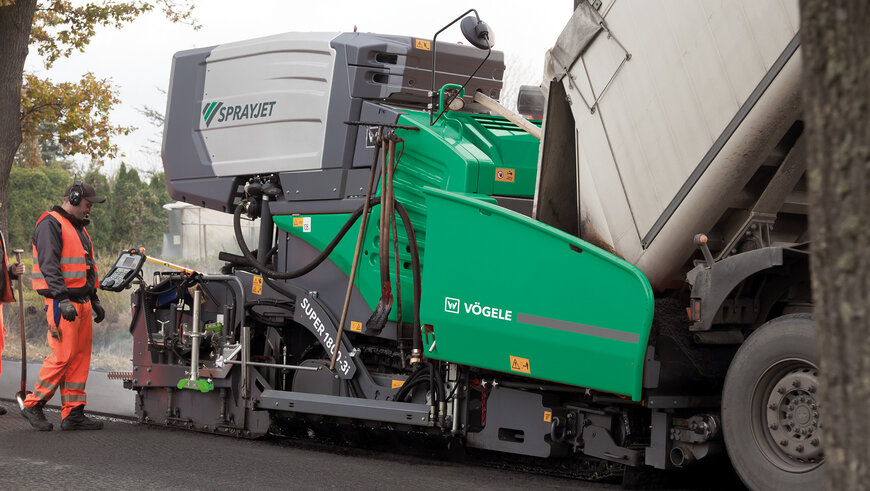
Broad range: The SUPER 1800-3(i) SprayJet from Vögele is a globally unique spray paver for paving thin overlays and conventional surface as well as binder courses.
Three to five times faster, less material consumption
The SprayJet technology is generally suitable for all traffic areas and is particularly efficient. The paving speed is often significantly higher than with conventional paving, and because the layer thickness is usually only 2 cm instead of the usual 4 cm, up to 50 % of the expensive surface course material can be saved.
The SprayJet method is also convincing in terms of quality: As the emulsion is sprayed on and the surface course is applied in a single operation, the binding agent film cannot be accidentally driven over and damaged by construction vehicles. The binding agent film seals the lower layer over the entire surface and effectively seals it against water. This also increases the service life of the road.
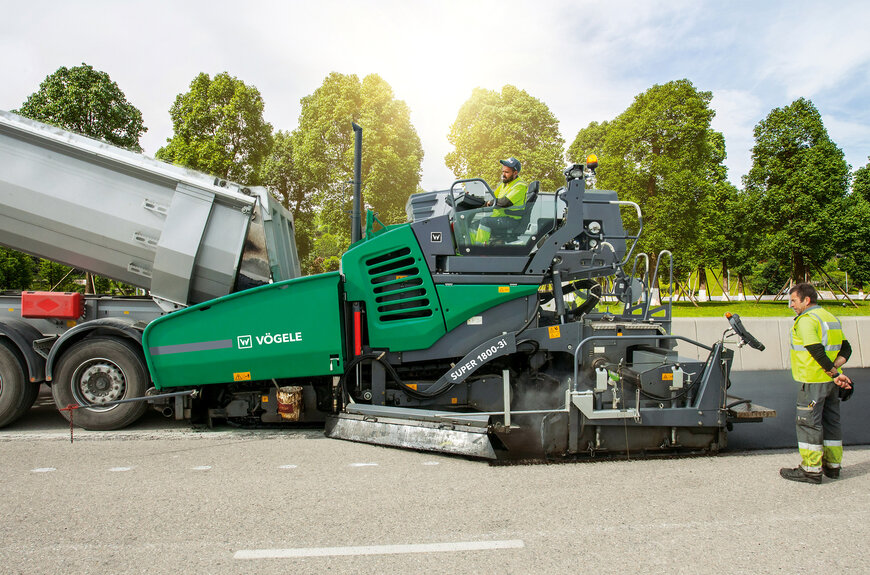
Thanks to its modular design, the SUPER 1800-3(i) can be used either as a spray paver or, with little conversion work, as a standard paver.
Spray paver SUPER 1800-3(i) SprayJet
The SUPER 1800-3(i) SprayJet is suitable for paving thin overlays as well as conventional surface and binder courses. The spray module is a self-contained unit. Thanks to its modular design, the machine can be used as a spray and standard paver.
Two processes for all requirements
Whether renovation or new construction, highway project or inner-city measure: With InLine Pave and SprayJet, Vögele offers two technologies that take into account the challenges of road construction companies as well as the requirements of clients – building or renovating roads faster and more efficiently, using less material and thus saving resources without compromising on quality.
www.wirtgen-group.com
Powered by
Induportals Media Publishing