What’s Really Under the Slab: Why Subsurface Verification Belongs in Every Pre-Construction Plan
More than 550 excavation dig-ins happen every day across the United States, according to OSHA’s Trenching and Excavation Safety guidance (OSHA 2226-10R, osha.gov). That’s not a rare accident. It’s a routine cost of doing business for contractors who treat utility locating as a box to check rather than a planning discipline. A single strike can […] What’s Really Under the Slab: Why Subsurface Verification Belongs in Every Pre-Construction Plan published on The HeavyQuip Magazine.
 machineryasia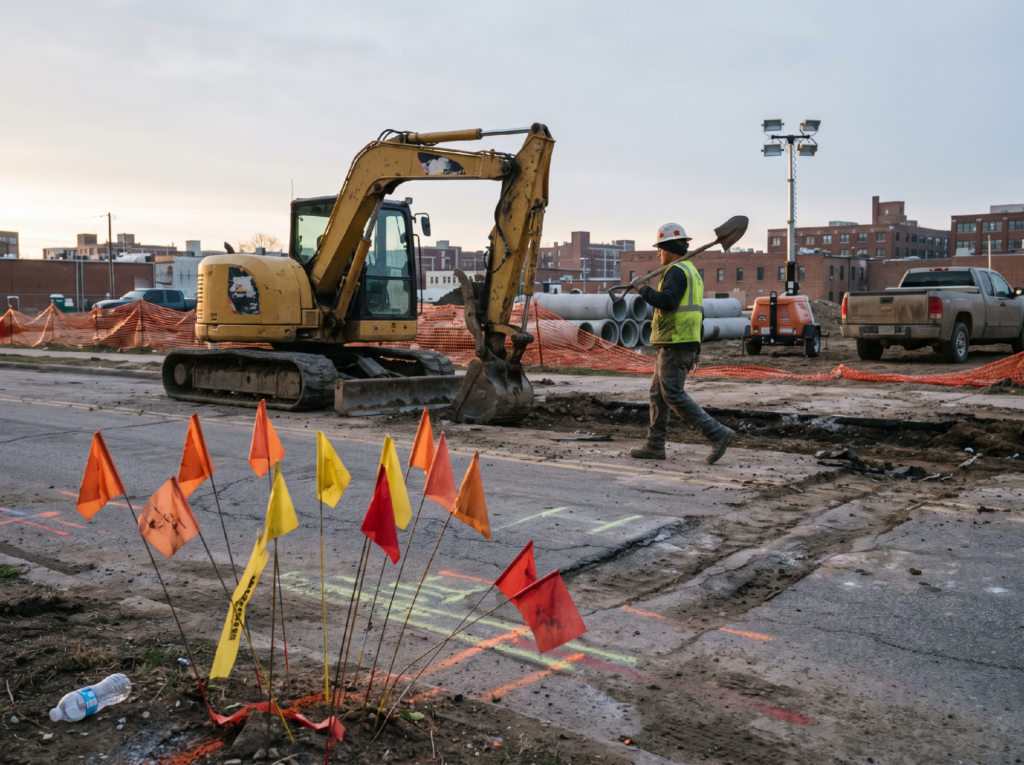
More than 550 excavation dig-ins happen every day across the United States, according to OSHA’s Trenching and Excavation Safety guidance (OSHA 2226-10R, osha.gov). That’s not a rare accident. It’s a routine cost of doing business for contractors who treat utility locating as a box to check rather than a planning discipline.
A single strike can shut down a crew for an afternoon or a week. Equipment gets damaged, gas lines get ruptured, fiber gets severed, and a job that was tracking on schedule suddenly isn’t. For fleet managers and project leads, the fix isn’t complicated. It just requires treating what’s buried under a site with the same rigor applied to what’s built on top of it.
The Rising Cost of What You Can’t See
The Common Ground Alliance’s 2025 DIRT Data Summary analyzed 221,717 unique damage reports to buried utilities across the U.S. and Canada. The CGA Damage Index hit a record high of 102 last year, up from 96.7 in 2024, despite a three-year industry push to cut excavation damage in half. Telecom and cable facilities accounted for 51% of 2025 damage reports and natural gas another 36%. The leading root cause, by a wide margin, was crews excavating without notifying 811 first.
The gap between what a locate ticket marks and what’s actually buried is why more crews now build a second verification layer into their pre-construction plan. Many pair their 811 locate with concrete scanning services before coring, cutting, or anchoring into an existing slab, since ground-penetrating radar can reveal rebar, conduit, and post-tension cable that surface markings never capture. A foundation crew preparing to core through a warehouse floor for new plumbing, for instance, has no way of knowing what runs through that slab from a locate ticket alone. A GPR pass takes an hour and tells them exactly where it’s safe to drill.
The financial exposure of skipping that step is real. A damage-cost analysis reported by Equipment World puts the annual toll on U.S. construction at roughly $30 billion a year once downtime, fines, claims, and legal costs are tallied nationally. A single strike averages about $56,000 in direct costs, a figure that can erase 10-20% of a small contractor’s profit on a job. Rework and idle equipment don’t show up as a line item until the invoice arrives, and by then the schedule has already slipped.
Why “Calling 811” Isn’t the Whole Answer
Calling 811 is the law in every state, and it’s the right first move. It’s also not sufficient on its own. A January 2025 survey from the Associated General Contractors of America found nearly two-thirds of utility line strikes by contractors occurred even after correct 811 notification, because the lines were located at least two feet from where they’d actually been marked. Surface paint and flags tell a crew roughly where something is buried; they don’t tell a crew what’s embedded inside a concrete slab, and OSHA’s excavation standard (1926.651(b)) requires utility locations to be determined before opening any excavation, full stop, no exceptions for “the marks looked close enough.”
Both the AGC survey and the Common Ground Alliance’s DIRT Report point to the same conclusion: locate tickets narrow the risk, they don’t eliminate it. Contractors who understand that distinction plan for a second, more precise check before equipment gets anywhere near a slab.
The Verification Stack: From 811 to the Slab
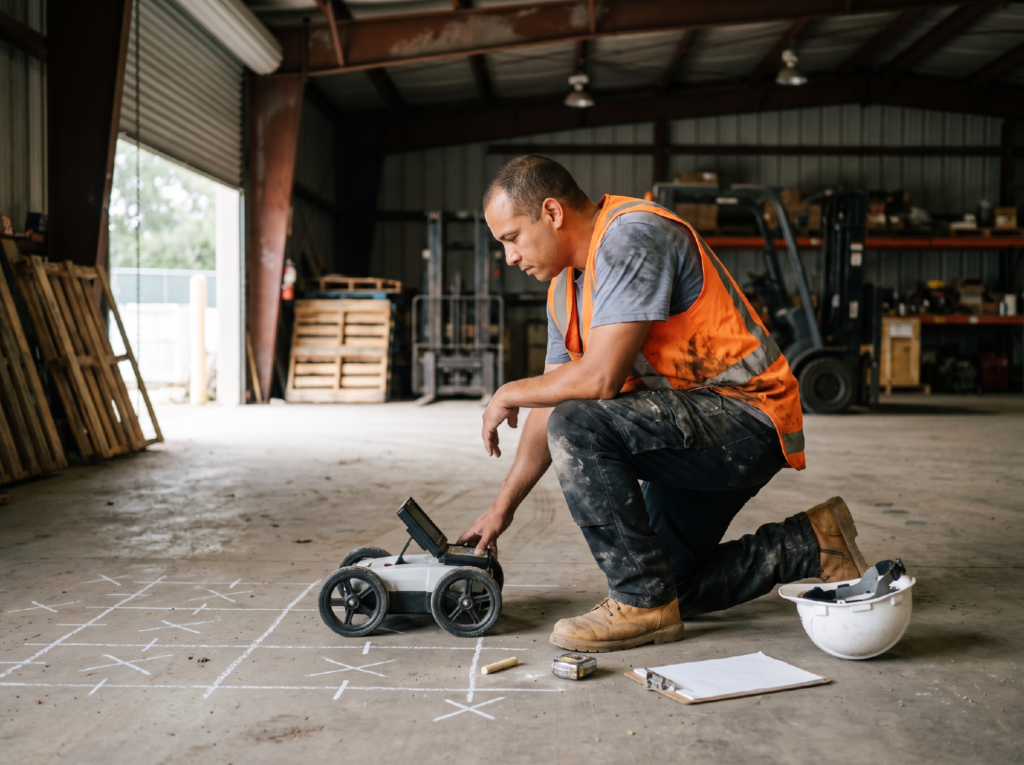
Think of subsurface verification as three layers, each catching something the one before it misses. The first layer, the 811 locate, covers public utility lines up to the property boundary or meter. The second layer, potholing or vacuum excavation, physically exposes a line at a specific point to confirm depth and location where the stakes are high enough to justify the time. The third layer, GPR or concrete scanning, covers what neither of the first two can: the private infrastructure embedded inside a slab itself, rebar mats, post-tension cables, conduit runs, and old utility stubs that were never mapped anywhere.
For demolition work, this third layer matters most. A crew that saws into a post-tension slab without knowing where the cables run risks a cable release that can injure a worker and compromise the slab’s structural integrity. For anchor-bolt installation on equipment pads, hitting embedded rebar can mean a failed inspection and a redrilled hole. None of these failures are expensive to prevent; they’re expensive to fix after the fact.
Digital planning tools are starting to fold this verification data into broader job-site technology stacks, the same way connected job-site technology now feeds telematics and fleet data into a single dashboard. That integration matters more every year as sites get denser with underground infrastructure and above-ground automation both.
Building Verification Into the Project Timeline
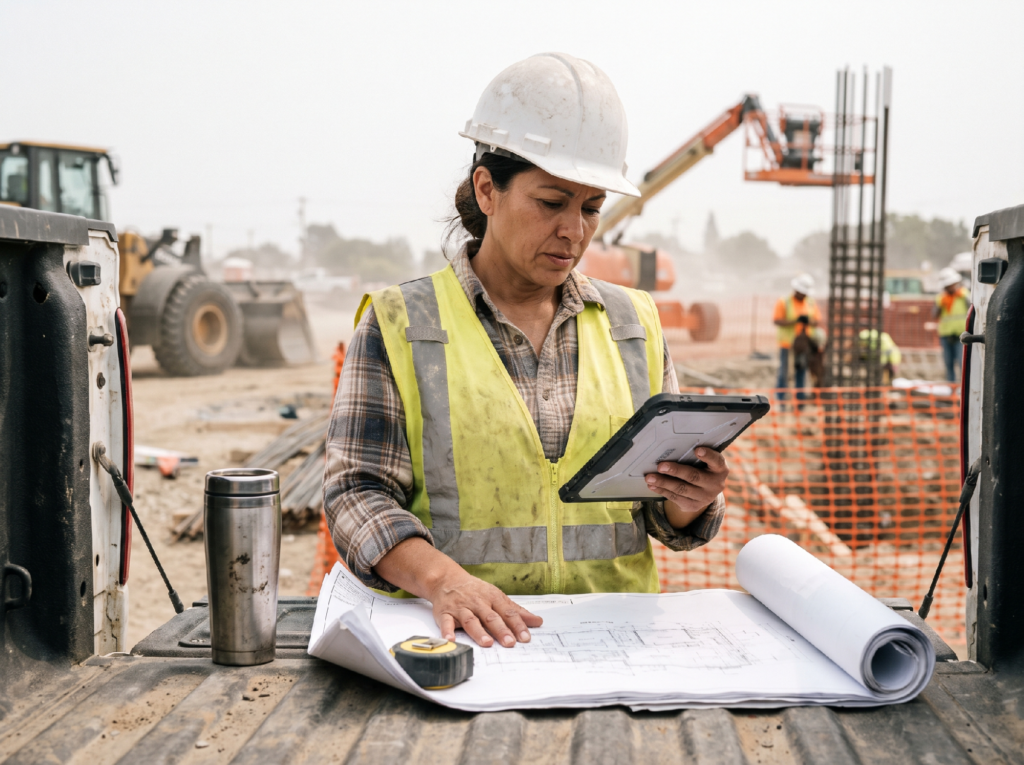
The contractors who avoid costly strikes aren’t the ones with better luck. They’re the ones who schedule verification as a line item in the project timeline, not an afterthought squeezed in the morning equipment mobilizes. That means budgeting a day or two for potholing and scanning before heavy machinery shows up, not after a subcontractor flags a concern on site.
Training matters here too. Operators should know the standard color codes: red for electric, yellow for gas or oil, orange for communications, blue for water, green for sewer. The NAHB’s Trenching and Excavation Toolkit is a useful reference for project managers building this training into onboarding rather than relying on tribal knowledge passed between crews. Pre-emptive site-risk planning, the kind that treats subsurface conditions like any other project variable, is becoming standard practice the same way preparing equipment fleets for site-level risks has become standard for weather exposure.
The Operator’s Role on Site
Verification planning only works if the people running equipment respect the boundaries it sets. Backhoes and excavators cause the largest share of utility damage industry-wide, mostly because operators working in a hurry drift into marked tolerance zones without a spotter confirming clearance. A designated spotter for any dig within two feet of a marked or scanned line isn’t excessive caution; it’s the difference between a normal workday and an afternoon spent waiting on a gas company response crew.
Job-site visibility and safety upgrades play a role too. An operator who can clearly see marking paint and flags in low light or dust is far less likely to miss them than one working with inadequate lighting. Safety culture on a site shows up in small decisions like these long before it shows up in an incident report.
Conclusion
Subsurface verification isn’t a compliance checkbox anymore; it’s a planning-stage cost-control decision with a direct line to the schedule and the budget. As the CGA’s damage index climbs instead of falling, the contractors who come out ahead are the ones who stopped treating “the locate came back clear” as the end of the conversation. Building a verification layer into the timeline, training operators on what the markings mean, and knowing what’s actually inside a slab before equipment gets near it costs far less than finding out the hard way.
What’s Really Under the Slab: Why Subsurface Verification Belongs in Every Pre-Construction Plan published on The HeavyQuip Magazine.