Tower Crane Control Architecture for Jobsite Productivity
Manitowoc introduces the Potain Ergo Control System to streamline tower crane wiring, enhance diagnostics, and improve operational precision across emerging construction markets. www.manitowoc.com Modern construction, energy, and infrastructure projects require high duty-cycle material handling while operating under tight site schedules, which places significant demands on lifting equipment reliability and crane installation speeds. In emerging industrial markets, complex electrical harnesses connecting drives, limiters, and safety sensors often create installation delays, increase susceptibility to signal interference, and prolong troubleshooting during unplanned downtime. Addressing these operational requirements depends on transitioning crane control architectures from point-to-point hardwiring toward modular industrial digital fieldbus communication networks. Industrial Fieldbus Architecture and Signal Routing The Potain Ergo Control System (ECS) replaces traditional multiconductor signal harnesses across next-generation tower cranes with a Controller Area Network (CAN) bus architecture. Rather than routing individual copper wiring pairs between the operator cabin and every discrete limit switch, drive unit, and sensor, the platform consolidates signal transmission onto a two-wire digital serial bus. This topology links a central controller directly to the crane's primary motion drives — including slewing, hoisting, luffing, and trolleying mechanisms — as well as limiters, encoders, and load measurement cells. By reducing overall wiring harness mass and terminating connections at localized control modules, the architecture reduces installation hours during crane erection, lowers electrical failure points in demanding environmental conditions, and permits modular expansion when integrating secondary sensors or functional modules. Operational Telemetry and Human Machine Interface Operating precision and load handling efficiency depend heavily on real-time feedback supplied to the operator. The Potain ECS incorporates an in-cab Human Machine Interface (HMI) built around a 13.3-inch touchscreen display with a native resolution of 1920 x 1080 pixels. Through eight configurable navigation screens, the HMI provides continuous telemetry on dynamic lifting parameters, including hook radius, suspended load mass, slewing angle, and ambient wind velocity. Operators can adjust drive response profiles directly through the interface, tailoring acceleration curves and speed parameters either for fast duty-cycle cycles or fine-positioning operations during delicate placement tasks. The interface also supports active site zoning functions to prevent boundary violations in restricted airspace. Maintenance Diagnostics and Fleet Integration System availability in demanding industrial settings relies on targeted fault detection and historical operational logs. Beyond standard operational readouts, the platform features embedded service diagnostics that identify electrical and mechanical operational irregularities, presenting procedural recovery steps directly to technicians on the display. The onboard system continuously logs operational parameters, duty cycles, and loading trends, generating a verified historical data set accessible to maintenance personnel and fleet administrators. Dedicated technician access modes allow direct calibration of encoders and limiters via software, eliminating manual potentiometer adjustments and reducing commissioning time on site. Manufacturing Rollout and Equipment Integration Manitowoc is deploying the Potain ECS as the standard control and monitoring platform across next-generation tower cranes produced at its regional manufacturing centers in Zhangjiagang, China, and Pune, India. According to Leong Kwong-Joon, regional product manager for tower cranes in Asia, the platform consolidates operator controls, service diagnostic routines, and fleet telemetry into a single architecture suited for expanding energy and infrastructure sectors. The initial commercial tower crane model equipped with the serial-bus ECS platform is scheduled for deployment within the current production cycle. Additional Context This section details technical specifications and competitive benchmarking not included in the original product announcement. Digital serial communication architectures have become standard in premium global lifting machinery, governed largely by international standards such as ISO 11898 for road vehicles and mobile machinery CAN communications, as well as EN 14439 covering crane safety. Historically, manufacturers operating in value-oriented emerging markets relied heavily on conventional relay logic or direct hardwired 4–20 mA analogue and discrete digital connections to control variable frequency drives (VFDs) and collect sensor inputs. In premium applications, comparable platforms — such as Liebherr's Litronic control system with Tower Crane OS or Wolffkran's Wolff Boost/electr
 machineryasia
Manitowoc introduces the Potain Ergo Control System to streamline tower crane wiring, enhance diagnostics, and improve operational precision across emerging construction markets.
www.manitowoc.com
Modern construction, energy, and infrastructure projects require high duty-cycle material handling while operating under tight site schedules, which places significant demands on lifting equipment reliability and crane installation speeds. In emerging industrial markets, complex electrical harnesses connecting drives, limiters, and safety sensors often create installation delays, increase susceptibility to signal interference, and prolong troubleshooting during unplanned downtime. Addressing these operational requirements depends on transitioning crane control architectures from point-to-point hardwiring toward modular industrial digital fieldbus communication networks.
Industrial Fieldbus Architecture and Signal Routing
The Potain Ergo Control System (ECS) replaces traditional multiconductor signal harnesses across next-generation tower cranes with a Controller Area Network (CAN) bus architecture. Rather than routing individual copper wiring pairs between the operator cabin and every discrete limit switch, drive unit, and sensor, the platform consolidates signal transmission onto a two-wire digital serial bus.
This topology links a central controller directly to the crane's primary motion drives — including slewing, hoisting, luffing, and trolleying mechanisms — as well as limiters, encoders, and load measurement cells. By reducing overall wiring harness mass and terminating connections at localized control modules, the architecture reduces installation hours during crane erection, lowers electrical failure points in demanding environmental conditions, and permits modular expansion when integrating secondary sensors or functional modules.
Operational Telemetry and Human Machine Interface
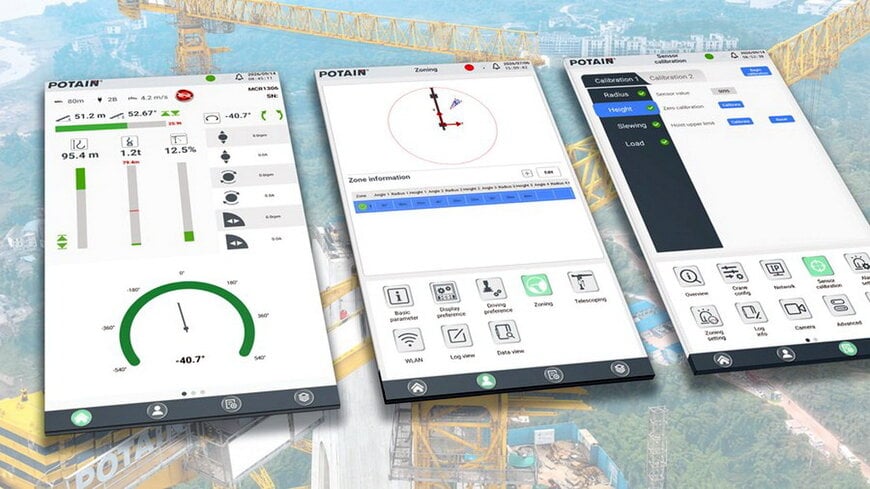
Operating precision and load handling efficiency depend heavily on real-time feedback supplied to the operator. The Potain ECS incorporates an in-cab Human Machine Interface (HMI) built around a 13.3-inch touchscreen display with a native resolution of 1920 x 1080 pixels.
Through eight configurable navigation screens, the HMI provides continuous telemetry on dynamic lifting parameters, including hook radius, suspended load mass, slewing angle, and ambient wind velocity. Operators can adjust drive response profiles directly through the interface, tailoring acceleration curves and speed parameters either for fast duty-cycle cycles or fine-positioning operations during delicate placement tasks. The interface also supports active site zoning functions to prevent boundary violations in restricted airspace.
Maintenance Diagnostics and Fleet Integration
System availability in demanding industrial settings relies on targeted fault detection and historical operational logs. Beyond standard operational readouts, the platform features embedded service diagnostics that identify electrical and mechanical operational irregularities, presenting procedural recovery steps directly to technicians on the display.
The onboard system continuously logs operational parameters, duty cycles, and loading trends, generating a verified historical data set accessible to maintenance personnel and fleet administrators. Dedicated technician access modes allow direct calibration of encoders and limiters via software, eliminating manual potentiometer adjustments and reducing commissioning time on site.
Manufacturing Rollout and Equipment Integration
Manitowoc is deploying the Potain ECS as the standard control and monitoring platform across next-generation tower cranes produced at its regional manufacturing centers in Zhangjiagang, China, and Pune, India.
According to Leong Kwong-Joon, regional product manager for tower cranes in Asia, the platform consolidates operator controls, service diagnostic routines, and fleet telemetry into a single architecture suited for expanding energy and infrastructure sectors. The initial commercial tower crane model equipped with the serial-bus ECS platform is scheduled for deployment within the current production cycle.
Additional Context
This section details technical specifications and competitive benchmarking not included in the original product announcement.
Digital serial communication architectures have become standard in premium global lifting machinery, governed largely by international standards such as ISO 11898 for road vehicles and mobile machinery CAN communications, as well as EN 14439 covering crane safety. Historically, manufacturers operating in value-oriented emerging markets relied heavily on conventional relay logic or direct hardwired 4–20 mA analogue and discrete digital connections to control variable frequency drives (VFDs) and collect sensor inputs.
In premium applications, comparable platforms — such as Liebherr's Litronic control system with Tower Crane OS or Wolffkran's Wolff Boost/electronic control architectures — utilize centralized fieldbus backbones (CANopen or industrial Ethernet variants) coupled with high-resolution graphical interfaces. These architectures deliver diagnostic resolution, load-curve adjustments, and zoning capabilities similar to the Potain ECS.
The migration of 1080p capacitive touch HMIs and two-wire CAN bus frameworks into manufacturing hubs in China and India signals a structural shift: regional manufacturers are harmonizing core control architectures between developing and mature markets to support standardized telematics, automated anti-collision zoning, and predictive fleet maintenance workflows.
Edited by Evgeny Churilov, Induportals Media - Adapted by AI.
www.manitowoc.com
Powered by
Induportals Media Publishing