Mobile Crane Enables Long-Reach Urban Antenna Replacement
SCHOLPP Kran & Transport used a mobile construction crane to replace rooftop communications equipment while limiting cost, noise and disruption in central Mannheim. www.liebherr.com Application area: Rooftop mobile communications equipment replacement, urban lifting operations Industry sector: Crane and heavy-lift services, telecommunications infrastructure, construction Replacing rooftop telecommunications equipment in a dense city centre creates a combination of lifting, access and environmental constraints. SCHOLPP Kran & Transport GmbH faced these conditions when replacing a mobile communications system on an extension of the Rosengarten Congress Centre in Mannheim, Germany. The equipment was located at a considerable horizontal distance from the crane position, requiring a lifting solution capable of reaching more than 64 metres while operating close to buildings. At the same time, events at the congress centre and activities at surrounding hotels had to continue with minimal disturbance. Long Reach Creates an Equipment Selection Challenge The Rosengarten Mannheim is a major conference and event venue located opposite the city’s water tower. Its combination of historic Art Nouveau architecture, modern extensions and surrounding urban development places restrictions on the positioning and operation of heavy lifting equipment. For the antenna replacement, SCHOLPP needed to reach equipment installed on the roof of an extension from a suitable crane setup position at ground level. A conventional large mobile crane was technically possible. According to SCHOLPP, however, achieving the required working radius would have required a crane in the 350-tonne class equipped with a luffing jib. This would have increased the equipment requirements and cost of the operation. “For this job, I opted for the MK 140-5.1 mobile construction crane. Alternatively, a 350-tonne mobile crane could have been used, but to achieve the required reach, we would have had to fit a luffing jib. This solution would have been considerably more expensive for our client,” said Florian Schmid, branch manager at SCHOLPP in Mannheim. Mobile Construction Crane Selected for Reach and Flexibility SCHOLPP instead deployed Liebherr’s MK 140-5.1E, a five-axle mobile construction crane designed to combine the mobility of a road-going crane with the working geometry of a tower crane. For the Mannheim operation, the crane worked in luffing jib mode and used its full 13.3-tonne counterweight. The mobile communications equipment was handled at a working radius of 64.2 metres. The crane’s Vario Jib system was relevant to the application because it allows the boom configuration to be changed from trolley jib operation to luffing jib operation. The latter provides additional working height and enables the boom angle to be adjusted when operating around buildings and other obstacles. In this configuration, the crane can achieve a hook height of up to 94.4 metres and a maximum reach of 65 metres, with a one-tonne capacity at the jib tip. This combination allowed SCHOLPP to perform the rooftop lift without moving to the substantially larger mobile crane configuration considered as an alternative. Electric Operation Reduces Urban Noise Noise was another operational consideration because the lift took place next to an active congress centre and hotels. The crane therefore operated electrically during the lifting work. Its crane functions, including the drives and winches, can run on electrical power, reducing operating noise and eliminating local exhaust emissions from crane operation. This allowed events at the Rosengarten and normal activities in surrounding buildings to continue without the level of engine noise associated with conventional crane operation. Electric crane operation was therefore not simply an environmental feature of the equipment but addressed a specific requirement of the urban lifting application. Crane Geometry Supports Work Near Buildings The crane's vertical telescopic tower also helped accommodate the restricted working environment. Combined with adjustable boom angles, this configuration enables loads to be handled over or around buildings without requiring the same ground footprint and boom arrangement as some larger conventional mobile crane configurations. The height-adjustable operator cab provided a direct view toward the working area, supporting load positioning during the long-reach rooftop operation. Rapid setup was another factor in the deployment. The mobile construction crane is designed to travel as an integrated unit and can be prepared for lifting without the extensive assembly associated with larger crane and jib combinations. A 64.2-Metre Reach Without Moving to a Larger Crane Class The operation demonstrated that the required rooftop communications equipment replacement could be completed at a 64.2-metre working radius using a five-axle mobile construction crane. The principal operational bene
 machineryasia
SCHOLPP Kran & Transport used a mobile construction crane to replace rooftop communications equipment while limiting cost, noise and disruption in central Mannheim.
www.liebherr.com
Application area: Rooftop mobile communications equipment replacement, urban lifting operations
Industry sector: Crane and heavy-lift services, telecommunications infrastructure, construction
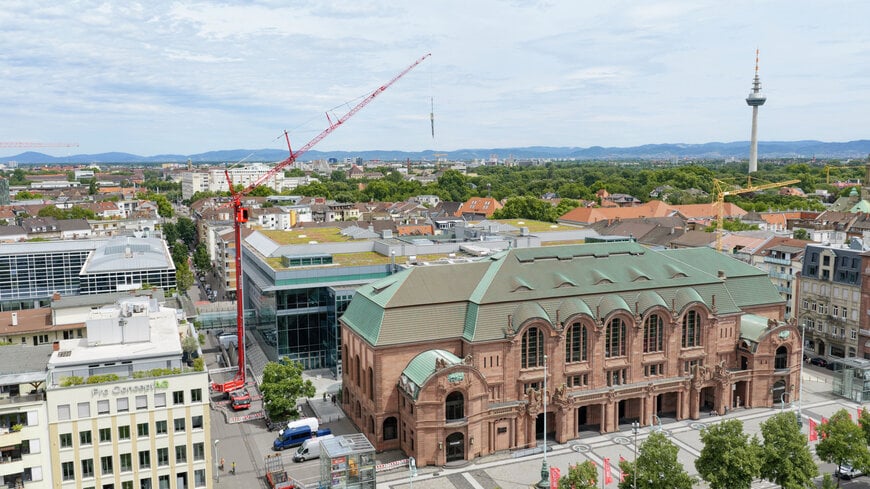
Replacing rooftop telecommunications equipment in a dense city centre creates a combination of lifting, access and environmental constraints. SCHOLPP Kran & Transport GmbH faced these conditions when replacing a mobile communications system on an extension of the Rosengarten Congress Centre in Mannheim, Germany.
The equipment was located at a considerable horizontal distance from the crane position, requiring a lifting solution capable of reaching more than 64 metres while operating close to buildings. At the same time, events at the congress centre and activities at surrounding hotels had to continue with minimal disturbance.
Long Reach Creates an Equipment Selection Challenge
The Rosengarten Mannheim is a major conference and event venue located opposite the city’s water tower. Its combination of historic Art Nouveau architecture, modern extensions and surrounding urban development places restrictions on the positioning and operation of heavy lifting equipment.
For the antenna replacement, SCHOLPP needed to reach equipment installed on the roof of an extension from a suitable crane setup position at ground level.
A conventional large mobile crane was technically possible. According to SCHOLPP, however, achieving the required working radius would have required a crane in the 350-tonne class equipped with a luffing jib.
This would have increased the equipment requirements and cost of the operation.
“For this job, I opted for the MK 140-5.1 mobile construction crane. Alternatively, a 350-tonne mobile crane could have been used, but to achieve the required reach, we would have had to fit a luffing jib. This solution would have been considerably more expensive for our client,” said Florian Schmid, branch manager at SCHOLPP in Mannheim.
Mobile Construction Crane Selected for Reach and Flexibility
SCHOLPP instead deployed Liebherr’s MK 140-5.1E, a five-axle mobile construction crane designed to combine the mobility of a road-going crane with the working geometry of a tower crane.
For the Mannheim operation, the crane worked in luffing jib mode and used its full 13.3-tonne counterweight. The mobile communications equipment was handled at a working radius of 64.2 metres.
The crane’s Vario Jib system was relevant to the application because it allows the boom configuration to be changed from trolley jib operation to luffing jib operation. The latter provides additional working height and enables the boom angle to be adjusted when operating around buildings and other obstacles.
In this configuration, the crane can achieve a hook height of up to 94.4 metres and a maximum reach of 65 metres, with a one-tonne capacity at the jib tip.
This combination allowed SCHOLPP to perform the rooftop lift without moving to the substantially larger mobile crane configuration considered as an alternative.
Electric Operation Reduces Urban Noise
Noise was another operational consideration because the lift took place next to an active congress centre and hotels.
The crane therefore operated electrically during the lifting work. Its crane functions, including the drives and winches, can run on electrical power, reducing operating noise and eliminating local exhaust emissions from crane operation.
This allowed events at the Rosengarten and normal activities in surrounding buildings to continue without the level of engine noise associated with conventional crane operation.
Electric crane operation was therefore not simply an environmental feature of the equipment but addressed a specific requirement of the urban lifting application.
Crane Geometry Supports Work Near Buildings
The crane's vertical telescopic tower also helped accommodate the restricted working environment. Combined with adjustable boom angles, this configuration enables loads to be handled over or around buildings without requiring the same ground footprint and boom arrangement as some larger conventional mobile crane configurations.
The height-adjustable operator cab provided a direct view toward the working area, supporting load positioning during the long-reach rooftop operation.
Rapid setup was another factor in the deployment. The mobile construction crane is designed to travel as an integrated unit and can be prepared for lifting without the extensive assembly associated with larger crane and jib combinations.
A 64.2-Metre Reach Without Moving to a Larger Crane Class
The operation demonstrated that the required rooftop communications equipment replacement could be completed at a 64.2-metre working radius using a five-axle mobile construction crane.
The principal operational benefit was avoiding the alternative 350-tonne mobile crane and additional luffing jib configuration identified by SCHOLPP. Although the company did not disclose the resulting financial savings, reducing the crane size and auxiliary configuration requirements lowered the equipment complexity associated with the lift.
Electric operation simultaneously reduced noise around the active congress centre and nearby hotels, while the luffing jib configuration provided the reach and working geometry required for the rooftop installation.
For urban telecommunications infrastructure work, the Mannheim project illustrates how crane selection based on working radius, boom geometry, setup requirements and operating noise can reduce the resources required for technically demanding lifts in densely built environments.
Edited by Sucithra Mani, Induportals editor – adapted by AI.
www.liebherr.com
Powered by
Induportals Media Publishing