Conexpo 2026: Moog’s AEMS Bets on Standardized Electrification for OEMs
The centrepiece was its Adaptive Electrification Management System (AEMS), a modular electronics platform that packages the functions OEMs usually assemble from multiple suppliers. In Moog’s layout, the stack integrates a configurable controller, DC/DC conversion, high-voltage distribution, and single- and dual-axis inverters in a compact “bookshelf-style” package. The system scales by adding modules. Moog describes it […] Conexpo 2026: Moog’s AEMS Bets on Standardized Electrification for OEMs published on The HeavyQuip Magazine.
 machineryasia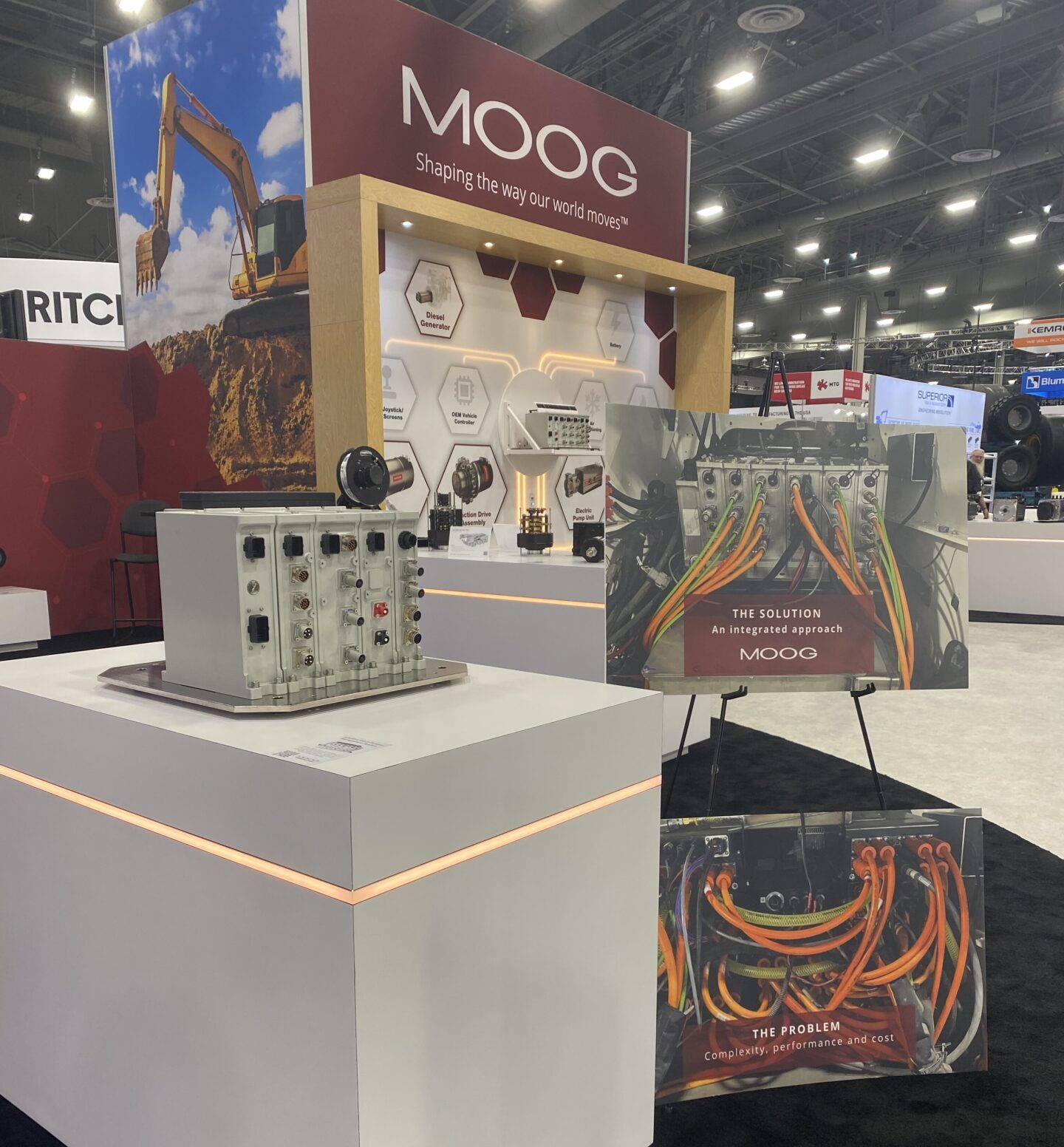
The centrepiece was its Adaptive Electrification Management System (AEMS), a modular electronics platform that packages the functions OEMs usually assemble from multiple suppliers. In Moog’s layout, the stack integrates a configurable controller, DC/DC conversion, high-voltage distribution, and single- and dual-axis inverters in a compact “bookshelf-style” package.
The system scales by adding modules. Moog describes it in “axes”: more motors and functions simply require more inverter capacity and control boxes, rather than a fresh architecture each time. The practical promise is supply-chain simplicity: one standardised module part number that can be reused across different machine classes, reducing part-number proliferation and inventory variation.
Moog also leaned on a manufacturing argument, not just an engineering one. AEMS is built around a high-voltage busbar and a shared coolant manifold, which the company says can reduce the number of cables and hoses by 30%. Less cabling and fewer hose runs are positioned as a direct win for assembly repeatability and service access, with faulty modules intended to be swapped on site rather than repaired through long troubleshooting cycles.
Prototype work was part of the credibility layer. Industry coverage links AEMS with Bobcat’s RogueX3 concept machine, and Moog has cited earlier integrations across other electric concept platforms as well.
From your material, Moog’s stance on the market is blunt: production programs first. Aftermarket and low-volume speciality builds can be supported, but the business case Moog is chasing is OEM production scale because that is where system costs come down, and architectures can be standardised across product lines. (Attributed to the remarks in the transcript you provided.)
Two other points stood out in the technical narrative you shared. First, the emphasis on being power-source agnostic, designed to tolerate different power-management strategies, because electrification in off-highway is not converging on one single recipe. Second, a pragmatic view of actuation: electromechanical actuators have a clearer near-term place in smaller machines and in leak-free or automation-driven applications, while hydraulics are not expected to disappear from larger equipment where weight and cost penalties stack up fast. (Attributed to the remarks in the transcript you provided.)
Moog’s CONEXPO message, stripped to its essentials, was simple: electrification does not scale if every new machine becomes a custom electronics project. AEMS is Moog’s attempt to turn electrification into a repeatable module strategy.
Conexpo 2026: Moog’s AEMS Bets on Standardized Electrification for OEMs published on The HeavyQuip Magazine.