Volunteers, Four Compact Cranes and a 70-Metre Bridge: THW Spans the Danube Ahead of Schedule
Germany's THW used four Liebherr LTC 1050-3.1 compact cranes to build a 70 m temporary Danube bridge in Tuttlingen, five days ahead of schedule. Volunteers, Four Compact Cranes and a 70-Metre Bridge: THW Spans the Danube Ahead of Schedule published on The HeavyQuip Magazine.
 machineryasia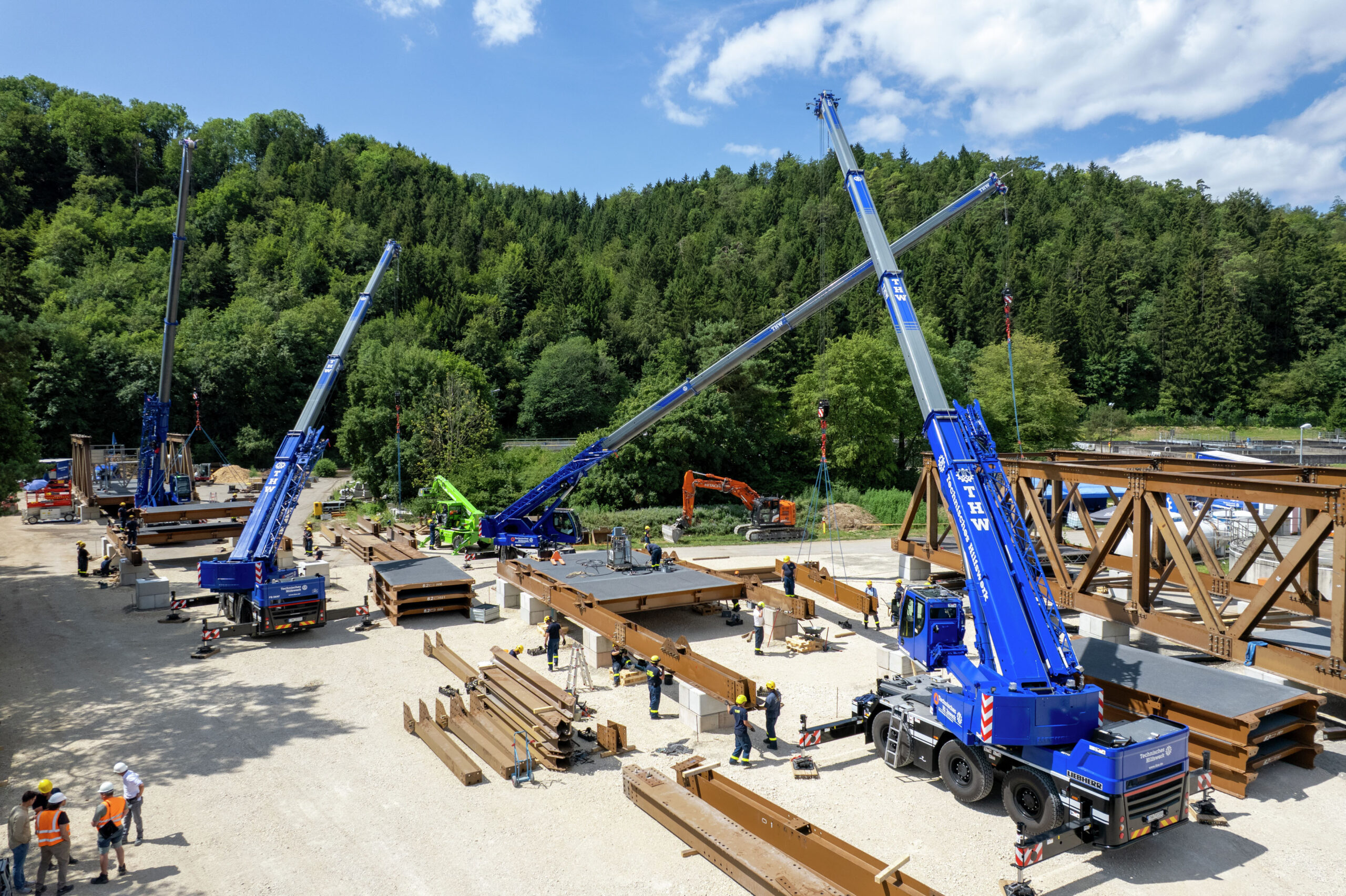
Germany’s civil protection agency used Liebherr LTC 1050-3.1 cranes to build its largest column-free temporary bridge yet
In Tuttlingen, in southern Germany, a Danube bridge is due for demolition. Before it comes down, traffic needs another way across the river. The temporary replacement, a 70 m steel truss bridge that will stay in service for two years while the new bridge is built, has been put up by the Federal Agency for Technical Relief (THW) as part of a civil defence exercise.
It is the largest column-free heavy-duty bridge the THW has ever erected, and the key tools were four Liebherr LTC 1050-3.1 compact cranes. In just two weeks, THW crews pre-assembled the structure from hundreds of individual parts and moved it into position on the river.
Working in a crowded yard
The pre-assembly area was the main constraint. The cranes shared it with stored materials, lorries, forklifts, telehandlers and aerial work platforms. To gain manoeuvrability, THW removed the front box, normally used for storage, from some of the cranes, cutting vehicle length to 10.35 m.
The four cranes assembled four bridge segments, each weighing around 100 t. These were then moved several hundred metres to the river, joined into one continuous structure and pushed roughly halfway across the Danube. For the final lift, two Liebherr LTM 1650-8.1 mobile cranes from MSG Krandienst and Scholpp Kran & Transport worked in tandem from both banks to set the structure onto its abutments.
The value of a raised cab
All the THW’s LTC 1050-3.1s are fitted with the optional height-adjustable cab, which can rise to seven metres. “Especially when building bridges, the height-adjustable cab is simply unbeatable for me,” said Niklas Stein, who operated one of the cranes for a week. “Particularly when assembling the upper steel sections, having a direct view of my colleagues from a height of seven metres is, of course, a major safety benefit.”
Stein belongs to one of 16 volunteer groups specialising in bridge construction that the THW maintains across Germany. They build temporary bridges regularly to keep their skills current.
A fleet decision that is paying off
Two years ago the THW took delivery of the first of 18 LTC 1050-3.1 cranes from Liebherr’s Ehingen plant. Before that, it relied mostly on its own loader cranes for this kind of work.
“With the new Liebherr LTC 1050-3.1s, we are now in a much stronger position and can complete projects such as this temporary bridge in less time,” said Patrick Weisser, the engineer who coordinated the operation with Fiona Mager, head of the THW Müllheim bridge construction group. “Here in Tuttlingen, we were even five days ahead of schedule.”
For public agencies and contractors alike, the project is a practical case for compact cranes on congested sites: enough capacity for steel structures, in a footprint that fits between everything else.
Volunteers, Four Compact Cranes and a 70-Metre Bridge: THW Spans the Danube Ahead of Schedule published on The HeavyQuip Magazine.