Tadano Introduces Powerful Electric V320RC Pick And Carry Crane Globally
Delivering thirty-five tonnes of zero-emission lifting capacity, this compact machine combines multi-day battery autonomy with advanced precision hydraulics for modern confined industrial jobsites. www.tadano.com Confined manufacturing facilities, historical halls, and process plants frequently require heavy machinery installation and component repositioning where overhead bridge cranes cannot reach and conventional mobile cranes cannot fit. Heavy industrial lifting in enclosed spaces demands zero exhaust emissions, low acoustic footprints, and strict adherence to structural floor-loading limits. Engineering Architecture and Electro-Hydraulic Powertrain To resolve the trade-off between physical envelope and payload, Tadano developed the V320RC in engineering cooperation with industrial lifting specialist NMG Italia. Built with an overall length of 5,000 mm, a width of 2,150 mm, and an overhead clearance height of 2,400 mm, the unit achieves a maximum lifting capacity of 35 tonnes. Total gross vehicle weight stands at 31,150 kg, which includes 9,500 kg of modular, removable counterweights configured for rapid axle-load adaptation during transit and site staging. The powertrain utilizes a 120 V, 1,120 Ah lead-acid battery system, with an optional lithium-ion chemistry package for facilities requiring fast-charging cycles or prolonged shift work. Energy efficiency is governed by an electro-hydraulic architecture that incorporates a variable-displacement hydraulic pump managed via high-end proportional electro-hydraulic control valves. In traditional pick and carry machinery, fixed-displacement pumps continuously route surplus fluid over relief valves, generating thermal losses and rapidly depleting battery reserves. The variable-displacement system throttles hydraulic output strictly to real-time flow demand, stabilizing working pressures while lowering energy consumption per lifting cycle. Digital control software maps operator joystick inputs directly to valve spools, eliminating mechanical deadband and enabling millimeter-level creep speed under maximum load. Structural Protection and Real-Time Telemetry Operating high-capacity machinery across elevated factory floors, suspended slabs, or paved surfaces requires continuous verification of ground bearing capacity. The crane integrates the patented Ground Pressure Selection System (GPSS), which monitors individual wheel loads in real time through dedicated pressure transducers. If surface bearing stress approaches predetermined structural threshold limits, the onboard control unit emits active operational alerts to prevent point overloading and slab damage. Rigidity during load handling is maintained by a fully hydraulic telescopic boom that replaces internal mechanical extension cables, sheaves, and chains with multi-stage hydraulic cylinders. Eliminating internal mechanical linkage cables mitigates stretch wear, reduces mandatory inspection intervals, and removes structural compliance during high-inertia maneuvers. Operator control interfaces include a cab-operated arrangement and an industrial radio-remote variant engineered to provide unobstructed sightlines during tight installations. Automated sensor arrays automatically register the active counterweight mass and attached lifting equipment, projecting verified dynamic load charts directly onto an onboard 10-inch digital interface. Field Validation in Heavy Process Industries The crane underwent operational testing during machine setup and dismantling activities at the Marmomac trade fair in Verona, Italy. Handling dense natural stone blocks and tooling under constrained exhibition hall clearances validated the low-speed electro-hydraulic control loop. During field operations conducted by NMG Italia, the variable-displacement architecture delivered up to a 50 percent measured productivity gain relative to baseline cranes handling equivalent payloads, maintaining multi-day operational autonomy on a single charge cycle without thermal throttling. Additional Context This section details technical specifications and competitive benchmarking not included in the original product announcement. Heavy industrial pick and carry operations in European and North American manufacturing environments have historically relied on compact diesel cranes or retrofitted counterbalanced warehouse units. Modern machinery moving within semiconductor cleanrooms, automotive stamping facilities, and pharmaceutical plants is increasingly governed by stringent indoor air quality regulations, driving the adoption of zero-emission machinery designed under EN 13000 safety standards. Within the 30-to-45-tonne electric industrial crane segment, engineering benchmarks are established by specialized European manufacturers such as JMG Cranes (notably the MC 350 and MC 580 series) and Ormig (such as the 35iE). Comparable machines typically operate on 80 V to 96 V electrical architectures utilizing dual electric traction motors co
 machineryasia

Delivering thirty-five tonnes of zero-emission lifting capacity, this compact machine combines multi-day battery autonomy with advanced precision hydraulics for modern confined industrial jobsites.
www.tadano.com
Confined manufacturing facilities, historical halls, and process plants frequently require heavy machinery installation and component repositioning where overhead bridge cranes cannot reach and conventional mobile cranes cannot fit. Heavy industrial lifting in enclosed spaces demands zero exhaust emissions, low acoustic footprints, and strict adherence to structural floor-loading limits.
Engineering Architecture and Electro-Hydraulic Powertrain
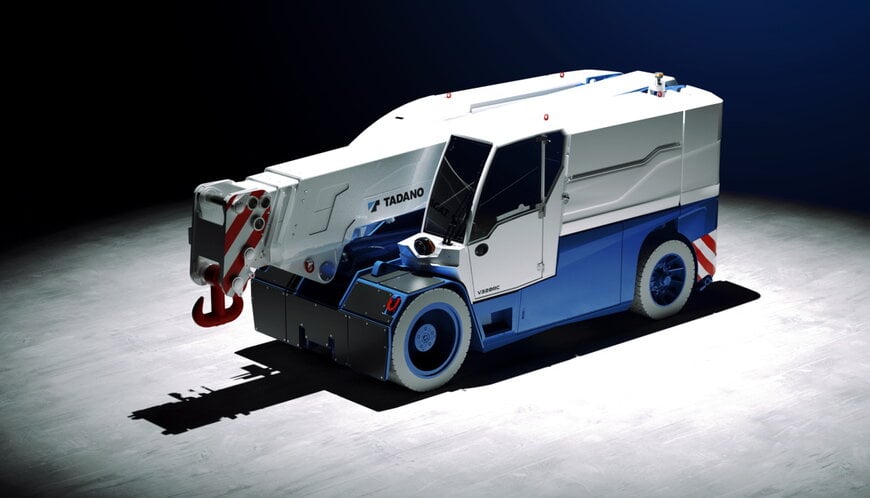
To resolve the trade-off between physical envelope and payload, Tadano developed the V320RC in engineering cooperation with industrial lifting specialist NMG Italia. Built with an overall length of 5,000 mm, a width of 2,150 mm, and an overhead clearance height of 2,400 mm, the unit achieves a maximum lifting capacity of 35 tonnes. Total gross vehicle weight stands at 31,150 kg, which includes 9,500 kg of modular, removable counterweights configured for rapid axle-load adaptation during transit and site staging.
The powertrain utilizes a 120 V, 1,120 Ah lead-acid battery system, with an optional lithium-ion chemistry package for facilities requiring fast-charging cycles or prolonged shift work. Energy efficiency is governed by an electro-hydraulic architecture that incorporates a variable-displacement hydraulic pump managed via high-end proportional electro-hydraulic control valves.
In traditional pick and carry machinery, fixed-displacement pumps continuously route surplus fluid over relief valves, generating thermal losses and rapidly depleting battery reserves. The variable-displacement system throttles hydraulic output strictly to real-time flow demand, stabilizing working pressures while lowering energy consumption per lifting cycle. Digital control software maps operator joystick inputs directly to valve spools, eliminating mechanical deadband and enabling millimeter-level creep speed under maximum load.
Structural Protection and Real-Time Telemetry
Operating high-capacity machinery across elevated factory floors, suspended slabs, or paved surfaces requires continuous verification of ground bearing capacity. The crane integrates the patented Ground Pressure Selection System (GPSS), which monitors individual wheel loads in real time through dedicated pressure transducers. If surface bearing stress approaches predetermined structural threshold limits, the onboard control unit emits active operational alerts to prevent point overloading and slab damage.
Rigidity during load handling is maintained by a fully hydraulic telescopic boom that replaces internal mechanical extension cables, sheaves, and chains with multi-stage hydraulic cylinders. Eliminating internal mechanical linkage cables mitigates stretch wear, reduces mandatory inspection intervals, and removes structural compliance during high-inertia maneuvers.
Operator control interfaces include a cab-operated arrangement and an industrial radio-remote variant engineered to provide unobstructed sightlines during tight installations. Automated sensor arrays automatically register the active counterweight mass and attached lifting equipment, projecting verified dynamic load charts directly onto an onboard 10-inch digital interface.
Field Validation in Heavy Process Industries
The crane underwent operational testing during machine setup and dismantling activities at the Marmomac trade fair in Verona, Italy. Handling dense natural stone blocks and tooling under constrained exhibition hall clearances validated the low-speed electro-hydraulic control loop. During field operations conducted by NMG Italia, the variable-displacement architecture delivered up to a 50 percent measured productivity gain relative to baseline cranes handling equivalent payloads, maintaining multi-day operational autonomy on a single charge cycle without thermal throttling.
Additional Context
This section details technical specifications and competitive benchmarking not included in the original product announcement.
Heavy industrial pick and carry operations in European and North American manufacturing environments have historically relied on compact diesel cranes or retrofitted counterbalanced warehouse units. Modern machinery moving within semiconductor cleanrooms, automotive stamping facilities, and pharmaceutical plants is increasingly governed by stringent indoor air quality regulations, driving the adoption of zero-emission machinery designed under EN 13000 safety standards.
Within the 30-to-45-tonne electric industrial crane segment, engineering benchmarks are established by specialized European manufacturers such as JMG Cranes (notably the MC 350 and MC 580 series) and Ormig (such as the 35iE). Comparable machines typically operate on 80 V to 96 V electrical architectures utilizing dual electric traction motors combined with proportional load-sensing hydraulic circuits.
Tadano's integration of a 120 V platform and a dedicated variable-displacement pump represents a technical departure toward higher electrical system efficiency, minimizing I²R thermal resistance losses in cables and controllers under maximum torque conditions. Furthermore, while conventional equipment relies on post-lift ground pressure calculations derived from external load indicators, integrated dynamic monitoring like the GPSS mechanism directly addresses indoor civil infrastructure limitations by embedding active floor protection into the control software.
Edited by Evgeny Churilov, Induportals Media - Adapted by AI.
www.tadano.com
Powered by
Induportals Media Publishing