Liebherr crane supports heavy lifting in wind energy
Sommer Kranverleih expands its fleet with an 800-tonne mobile crane for wind turbine installation and industrial lifting projects. www.liebherr.com Demand for high-capacity mobile cranes is increasing in wind energy construction, industrial maintenance, and infrastructure projects where heavy components must be installed with limited setup time. In this context, Sommer Kranverleih GmbH added another Liebherr LTM 1750-9.1 mobile crane to its heavy-lift fleet. Fleet expansion focused on heavy lifting applications With the latest delivery, the Bremen-based crane rental company operates five LTM 1750-9.1 cranes and one LTM 1650-8.1, reflecting a fleet strategy focused on the heavy-duty crane segment. An additional LTM 1650-8.1 is scheduled to join the fleet. The company, founded in 1959 and managed by the third generation of the Sommer family, operates around 30 mobile cranes with lifting capacities ranging from 40 to 800 tonnes. While smaller units operate mainly around Bremen, the heavy-duty cranes are deployed across Germany. Transportable boom concept reduces mobilisation time The nine-axle LTM 1750-9.1 is designed so that its complete telescopic boom can be transported on public roads, reducing logistical complexity during mobilisation. The crane configuration also supports relatively short setup times compared with heavy lattice boom alternatives, supporting project timelines in sectors such as renewable energy and infrastructure construction. The crane’s lifting capacity of 800 tonnes allows it to support installation work on modern wind turbines. Typical applications include positioning lower concrete tower sections, while upper tower segments, nacelles, and rotor assemblies are typically installed using larger lattice boom cranes. Wind energy maintenance and repowering operations Beyond new installations, the crane is also used for maintenance tasks such as component replacement and repair work on existing wind turbines. These applications include repowering projects, where older turbines are dismantled and replaced with higher-capacity units. Additional deployment areas include industrial plant work, chemical sector lifting operations, and bridge construction projects. The newly delivered crane is scheduled to begin operations with a tandem lift alongside another LTM 1750-9.1 from the same fleet. Long-term fleet strategy and equipment mix Sommer Kranverleih maintains a mixed fleet of mobile and specialised cranes to address different lifting scenarios. In addition to heavy-duty models, the company operates cranes such as the Liebherr LTC 1050-3.1 compact crane, the LTR 1100 telescopic crawler crane, and the MK 88 Plus and MK 120-5.1 mobile construction cranes. Edited by industrial journalist Aishwarya Mambet, with AI-assistance. www.liebherr.com Powered by Induportals Media Publishing
 machineryasia
Sommer Kranverleih expands its fleet with an 800-tonne mobile crane for wind turbine installation and industrial lifting projects.
www.liebherr.com
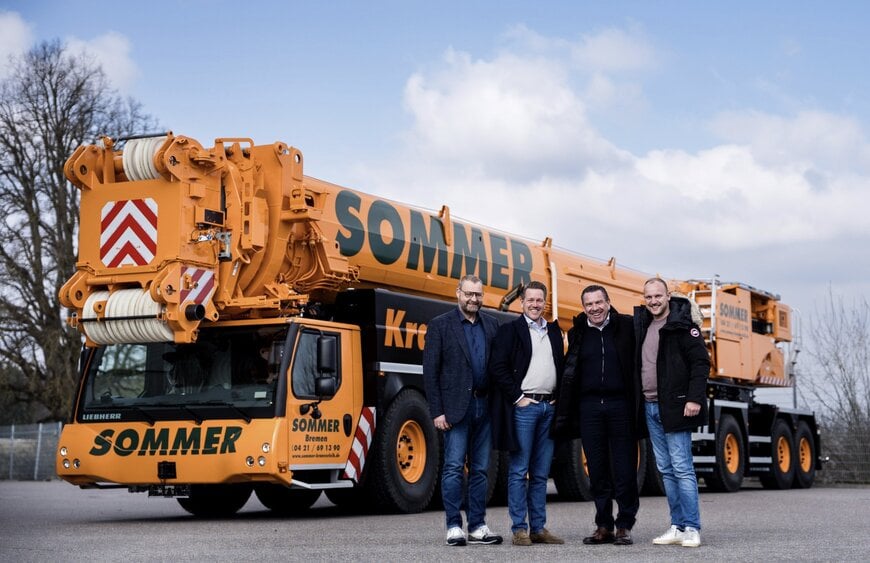
Demand for high-capacity mobile cranes is increasing in wind energy construction, industrial maintenance, and infrastructure projects where heavy components must be installed with limited setup time. In this context, Sommer Kranverleih GmbH added another Liebherr LTM 1750-9.1 mobile crane to its heavy-lift fleet.
Fleet expansion focused on heavy lifting applications
With the latest delivery, the Bremen-based crane rental company operates five LTM 1750-9.1 cranes and one LTM 1650-8.1, reflecting a fleet strategy focused on the heavy-duty crane segment. An additional LTM 1650-8.1 is scheduled to join the fleet.
The company, founded in 1959 and managed by the third generation of the Sommer family, operates around 30 mobile cranes with lifting capacities ranging from 40 to 800 tonnes. While smaller units operate mainly around Bremen, the heavy-duty cranes are deployed across Germany.
Transportable boom concept reduces mobilisation time
The nine-axle LTM 1750-9.1 is designed so that its complete telescopic boom can be transported on public roads, reducing logistical complexity during mobilisation. The crane configuration also supports relatively short setup times compared with heavy lattice boom alternatives, supporting project timelines in sectors such as renewable energy and infrastructure construction.
The crane’s lifting capacity of 800 tonnes allows it to support installation work on modern wind turbines. Typical applications include positioning lower concrete tower sections, while upper tower segments, nacelles, and rotor assemblies are typically installed using larger lattice boom cranes.
Wind energy maintenance and repowering operations
Beyond new installations, the crane is also used for maintenance tasks such as component replacement and repair work on existing wind turbines. These applications include repowering projects, where older turbines are dismantled and replaced with higher-capacity units.
Additional deployment areas include industrial plant work, chemical sector lifting operations, and bridge construction projects. The newly delivered crane is scheduled to begin operations with a tandem lift alongside another LTM 1750-9.1 from the same fleet.
Long-term fleet strategy and equipment mix
Sommer Kranverleih maintains a mixed fleet of mobile and specialised cranes to address different lifting scenarios. In addition to heavy-duty models, the company operates cranes such as the Liebherr LTC 1050-3.1 compact crane, the LTR 1100 telescopic crawler crane, and the MK 88 Plus and MK 120-5.1 mobile construction cranes.
Edited by industrial journalist Aishwarya Mambet, with AI-assistance.
www.liebherr.com
Powered by
Induportals Media Publishing