John Deere Launches Highly Efficient X-Tier Wheel Loaders Globally
The new 844 and 904 X-Tier machines feature an advanced electric variable transmission, improving fuel efficiency, productivity, and jobsite visibility for high-production environments. www.deere.com The integration of electrified drivetrains into heavy earthmoving equipment addresses the dual challenges of reducing operating costs and maximizing hourly material throughput in high-volume industrial applications. In sectors such as aggregate processing, quarrying, and large-scale infrastructure development, bulk material rehandling requires continuous high-torque performance. The introduction of the John Deere 844 and 904 X-Tier wheel loaders implements an alternative to conventional mechanical or hydrodynamic drivetrains by utilizing electronic power management to decouple engine speed from hydraulic capacity. Electric Variable Transmission Architecture and Operational Efficiency The primary technological advancement in these production-class wheel loaders is the Electric Variable Transmission (EVT). Conventional wheel loaders rely on torque converters and multi-speed powershift transmissions, which link engine revolutions directly to ground speed and hydraulic pump output. The EVT system replaces these mechanical constraints with an electronically managed electrical drivetrain. This architecture allows the diesel engine to operate within its most efficient revolutions-per-minute (RPM) band, while the electrical components independently modulate ground torque and hydraulic flow. This drivetrain configuration enables a single-pedal control mechanism, allowing operators to manage machine acceleration and deceleration without constant manual shifting or heavy braking. By decoupling hydraulic performance from engine speed, the system ensures that full hydraulic breakout force remains available even when the machine is operating at low ground speeds. Quantifiable performance metrics demonstrate the operational impact of this powertrain configuration: Standard Mode: Configures the power management system to prioritize energy efficiency, yielding up to a 15% reduction in fuel consumption compared to conventional P-Tier models. Performance Mode: Optimizes power delivery for high-demand applications, resulting in up to a 5% increase in material handling productivity. The combination of these operating modes contributes to a reduction in the total cost of ownership by up to 4% when evaluated against previous mechanical-drive configurations. Traction Control and Operator Awareness Systems In high-production aggregate handling, tire wear represents a significant percentage of variable operating costs. To mitigate wheel spin during pile entry, the wheel loaders incorporate a digital traction management system designated as Pile Slip Assist. This system monitors wheel slip in real time and automatically modulates torque delivery to optimize bucket penetration and fill factors while preventing tire degradation. The system works in tandem with redesigned high-strength steel buckets engineered for higher volumetric capacity per pass. Visual awareness on industrial jobsites is managed via an optional Advanced Vision System (AVS) and Advanced Object Detection suite: Two digital cameras mounted on the exterior side mirrors to extend lateral visibility beyond the field of view provided by standard physical mirrors. A dedicated, single display monitor inside the operator cab that integrates the side-view feeds with the standard rearview camera. A dynamic reversal projected path system that overlays predictive trajectory lines on the monitor based on the articulation angle of the articulated steering joint. Fleet management and machine health monitoring are handled through the John Deere Operations Center, which provides remote diagnostics and telematics. The manufacturer supports the electrical propulsion system with a 5-year or 15,000-hour component coverage plan for qualified electronic-drive parts. Additional Context: Technical Specifications and Competitive Benchmarking The transition to diesel-electric and electric variable transmissions in the 300 to 400 horsepower wheel loader class represents a distinct engineering methodology compared to alternative drivetrain designs available in the heavy equipment industry. The primary competitive benchmark for this technology is the traditional hydrostatic transmission and the split-path continuously variable transmission (CVT) utilized by manufacturers such as Caterpillar and Liebherr. For example, the Caterpillar 966M XE and 972M XE utilize a mechanical-hydraulic parallel path CVT. While mechanical CVTs achieve high efficiency at specific speed ratios, the John Deere EVT system replaces the hydraulic pumps and motors of a CVT with electric generators and motors. This eliminates the fluid compression losses inherent to hydrostatic systems, particularly under heavy rimpull conditions. In terms of heavy production benchmarking, the John Deere 904 X-Tier competes directly
 machineryasia
The new 844 and 904 X-Tier machines feature an advanced electric variable transmission, improving fuel efficiency, productivity, and jobsite visibility for high-production environments.
www.deere.com
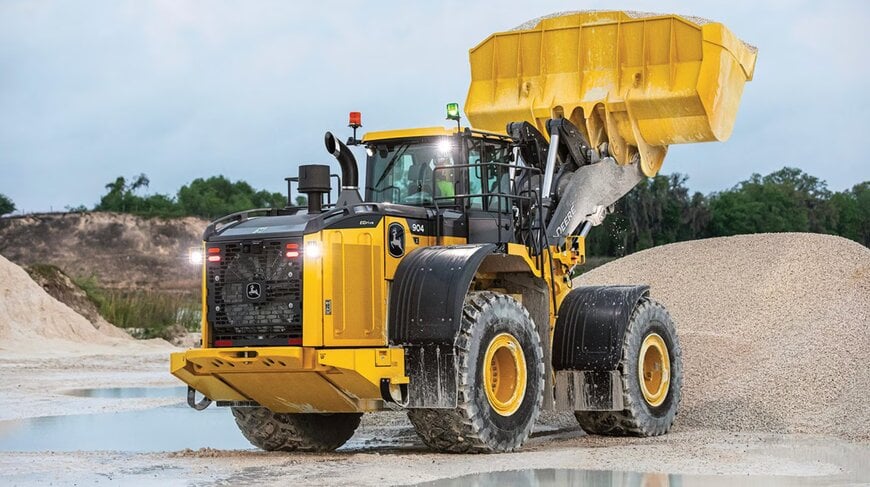
The integration of electrified drivetrains into heavy earthmoving equipment addresses the dual challenges of reducing operating costs and maximizing hourly material throughput in high-volume industrial applications. In sectors such as aggregate processing, quarrying, and large-scale infrastructure development, bulk material rehandling requires continuous high-torque performance. The introduction of the John Deere 844 and 904 X-Tier wheel loaders implements an alternative to conventional mechanical or hydrodynamic drivetrains by utilizing electronic power management to decouple engine speed from hydraulic capacity.
Electric Variable Transmission Architecture and Operational Efficiency
The primary technological advancement in these production-class wheel loaders is the Electric Variable Transmission (EVT). Conventional wheel loaders rely on torque converters and multi-speed powershift transmissions, which link engine revolutions directly to ground speed and hydraulic pump output. The EVT system replaces these mechanical constraints with an electronically managed electrical drivetrain. This architecture allows the diesel engine to operate within its most efficient revolutions-per-minute (RPM) band, while the electrical components independently modulate ground torque and hydraulic flow.
This drivetrain configuration enables a single-pedal control mechanism, allowing operators to manage machine acceleration and deceleration without constant manual shifting or heavy braking. By decoupling hydraulic performance from engine speed, the system ensures that full hydraulic breakout force remains available even when the machine is operating at low ground speeds.
Quantifiable performance metrics demonstrate the operational impact of this powertrain configuration:
- Standard Mode: Configures the power management system to prioritize energy efficiency, yielding up to a 15% reduction in fuel consumption compared to conventional P-Tier models.
- Performance Mode: Optimizes power delivery for high-demand applications, resulting in up to a 5% increase in material handling productivity.
The combination of these operating modes contributes to a reduction in the total cost of ownership by up to 4% when evaluated against previous mechanical-drive configurations.
Traction Control and Operator Awareness Systems
In high-production aggregate handling, tire wear represents a significant percentage of variable operating costs. To mitigate wheel spin during pile entry, the wheel loaders incorporate a digital traction management system designated as Pile Slip Assist. This system monitors wheel slip in real time and automatically modulates torque delivery to optimize bucket penetration and fill factors while preventing tire degradation. The system works in tandem with redesigned high-strength steel buckets engineered for higher volumetric capacity per pass.
Visual awareness on industrial jobsites is managed via an optional Advanced Vision System (AVS) and Advanced Object Detection suite:
In high-production aggregate handling, tire wear represents a significant percentage of variable operating costs. To mitigate wheel spin during pile entry, the wheel loaders incorporate a digital traction management system designated as Pile Slip Assist. This system monitors wheel slip in real time and automatically modulates torque delivery to optimize bucket penetration and fill factors while preventing tire degradation. The system works in tandem with redesigned high-strength steel buckets engineered for higher volumetric capacity per pass.
Visual awareness on industrial jobsites is managed via an optional Advanced Vision System (AVS) and Advanced Object Detection suite:
- Two digital cameras mounted on the exterior side mirrors to extend lateral visibility beyond the field of view provided by standard physical mirrors.
- A dedicated, single display monitor inside the operator cab that integrates the side-view feeds with the standard rearview camera.
- A dynamic reversal projected path system that overlays predictive trajectory lines on the monitor based on the articulation angle of the articulated steering joint.
Fleet management and machine health monitoring are handled through the John Deere Operations Center, which provides remote diagnostics and telematics. The manufacturer supports the electrical propulsion system with a 5-year or 15,000-hour component coverage plan for qualified electronic-drive parts.
Additional Context: Technical Specifications and Competitive Benchmarking
The transition to diesel-electric and electric variable transmissions in the 300 to 400 horsepower wheel loader class represents a distinct engineering methodology compared to alternative drivetrain designs available in the heavy equipment industry.
The primary competitive benchmark for this technology is the traditional hydrostatic transmission and the split-path continuously variable transmission (CVT) utilized by manufacturers such as Caterpillar and Liebherr. For example, the Caterpillar 966M XE and 972M XE utilize a mechanical-hydraulic parallel path CVT. While mechanical CVTs achieve high efficiency at specific speed ratios, the John Deere EVT system replaces the hydraulic pumps and motors of a CVT with electric generators and motors. This eliminates the fluid compression losses inherent to hydrostatic systems, particularly under heavy rimpull conditions.
In terms of heavy production benchmarking, the John Deere 904 X-Tier competes directly with machines like the Komatsu WA500-8 and the Caterpillar 980. While the Komatsu WA500-8 relies on a conventional torque converter lock-up transmission to achieve up to a 15% fuel reduction in specific long-haul scenarios, the X-Tier's EVT provides continuous efficiency gains across short-cycle truck loading where lock-up clutches cannot typically engage. Furthermore, the decoupling of engine speed from hydraulic power allows the 844 and 904 X-Tier loaders to maintain a constant hydraulic cycle time of approximately 10 seconds for a full lift, dump, and lower sequence, independent of the travel speed, a metric that conventional powershift machines can only replicate by riding the throttle and riding the brakes simultaneously.
Edited by Evgeny Churilov, Induportals Media - Adapted by AI.
www.deere.com
Additional Context: Technical Specifications and Competitive Benchmarking
The transition to diesel-electric and electric variable transmissions in the 300 to 400 horsepower wheel loader class represents a distinct engineering methodology compared to alternative drivetrain designs available in the heavy equipment industry.
The primary competitive benchmark for this technology is the traditional hydrostatic transmission and the split-path continuously variable transmission (CVT) utilized by manufacturers such as Caterpillar and Liebherr. For example, the Caterpillar 966M XE and 972M XE utilize a mechanical-hydraulic parallel path CVT. While mechanical CVTs achieve high efficiency at specific speed ratios, the John Deere EVT system replaces the hydraulic pumps and motors of a CVT with electric generators and motors. This eliminates the fluid compression losses inherent to hydrostatic systems, particularly under heavy rimpull conditions.
In terms of heavy production benchmarking, the John Deere 904 X-Tier competes directly with machines like the Komatsu WA500-8 and the Caterpillar 980. While the Komatsu WA500-8 relies on a conventional torque converter lock-up transmission to achieve up to a 15% fuel reduction in specific long-haul scenarios, the X-Tier's EVT provides continuous efficiency gains across short-cycle truck loading where lock-up clutches cannot typically engage. Furthermore, the decoupling of engine speed from hydraulic power allows the 844 and 904 X-Tier loaders to maintain a constant hydraulic cycle time of approximately 10 seconds for a full lift, dump, and lower sequence, independent of the travel speed, a metric that conventional powershift machines can only replicate by riding the throttle and riding the brakes simultaneously.
Edited by Evgeny Churilov, Induportals Media - Adapted by AI.
www.deere.com
Powered by
Induportals Media Publishing