[Job Story] Jobsites Don’t Stop for Summer: Following MB Crusher Attachments from India to Australia
Summer may signal holiday season across much of the world, but for major civil engineering and infrastructure projects, operations don’t slow down. Construction sites in fact face a persistent set of seasonal and operational pressures: strict environmental regulations, summer restrictions on heavy truck transport, demanding timelines, and tight operating margins. To maintain productivity without escalating […] [Job Story] Jobsites Don’t Stop for Summer: Following MB Crusher Attachments from India to Australia published on The HeavyQuip Magazine.
 machineryasia
 ![[Job Story] Jobsites Don’t Stop for Summer: Following MB Crusher Attachments from India to Australia](https://www.heavyquipmag.com/wp-content/uploads/2026/08/mb-crusher-e1786111397191.jpg)
Summer may signal holiday season across much of the world, but for major civil engineering and infrastructure projects, operations don’t slow down. Construction sites in fact face a persistent set of seasonal and operational pressures: strict environmental regulations, summer restrictions on heavy truck transport, demanding timelines, and tight operating margins.
To maintain productivity without escalating costs, a growing number of contractors are re-evaluating material management on site. By processing demolition debris and excavated material directly at the jobsite using hydraulic attachments mounted on existing excavators, operators are cutting out off-site transport and creating usable secondary aggregates on demand.
MB Crusher Attachments are currently being used on two infrastructure jobsites, one in India and another in Australia, addressing heavy material logistics during busy operational periods.
Bridge Demolition in India: Direct Material Conversion
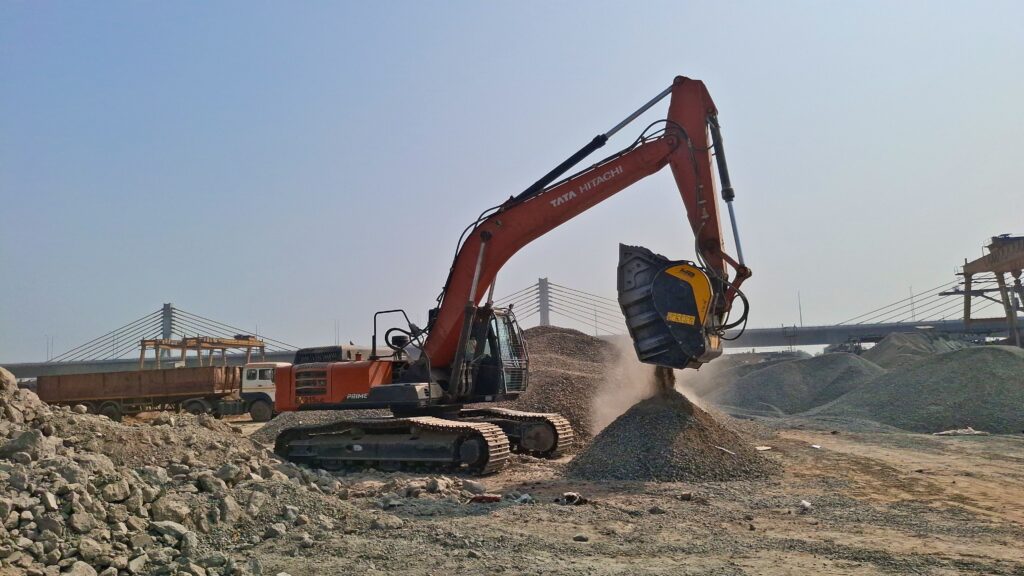
On the Kacchi Dargah–Bidupur bridge project in Bihar, India (a major six-lane structure) contractors faced the challenge of demolishing existing concrete elements and managing large volumes of heavy debris.
To handle the material on site, the team deployed an MB Crusher BF90.3 crusher bucket mounted on a TATA Hitachi EX215 excavator. The unit processed concrete blocks measuring approximately 250 mm down to a uniform 60 mm output size.
By crushing the material directly within the project footprint, the concrete was immediately repurposed for ongoing base works across the development. This eliminated the need to truck heavy material off-site, avoiding regional traffic delays and lowering overall logistical expenses.
Commercial Logistics Park in Australia: Internal Resource Recycling
Near Melbourne, Australia, project developer Austrak Management & Consulting Pty Ltd undertook the construction of the Somerton Business Park, an industrial hub extending over one km with direct transport links to regional highways and airports.
Given the scale of the site works, handling excavated rock and concrete demolition material presented significant potential transport and disposal costs.
The site team equipped an excavator already operating on the project with an MB Crusher BF120.4 crusher bucket. The attachment processed the site-generated rock and concrete into crushed aggregate, which was subsequently reused to build internal roads and foundational sub-bases throughout the park. The method kept the recycling process within the jobsite boundary, preventing operational downtime and eliminating off-site hauling fees.
Optimizing Site Operations
Across different geographic locations and project types, managing bulky waste materials remains a core operational variable for infrastructure contractors. By integrating crushing capabilities directly into active fleet machinery, project managers retain control over site logistics, maintain continuous workflow during peak seasons, and reduce the total environmental impact of transport operations.
[Job Story] Jobsites Don’t Stop for Summer: Following MB Crusher Attachments from India to Australia published on The HeavyQuip Magazine.