STRABAG Digitalizes Construction Equipment Training with CM Labs
Advantage simulators reduce training costs and risks through realistic training for excavators, cranes, and wheel loaders. cm-labs.com To increase efficiency and safety in operator training, European construction group STRABAG has installed two CM Labs "Advantage" simulators at its Hungarian training center. Previously, the qualification of new operators was primarily done through time-consuming and costly "training on the job" on real construction machines—a process that often took up to a year. After a rigorous evaluation of various systems by experienced trainers, STRABAG chose CM Labs because their simulators achieved the highest ratings for graphic quality, joystick haptics, and the realistic depiction of workflows. Objective Assessment Without Machine Wear The new systems support training for a wide range of heavy equipment, including excavators, bulldozers, graders, wheel loaders, mobile cranes, and forklifts. New employees now initially undergo a three- to four-day intensive training program following the CM Labs curriculum in a safe, controlled environment. According to Anna Kiss, head of the training center in Hungary, the simulators serve not only for pure driving training but also as a precise assessment tool. They enable instructors to objectively test the operators' coordination and responsiveness without having to accept the risks, fuel consumption, or wear and tear of real machines. Scaling Up Virtual Training The acceptance of the virtual environment is high among the workforce; even experienced employees use the systems for further training. In close cooperation with CM Labs' IT support, the user interfaces were configured in three languages (Hungarian, English, German). In its first year of operation, the center has already trained 271 employees and plans to double this number in the current year. Due to the drastic optimization of training and certification costs, STRABAG is now preparing to expand simulation-based training to its branches in Romania, Serbia, and Croatia. Additional Context: Physics Engines and Kinesthetic Learning in Machine Simulation This section details technical specifications and biomechanical backgrounds not included in the original project report. The simulation of heavy construction equipment requires much more than just high-resolution graphics; the critical factor is the physical modeling (physics engine) beneath the surface. Industrial-grade systems utilize advanced multi-body simulation algorithms to calculate the complex interaction between machine kinematics, soil conditions (earthmoving simulation), and hydraulic pressures in real time. For example, if the bucket of a simulated excavator hits hard rock or compacted clay, the system must physically feed back the hydraulic resistance to the operator via actuators in the joysticks and the seat console (force feedback). This kinesthetic feedback is crucial for building muscle memory. Without this exact mechanical feedback, operators would learn incorrect movement patterns in the virtual environment, which could lead to jerky movements, increased material wear, or dangerous operating errors on the construction site when switching to real machines. Edited by industrial journalist Lekshman Ramdas, with AI assistance. www.cm-labs.com Powered by Induportals Media Publishing
 machineryasia

Advantage simulators reduce training costs and risks through realistic training for excavators, cranes, and wheel loaders.
cm-labs.com
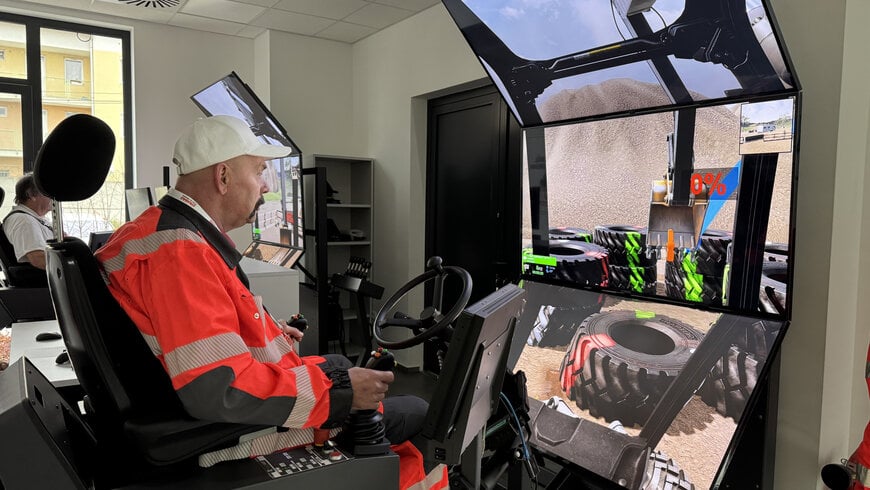
To increase efficiency and safety in operator training, European construction group STRABAG has installed two CM Labs "Advantage" simulators at its Hungarian training center. Previously, the qualification of new operators was primarily done through time-consuming and costly "training on the job" on real construction machines—a process that often took up to a year. After a rigorous evaluation of various systems by experienced trainers, STRABAG chose CM Labs because their simulators achieved the highest ratings for graphic quality, joystick haptics, and the realistic depiction of workflows.
Objective Assessment Without Machine Wear
The new systems support training for a wide range of heavy equipment, including excavators, bulldozers, graders, wheel loaders, mobile cranes, and forklifts. New employees now initially undergo a three- to four-day intensive training program following the CM Labs curriculum in a safe, controlled environment. According to Anna Kiss, head of the training center in Hungary, the simulators serve not only for pure driving training but also as a precise assessment tool. They enable instructors to objectively test the operators' coordination and responsiveness without having to accept the risks, fuel consumption, or wear and tear of real machines.
Scaling Up Virtual Training
The acceptance of the virtual environment is high among the workforce; even experienced employees use the systems for further training. In close cooperation with CM Labs' IT support, the user interfaces were configured in three languages (Hungarian, English, German). In its first year of operation, the center has already trained 271 employees and plans to double this number in the current year. Due to the drastic optimization of training and certification costs, STRABAG is now preparing to expand simulation-based training to its branches in Romania, Serbia, and Croatia.
Additional Context: Physics Engines and Kinesthetic Learning in Machine Simulation
This section details technical specifications and biomechanical backgrounds not included in the original project report.
The simulation of heavy construction equipment requires much more than just high-resolution graphics; the critical factor is the physical modeling (physics engine) beneath the surface. Industrial-grade systems utilize advanced multi-body simulation algorithms to calculate the complex interaction between machine kinematics, soil conditions (earthmoving simulation), and hydraulic pressures in real time. For example, if the bucket of a simulated excavator hits hard rock or compacted clay, the system must physically feed back the hydraulic resistance to the operator via actuators in the joysticks and the seat console (force feedback). This kinesthetic feedback is crucial for building muscle memory. Without this exact mechanical feedback, operators would learn incorrect movement patterns in the virtual environment, which could lead to jerky movements, increased material wear, or dangerous operating errors on the construction site when switching to real machines.
Edited by industrial journalist Lekshman Ramdas, with AI assistance.
www.cm-labs.com
Powered by
Induportals Media Publishing