JCB Unveils New 480 & 490 Wheeled Loaders at Hillhead 2026
New Stage V loaders deliver up to 9-tonne payloads, CVT transmission, advanced hydraulics and enhanced operator assistance technologies. www.jcb.com JCB has expanded its equipment portfolio with two high-capacity wheeled loaders engineered with continuously variable transmissions and advanced electro-hydraulic controls. These machines are designed for high-payload material handling across the quarrying, waste management, port logistics, and construction industries. Driveline Architecture and Power Output The equipment utilizes a Stage V and Tier 4 Final compliant Cummins X12 diesel engine that produces 250kW of power and 1,695Nm of torque at 1,400rpm. Power distribution is managed through a standard ZF Continuously Variable Transmission, which adjusts rimpull to maintain traction across varying ground conditions. The transmission architecture includes four virtual gear modes, hill-hold functionality, and an integrated transmission brake paired with automatic engine exhaust braking to minimize axle brake wear. A single-pedal interface regulates both travel speed and torque, while an intelligent hydraulic boost function automatically calibrates engine output to meet the fluctuating hydraulic demands of the front loader mechanism. Kinematics and Lift Geometry Engineered for high-capacity transfer, the loaders accommodate payloads of 8,000kg and 9,000kg. The lifting mechanism utilizes a patented arm geometry that integrates the breakout force typical of a Z-bar linkage with the operational visibility of a tool carrier configuration. The omission of a forward-protruding Z-link permits the installation of oversized, low-density buckets, maintaining wide-angle rotation and high torque across the full working envelope to facilitate material discharge on steep loading ramps. Operators can specify standard or high-lift arms, achieving maximum pin heights between 4,445mm and 5,000mm to load high-sided trailers, crushers, and industrial hoppers. The structural joints employ sealed, lubricated pins housed within heavy-duty castings to withstand continuous cyclic loading. Electro-Hydraulic Interfaces and Operational Safety The cabin infrastructure features fully programmable electro-hydraulic controls integrated into an air-suspended seating framework. Machine diagnostics and operational parameters are centralized within a 10-inch full-color touchscreen interface, governing standard functions and optional integrations such as automated lubrication and onboard payload weighing. For worksite safety, the exterior incorporates flush-mounted corner beacons and an object detection array linked to an automatic braking override to mitigate impact risks. The mechanical and safety specifications for these loaders were presented at the Hillhead 2026 quarry show near Buxton. Additional Context: This section details technical specifications and competitive benchmarking not included in the original product announcement In the 8,000kg to 9,000kg payload class, continuous variable transmission architecture is increasingly utilized to optimize fuel efficiency during repetitive V-pattern loading cycles. The JCB units compete with equipment such as the Caterpillar 980 XE and the Volvo L220H. While the Caterpillar 980 XE employs a continuously variable transmission with power outputs exceeding 290kW, the JCB models achieve their payload metrics utilizing a 250kW powerplant. The integration of single-pedal torque and speed regulation parallels advanced driveline management systems found in Komatsu's WA480-8 hydrostatic models, indicating a broader market transition away from conventional torque converter transmissions toward integrated electro-mechanical split-power systems in heavy-duty material handling. Edited by Natania Lyngdoh, Induportals editor, assisted by AI. www.jcb.com Powered by Induportals Media Publishing
 machineryasia
New Stage V loaders deliver up to 9-tonne payloads, CVT transmission, advanced hydraulics and enhanced operator assistance technologies.
www.jcb.com
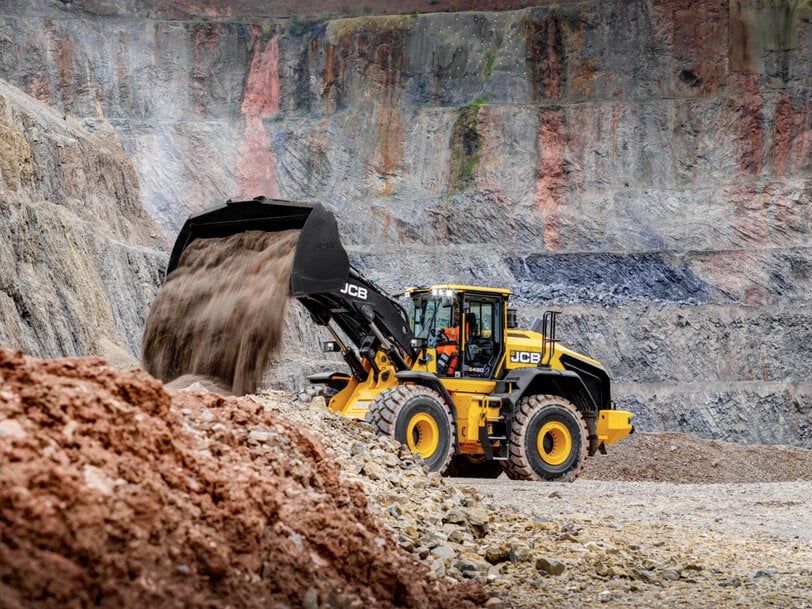
JCB has expanded its equipment portfolio with two high-capacity wheeled loaders engineered with continuously variable transmissions and advanced electro-hydraulic controls. These machines are designed for high-payload material handling across the quarrying, waste management, port logistics, and construction industries.
Driveline Architecture and Power Output
The equipment utilizes a Stage V and Tier 4 Final compliant Cummins X12 diesel engine that produces 250kW of power and 1,695Nm of torque at 1,400rpm. Power distribution is managed through a standard ZF Continuously Variable Transmission, which adjusts rimpull to maintain traction across varying ground conditions. The transmission architecture includes four virtual gear modes, hill-hold functionality, and an integrated transmission brake paired with automatic engine exhaust braking to minimize axle brake wear. A single-pedal interface regulates both travel speed and torque, while an intelligent hydraulic boost function automatically calibrates engine output to meet the fluctuating hydraulic demands of the front loader mechanism.
Kinematics and Lift Geometry
Engineered for high-capacity transfer, the loaders accommodate payloads of 8,000kg and 9,000kg. The lifting mechanism utilizes a patented arm geometry that integrates the breakout force typical of a Z-bar linkage with the operational visibility of a tool carrier configuration. The omission of a forward-protruding Z-link permits the installation of oversized, low-density buckets, maintaining wide-angle rotation and high torque across the full working envelope to facilitate material discharge on steep loading ramps. Operators can specify standard or high-lift arms, achieving maximum pin heights between 4,445mm and 5,000mm to load high-sided trailers, crushers, and industrial hoppers. The structural joints employ sealed, lubricated pins housed within heavy-duty castings to withstand continuous cyclic loading.
Electro-Hydraulic Interfaces and Operational Safety
The cabin infrastructure features fully programmable electro-hydraulic controls integrated into an air-suspended seating framework. Machine diagnostics and operational parameters are centralized within a 10-inch full-color touchscreen interface, governing standard functions and optional integrations such as automated lubrication and onboard payload weighing. For worksite safety, the exterior incorporates flush-mounted corner beacons and an object detection array linked to an automatic braking override to mitigate impact risks. The mechanical and safety specifications for these loaders were presented at the Hillhead 2026 quarry show near Buxton.
Additional Context:
This section details technical specifications and competitive benchmarking not included in the original product announcement
In the 8,000kg to 9,000kg payload class, continuous variable transmission architecture is increasingly utilized to optimize fuel efficiency during repetitive V-pattern loading cycles. The JCB units compete with equipment such as the Caterpillar 980 XE and the Volvo L220H. While the Caterpillar 980 XE employs a continuously variable transmission with power outputs exceeding 290kW, the JCB models achieve their payload metrics utilizing a 250kW powerplant. The integration of single-pedal torque and speed regulation parallels advanced driveline management systems found in Komatsu's WA480-8 hydrostatic models, indicating a broader market transition away from conventional torque converter transmissions toward integrated electro-mechanical split-power systems in heavy-duty material handling.
Edited by Natania Lyngdoh, Induportals editor, assisted by AI.
www.jcb.com
Powered by
Induportals Media Publishing