How ESCO Vertasys is advancing ground engaging tool design
Ground-engaging tools (GET) operate at the front line of excavation and loading, absorbing the abrasion and impact associated with moving material. As sacrificial wear components, bucket teeth are designed to be replaced. But while wear life remains an important measure of performance, manufacturers are now looking beyond durability. Contractors are under pressure to maximize machine utilization, reduce maintenance downtime, and improve job site safety. With its new Vertasys tooth system, ESCO is evolving wear-part design to address these pressures. Developed over five years and validated through extensive analytical, laboratory, and field testing, the system is designed to improve wear life while simplifying maintenance and reducing the operational disruptions associated with tooth replacement. "We are critically focused on making sure these teeth last as long as possible," says Casey Springer, senior director of product development at ESCO. "We are reducing the number of maintenance intervals that our customers are subjected to so that machines can stay active in digging as opposed to [being] down for preventive maintenance." Longer tooth life increases uptime For contractors, wear parts are often evaluated based on how long they last in service. Longer-lasting teeth reduce replacement frequency, minimize planned maintenance events, and help keep equipment productive. According to Springer, the Vertasys system is the next-generation successor to ESCO's Ultralok system. Although Ultralok continues to be manufactured and supported by ESCO, the company is encouraging customers to adopt the Vertasys system, which incorporates a stronger nose design allowing engineers to reduce the size of the nose and allocate more wear material into the tooth itself. The result is a longer-lasting tooth that doesn't sacrifice reliability. Compared to its Ultralok system, ESCO reports a 10 to 12 percent increase in tooth life. That may seem incremental, but across a fleet operating in abrasive applications, even modest improvements can reduce the number of maintenance intervals required over the course of a year. The development process behind those gains was extensive. During the first year of the program, ESCO benchmarked its own legacy systems, evaluated competing products, and gathered customer feedback. The company then generated dozens of design concepts before narrowing the field and conducting laboratory and field testing. "This system [has] over 20,000 hours of field trial under its belt across 10 different sites, and a variety of different applications from super cold in [Atlantic] Canada to blazing hot in Arizona," says Springer. "So we've really vetted this across the depth and breadth of the types of applications that our customers are likely to encounter."
 machineryasia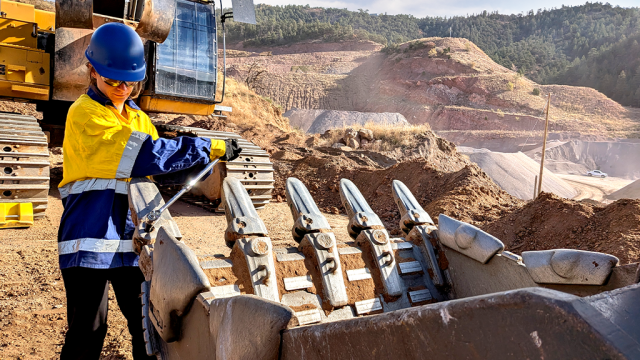
Ground-engaging tools (GET) operate at the front line of excavation and loading, absorbing the abrasion and impact associated with moving material. As sacrificial wear components, bucket teeth are designed to be replaced. But while wear life remains an important measure of performance, manufacturers are now looking beyond durability.
Contractors are under pressure to maximize machine utilization, reduce maintenance downtime, and improve job site safety.
With its new Vertasys tooth system, ESCO is evolving wear-part design to address these pressures.
Developed over five years and validated through extensive analytical, laboratory, and field testing, the system is designed to improve wear life while simplifying maintenance and reducing the operational disruptions associated with tooth replacement.
"We are critically focused on making sure these teeth last as long as possible," says Casey Springer, senior director of product development at ESCO. "We are reducing the number of maintenance intervals that our customers are subjected to so that machines can stay active in digging as opposed to [being] down for preventive maintenance."
Longer tooth life increases uptime
For contractors, wear parts are often evaluated based on how long they last in service.
Longer-lasting teeth reduce replacement frequency, minimize planned maintenance events, and help keep equipment productive.
According to Springer, the Vertasys system is the next-generation successor to ESCO's Ultralok system. Although Ultralok continues to be manufactured and supported by ESCO, the company is encouraging customers to adopt the Vertasys system, which incorporates a stronger nose design allowing engineers to reduce the size of the nose and allocate more wear material into the tooth itself. The result is a longer-lasting tooth that doesn't sacrifice reliability.
Compared to its Ultralok system, ESCO reports a 10 to 12 percent increase in tooth life. That may seem incremental, but across a fleet operating in abrasive applications, even modest improvements can reduce the number of maintenance intervals required over the course of a year.
The development process behind those gains was extensive. During the first year of the program, ESCO benchmarked its own legacy systems, evaluated competing products, and gathered customer feedback. The company then generated dozens of design concepts before narrowing the field and conducting laboratory and field testing.
"This system [has] over 20,000 hours of field trial under its belt across 10 different sites, and a variety of different applications from super cold in [Atlantic] Canada to blazing hot in Arizona," says Springer. "So we've really vetted this across the depth and breadth of the types of applications that our customers are likely to encounter."