High-Capacity Crawler Cranes for Heavy Energy Infrastructure Projects
Liebherr delivers a 2,500-tonne lifting solution to handle oversized components for offshore wind farms and industrial plant construction in South Korea. www.liebherr.com Liebherr has supplied South Korean lifting services provider Hanchang Heavy Equipment with a 2,500-metric-tonne crawler crane to address the increasing physical demands of heavy equipment lifting infrastructure. The deployment of this high-capacity machinery enables the contractor to facilitate the assembly of massive structural components across the offshore wind energy and industrial construction sectors. Operational Challenges in Energy Infrastructure Hanchang Heavy Equipment provides heavy-duty crane services across South Korea’s shipbuilding, steel, petrochemical, and plant engineering sectors. As global energy infrastructure expands, contractors face the logistical and mechanical challenge of transporting and installing increasingly large and heavy structural components. The primary operational goal for the contractor was to secure lifting equipment capable of managing these massive loads safely within confined construction sites, without compromising on transportability between distinct project locations. Technical Solution and Boom Architecture To meet these load requirements, Hanchang integrated the new crawler crane into its existing fleet, filling a capability gap between standard 1,350-tonne and 3,000-tonne models. The selected machinery features a specialized wide lattice boom design, engineered to maximize structural rigidity and lifting capacity. This wide boom is integrated directly into a dedicated front section of the slewing platform. Power is supplied by two redundant 6-cylinder in-line engines delivering a combined output of 800 kW, an architecture chosen to ensure continuous operation and high equipment availability. The two main hoists are positioned on the 3.5-metre-wide rear section of the platform. Transportability and Field Deployment A critical factor in the technology selection was the crane's transport logistics. Despite the system's massive scale, the 10-metre-long lattice boom sections utilize a mechanical reduction mechanism to achieve cost-effective shipping dimensions. Furthermore, the 25-tonne ballast plates mirror the exact dimensions of standard 20-foot shipping containers, allowing for standardized loading via a spreader. By keeping the maximum transport width of most structural components under 3.5 metres, the crane can be deployed across global sites without requiring highly specialized transport for every part. A representative from Hanchang Heavy Equipment noted the importance of the manufacturer's operational backing during the deployment phase, stating, "The expert technical support and reliable supply of spare parts provided by Liebherr are important advantages for us." Measurable Results at an Offshore Wind Facility The crawler crane's initial field deployment took place at an offshore wind farm construction site operated by SK Ocean Plant. The primary technical use case involves lifting and positioning heavy steel jacket substructures, which function as the underwater foundations for offshore wind turbines. Configured with a 126-metre main boom, a derrick system, and a floating counterweight, the crane operates in tandem with a secondary 1,350-tonne crane to handle the steel structures. This setup provides the structural stability required to manage extreme loads safely within a limited operational footprint, objectively increasing the contractor's capacity to execute large-scale energy sector installations. Edited by Aishwarya Mambet, Induportals Editor, with AI assistance. www.liebherr.com Powered by Induportals Media Publishing
 machineryasia
Liebherr delivers a 2,500-tonne lifting solution to handle oversized components for offshore wind farms and industrial plant construction in South Korea.
www.liebherr.com
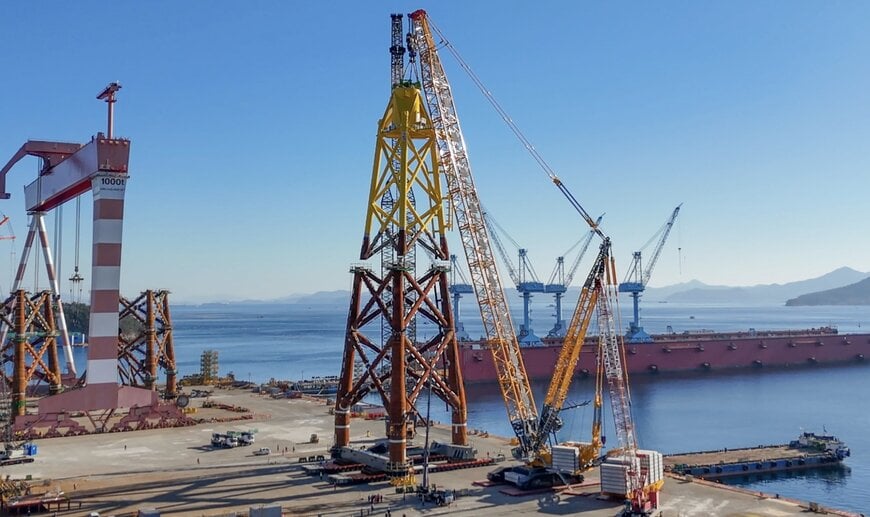
Liebherr has supplied South Korean lifting services provider Hanchang Heavy Equipment with a 2,500-metric-tonne crawler crane to address the increasing physical demands of heavy equipment lifting infrastructure. The deployment of this high-capacity machinery enables the contractor to facilitate the assembly of massive structural components across the offshore wind energy and industrial construction sectors.
Operational Challenges in Energy Infrastructure
Hanchang Heavy Equipment provides heavy-duty crane services across South Korea’s shipbuilding, steel, petrochemical, and plant engineering sectors. As global energy infrastructure expands, contractors face the logistical and mechanical challenge of transporting and installing increasingly large and heavy structural components. The primary operational goal for the contractor was to secure lifting equipment capable of managing these massive loads safely within confined construction sites, without compromising on transportability between distinct project locations.
Technical Solution and Boom Architecture
To meet these load requirements, Hanchang integrated the new crawler crane into its existing fleet, filling a capability gap between standard 1,350-tonne and 3,000-tonne models. The selected machinery features a specialized wide lattice boom design, engineered to maximize structural rigidity and lifting capacity. This wide boom is integrated directly into a dedicated front section of the slewing platform. Power is supplied by two redundant 6-cylinder in-line engines delivering a combined output of 800 kW, an architecture chosen to ensure continuous operation and high equipment availability. The two main hoists are positioned on the 3.5-metre-wide rear section of the platform.
Transportability and Field Deployment
A critical factor in the technology selection was the crane's transport logistics. Despite the system's massive scale, the 10-metre-long lattice boom sections utilize a mechanical reduction mechanism to achieve cost-effective shipping dimensions. Furthermore, the 25-tonne ballast plates mirror the exact dimensions of standard 20-foot shipping containers, allowing for standardized loading via a spreader. By keeping the maximum transport width of most structural components under 3.5 metres, the crane can be deployed across global sites without requiring highly specialized transport for every part.
A representative from Hanchang Heavy Equipment noted the importance of the manufacturer's operational backing during the deployment phase, stating, "The expert technical support and reliable supply of spare parts provided by Liebherr are important advantages for us."
Measurable Results at an Offshore Wind Facility
The crawler crane's initial field deployment took place at an offshore wind farm construction site operated by SK Ocean Plant. The primary technical use case involves lifting and positioning heavy steel jacket substructures, which function as the underwater foundations for offshore wind turbines. Configured with a 126-metre main boom, a derrick system, and a floating counterweight, the crane operates in tandem with a secondary 1,350-tonne crane to handle the steel structures. This setup provides the structural stability required to manage extreme loads safely within a limited operational footprint, objectively increasing the contractor's capacity to execute large-scale energy sector installations.
Edited by Aishwarya Mambet, Induportals Editor, with AI assistance.
www.liebherr.com
Powered by
Induportals Media Publishing