Bosch DCP 800 Test Bench For Common-Rail Pumps
Bosch introduces the DCP 800 test bench to diagnose high-pressure common-rail pumps up to 2,700 bar in commercial and heavy-duty vehicles. www.bosch.com The maintenance of modern diesel injection systems requires equipment capable of managing extreme operating pressures while ensuring efficiency and repeatability in diagnostic times. To address these engineering and operational challenges, Bosch has developed the DCP 800 test bench, a system dedicated to the hydraulic analysis and calibration of high-pressure common-rail pumps. System Architecture and Drive Mechanics The DCP 800 test bench is designed to test common-rail pumps for passenger cars, commercial vehicles, and off-highway applications, supporting operating pressures of up to 2,700 bar. The hardware architecture of the system is based on a 25 kW electric motor connected directly to the drive mechanism, eliminating the need for intermediate kinematics. This direct-drive configuration reduces mechanical power losses and ensures consistent torque delivery, which is fundamental for heavy-duty vehicle applications. Diagnostic precision is further guaranteed by an automatic regulation system for inlet pressure and backpressure, interfaced with an electronic volumetric flow measurement module. Workflow Integration and Backward Compatibility In specialized workshops, diagnostic downtime represents a critical issue for operating costs. The DCP 800 optimizes these processes by reducing operating times to approximately 20 minutes per test cycle, regardless of the specific application. The workflow is standardized through the use of predefined test plans and rapid software configuration procedures. The system covers a broad spectrum of Bosch pumps, from CP1 variants up to the CPN6 series. Furthermore, the architecture maintains physical and operational backward compatibility with pre-existing Bosch test kits, including the CP1, CP3, and CBX8 models originally developed for the EPS 815 and EPS 708 systems, enabling the reuse of already available diagnostic equipment. Structural Ergonomics and Spatial Configuration The machinery design features a frame with three-sided access, developed to facilitate maintenance operations and reduce the risk of injury during the installation of heavy components. The system introduces a new drive coupling that accelerates the mounting of different pump architectures, while a dedicated adapter solution allows the continued use of older mechanical coupling designs. The user interface is managed via a computer terminal with a screen for real-time control of test sequences; the terminal can be installed on either side of the bench depending on the spatial constraints of the infrastructure. The addition of automated filtration and cooling modules stabilizes fluid temperatures and extends the maintenance intervals of the machine. Additional Context This section details technical specifications and competitive benchmarking not included in the original product announcement. Latest-generation diesel engines for industrial vehicles and agricultural machinery must comply with rigorous global emission standards, such as Euro VI and Stage V, which has consistently pushed peak injection pressures beyond the 2,500 bar threshold. The ability to test components up to 2,700 bar ensures that workshops can manage calibrations in line with the tolerances required by current regulations. In the automotive test bench sector, benchmarking standards indicate that the absence of belt drives in favor of direct electric drives (such as the 25 kW motor) prevents speed fluctuations under load, an essential requirement for accurately validating injection parameters. These diagnostic architectures operate in synergy with injector test benches, offering comprehensive, closed-loop validation of the entire high-pressure common-rail ecosystem. Edited by Maria Brueva, Induportals editor – adapted by AI. www.bosch.com Powered by Induportals Media Publishing
 machineryasia
Bosch introduces the DCP 800 test bench to diagnose high-pressure common-rail pumps up to 2,700 bar in commercial and heavy-duty vehicles.
www.bosch.com
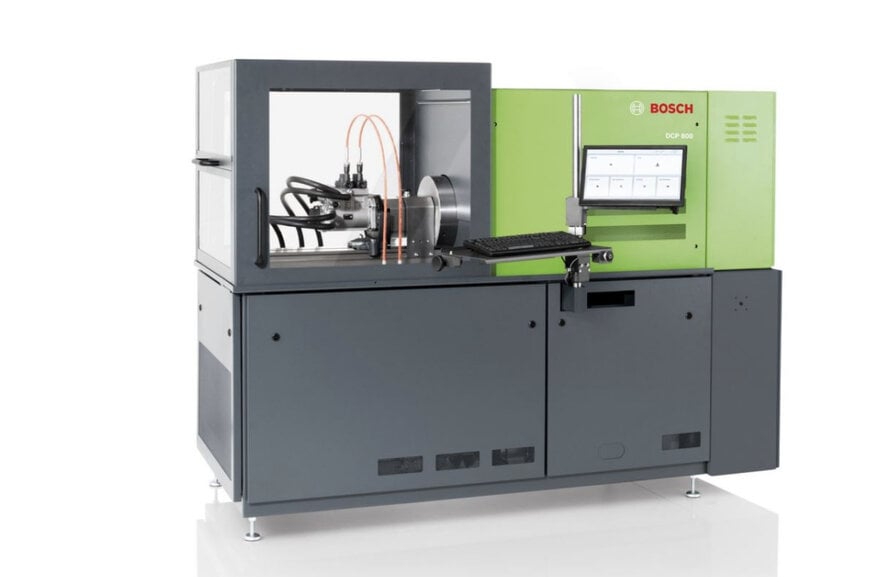
The maintenance of modern diesel injection systems requires equipment capable of managing extreme operating pressures while ensuring efficiency and repeatability in diagnostic times. To address these engineering and operational challenges, Bosch has developed the DCP 800 test bench, a system dedicated to the hydraulic analysis and calibration of high-pressure common-rail pumps.
System Architecture and Drive Mechanics
The DCP 800 test bench is designed to test common-rail pumps for passenger cars, commercial vehicles, and off-highway applications, supporting operating pressures of up to 2,700 bar. The hardware architecture of the system is based on a 25 kW electric motor connected directly to the drive mechanism, eliminating the need for intermediate kinematics. This direct-drive configuration reduces mechanical power losses and ensures consistent torque delivery, which is fundamental for heavy-duty vehicle applications. Diagnostic precision is further guaranteed by an automatic regulation system for inlet pressure and backpressure, interfaced with an electronic volumetric flow measurement module.
Workflow Integration and Backward Compatibility
In specialized workshops, diagnostic downtime represents a critical issue for operating costs. The DCP 800 optimizes these processes by reducing operating times to approximately 20 minutes per test cycle, regardless of the specific application. The workflow is standardized through the use of predefined test plans and rapid software configuration procedures. The system covers a broad spectrum of Bosch pumps, from CP1 variants up to the CPN6 series. Furthermore, the architecture maintains physical and operational backward compatibility with pre-existing Bosch test kits, including the CP1, CP3, and CBX8 models originally developed for the EPS 815 and EPS 708 systems, enabling the reuse of already available diagnostic equipment.
Structural Ergonomics and Spatial Configuration
The machinery design features a frame with three-sided access, developed to facilitate maintenance operations and reduce the risk of injury during the installation of heavy components. The system introduces a new drive coupling that accelerates the mounting of different pump architectures, while a dedicated adapter solution allows the continued use of older mechanical coupling designs. The user interface is managed via a computer terminal with a screen for real-time control of test sequences; the terminal can be installed on either side of the bench depending on the spatial constraints of the infrastructure. The addition of automated filtration and cooling modules stabilizes fluid temperatures and extends the maintenance intervals of the machine.
Additional Context
This section details technical specifications and competitive benchmarking not included in the original product announcement.
Latest-generation diesel engines for industrial vehicles and agricultural machinery must comply with rigorous global emission standards, such as Euro VI and Stage V, which has consistently pushed peak injection pressures beyond the 2,500 bar threshold. The ability to test components up to 2,700 bar ensures that workshops can manage calibrations in line with the tolerances required by current regulations. In the automotive test bench sector, benchmarking standards indicate that the absence of belt drives in favor of direct electric drives (such as the 25 kW motor) prevents speed fluctuations under load, an essential requirement for accurately validating injection parameters. These diagnostic architectures operate in synergy with injector test benches, offering comprehensive, closed-loop validation of the entire high-pressure common-rail ecosystem.
Edited by Maria Brueva, Induportals editor – adapted by AI.
www.bosch.com
Powered by
Induportals Media Publishing