60-Tonne All-Terrain Taxi Crane For Confined Spaces
Tadano introduces the AC 3.060-2 all-terrain crane to address heavy lifting requirements within confined urban construction sites and industrial facilities. www.tadano.com Operating in confined construction sites and urban environments requires lifting equipment that balances high capacity with stringent spatial and weight limitations. To address this operational engineering challenge, Tadano developed the AC 3.060-2, a 3-axle all-terrain taxi crane designed for rapid setup and heavy lifting within tight spatial constraints. Boom Architecture And Lifting Performance The structural design of the crane features a 50-meter main boom capable of executing lifts at steep boom angles. When fully extended and equipped with its maximum 13-tonne counterweight, the system lifts 5.8 tonnes at a working radius of 18 meters. For extended reach applications, integrating a 16-meter extension angled at 20 degrees enables a lifting capacity of 2.3 tonnes at a 28-meter radius. This configuration achieves a maximum system length of 69 meters. This steep-angle performance is engineered specifically for lifting heavy loads, such as industrial air conditioning units, over existing structures and physical obstacles. Hoist Mechanism And Setup Efficiency The winch system provides a line pull of 6.7 tonnes utilizing a single line. When configured with triple reeving on the single-sheave hook block, the hoist mechanism accommodates loads up to 20 tonnes. This high line pull reduces the reeving requirements for standard operations, thereby decreasing setup time and minimizing manual intervention during rigging. The underfloor positioning of the boom further supports safe reeving procedures and the installation of structural extensions. Roadability And Chassis Dimensions Designed as a mobile taxi crane, the vehicle complies with standard 12-tonne axle load limitations while carrying essential operational equipment. In its roadable configuration, the crane transports 4.2 tonnes of counterweight, a single-sheave hook block, and a 300 kg payload on a 6x6x6 drivetrain with 16-inch tires. The chassis is engineered for confined spaces, featuring a total width of 2.55 meters, a carrier length of 9.49 meters, and a low clearance height of 3.71 meters, allowing access into industrial halls and tight construction perimeters. Electronic Control And Spatial Positioning Systems To maximize lifting capacities in restricted areas, the machine utilizes the IC-1 Plus crane control system coupled with capacity radar. This software dynamically calculates the maximum permissible lifting capacity based on the real-time position of the boom and the stepless Flex Base outrigger system, which allows asymmetrical outrigger extension right up to physical obstacles. The Tadano Surround View system utilizes four external cameras to assist the operator during positioning. Additionally, the platform is compatible with the e-Pack system for emission-free crane operation and shares interchangeable components, such as runners and jibs, with other models in the manufacturer's portfolio. Additional Context This section details technical specifications and competitive benchmarking not included in the original product announcement. The 60-tonne, 3-axle all-terrain crane segment is highly competitive, serving as a critical benchmark for versatile urban lifting operations. Equipment in this class must adhere to strict regional axle load regulations while maximizing onboard counterweight for single-operator taxi operations. Comparable machines from manufacturers such as Liebherr and Grove similarly utilize variable outrigger positioning and smart control systems to maintain stability in asymmetrical setups. The integration of advanced load moment indicators, like the IC-1 Plus, reflects an industry standard where software-defined lifting configurations are essential for optimizing capacity charts dynamically, rather than relying on fixed outrigger positions. Edited by Maria Brueva, Induportals editor – adapted by AI. www.tadano.com Powered by Induportals Media Publishing
 machineryasia
Tadano introduces the AC 3.060-2 all-terrain crane to address heavy lifting requirements within confined urban construction sites and industrial facilities.
www.tadano.com
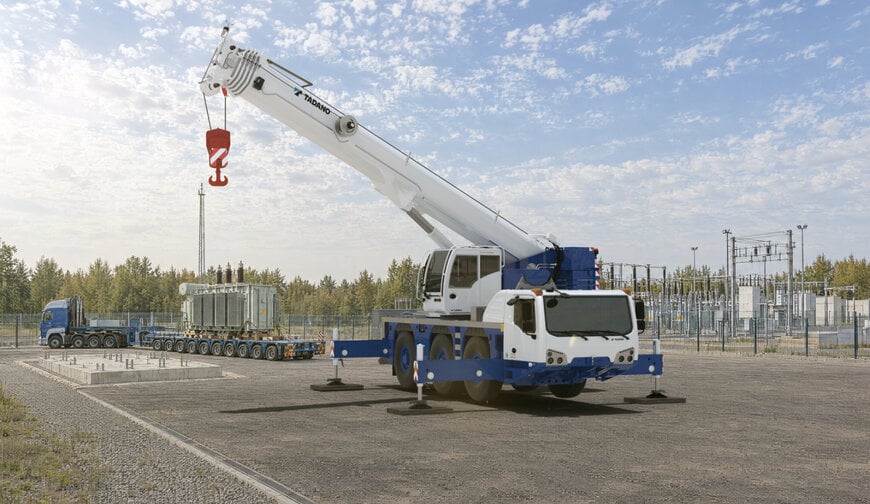
Operating in confined construction sites and urban environments requires lifting equipment that balances high capacity with stringent spatial and weight limitations. To address this operational engineering challenge, Tadano developed the AC 3.060-2, a 3-axle all-terrain taxi crane designed for rapid setup and heavy lifting within tight spatial constraints.
Boom Architecture And Lifting Performance
The structural design of the crane features a 50-meter main boom capable of executing lifts at steep boom angles. When fully extended and equipped with its maximum 13-tonne counterweight, the system lifts 5.8 tonnes at a working radius of 18 meters. For extended reach applications, integrating a 16-meter extension angled at 20 degrees enables a lifting capacity of 2.3 tonnes at a 28-meter radius. This configuration achieves a maximum system length of 69 meters. This steep-angle performance is engineered specifically for lifting heavy loads, such as industrial air conditioning units, over existing structures and physical obstacles.
Hoist Mechanism And Setup Efficiency
The winch system provides a line pull of 6.7 tonnes utilizing a single line. When configured with triple reeving on the single-sheave hook block, the hoist mechanism accommodates loads up to 20 tonnes. This high line pull reduces the reeving requirements for standard operations, thereby decreasing setup time and minimizing manual intervention during rigging. The underfloor positioning of the boom further supports safe reeving procedures and the installation of structural extensions.
Roadability And Chassis Dimensions
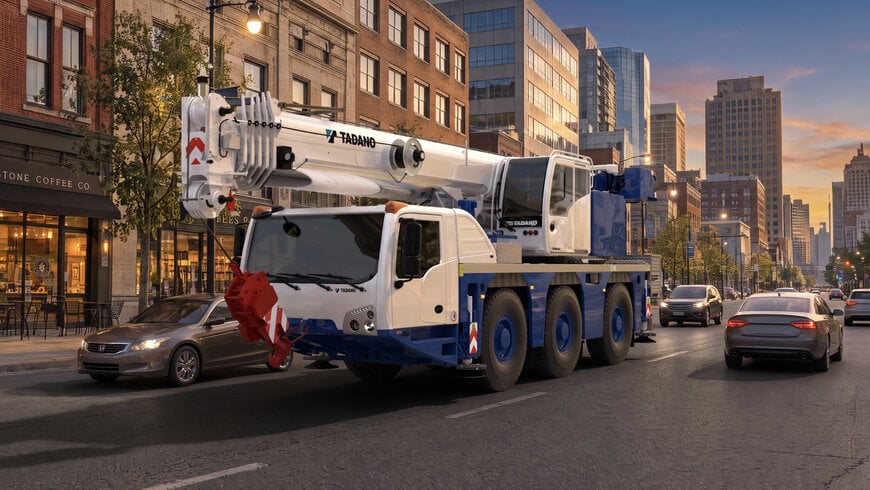
Designed as a mobile taxi crane, the vehicle complies with standard 12-tonne axle load limitations while carrying essential operational equipment. In its roadable configuration, the crane transports 4.2 tonnes of counterweight, a single-sheave hook block, and a 300 kg payload on a 6x6x6 drivetrain with 16-inch tires. The chassis is engineered for confined spaces, featuring a total width of 2.55 meters, a carrier length of 9.49 meters, and a low clearance height of 3.71 meters, allowing access into industrial halls and tight construction perimeters.
Electronic Control And Spatial Positioning Systems
To maximize lifting capacities in restricted areas, the machine utilizes the IC-1 Plus crane control system coupled with capacity radar. This software dynamically calculates the maximum permissible lifting capacity based on the real-time position of the boom and the stepless Flex Base outrigger system, which allows asymmetrical outrigger extension right up to physical obstacles. The Tadano Surround View system utilizes four external cameras to assist the operator during positioning. Additionally, the platform is compatible with the e-Pack system for emission-free crane operation and shares interchangeable components, such as runners and jibs, with other models in the manufacturer's portfolio.
Additional Context
This section details technical specifications and competitive benchmarking not included in the original product announcement.
The 60-tonne, 3-axle all-terrain crane segment is highly competitive, serving as a critical benchmark for versatile urban lifting operations. Equipment in this class must adhere to strict regional axle load regulations while maximizing onboard counterweight for single-operator taxi operations. Comparable machines from manufacturers such as Liebherr and Grove similarly utilize variable outrigger positioning and smart control systems to maintain stability in asymmetrical setups. The integration of advanced load moment indicators, like the IC-1 Plus, reflects an industry standard where software-defined lifting configurations are essential for optimizing capacity charts dynamically, rather than relying on fixed outrigger positions.
Edited by Maria Brueva, Induportals editor – adapted by AI.
www.tadano.com
Powered by
Induportals Media Publishing