Why machine control is an operational necessity for complex earthworks
Tight margins. Short timelines. A skilled labour shortage. The margin of error on a construction site has never been slimmer. Enter 3D machine control technology, which is redefining earthmoving and infrastructure building. By integrating Global Navigation Satellite Systems (GNSS) and 3D modelling directly into heavy equipment, machine control does more than just guide the blade or bucket; it digitizes the job site, turning heavy iron into precision instruments. "The construction landscape has changed dramatically, and the companies that thrive will be the ones that leverage technology to work smarter," says Dan Hendriks, vice-president of sales — positioning technology at Brandt. "Machine control isn't just about making existing processes more accurate — it's about fundamentally changing how projects are executed. When you can eliminate guesswork, reduce material waste, and empower your operators with real-time precision, you're not just improving efficiency. You're future-proofing your business." Two early adopters of the technology are Metric Contracting Services Corporation in the Greater Toronto Area, Ontario, and Weinrich Contracting Limited (WCL) in Edmonton, Alberta. For both, 3D machine control has evolved from a competitive edge to an operational necessity that delivers measurable improvements in accuracy, efficiency, and profitability. Early adoption gives contractors a competitive edge Metric is a family-run heavy civil contractor that has grown from a small earthmoving operation into a regional leader in excavation, site servicing, and infrastructure work. They focus on large-scale projects including transit, roadwork, and complex earthworks. "Our philosophy has always been to evolve with the industry, especially when it comes to technology. We invest heavily in equipment, people, and innovation because efficiency and accuracy are critical in today's construction environment," says Richard Liorti, operations manager. The company has more than 20 machines equipped with machine control, along with numerous handheld devices, base stations, rovers, and supporting technology. "Machine control has become a core part of how we operate on grading and earthworks projects, and it continues to expand across our fleet." WCL started in 1978 as a small, family-owned company. Today, they have 200 pieces of heavy equipment and specialize in roadway construction, earthmoving, residential land development, and general contracting services. "We were one of the first in Edmonton to run 3D machine control on equipment in our area and are typically the first in Canada to buy new-model equipment with technology, for example, the John Deere 850 X-Tier E-Drive dozer. We try to be an early adopter of technology. Our goal is to always be ahead of the competition," says WCL General Manager Andrew Kent. The company uses machine control on motor graders and dozers with plans to put it on mainline excavators when they launch their new underground division. WCL also uses drones, handheld units, and positioning technology for surveying.
 machineryasia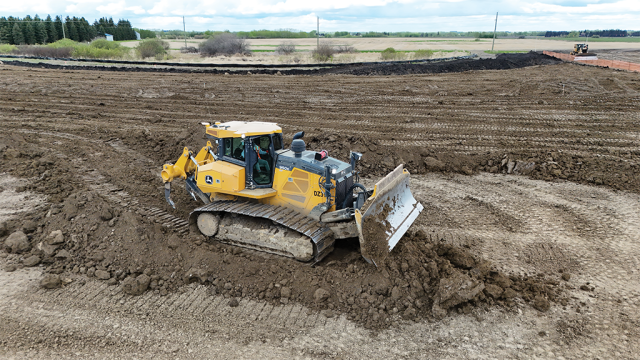
Tight margins. Short timelines. A skilled labour shortage. The margin of error on a construction site has never been slimmer. Enter 3D machine control technology, which is redefining earthmoving and infrastructure building. By integrating Global Navigation Satellite Systems (GNSS) and 3D modelling directly into heavy equipment, machine control does more than just guide the blade or bucket; it digitizes the job site, turning heavy iron into precision instruments.
"The construction landscape has changed dramatically, and the companies that thrive will be the ones that leverage technology to work smarter," says Dan Hendriks, vice-president of sales — positioning technology at Brandt. "Machine control isn't just about making existing processes more accurate — it's about fundamentally changing how projects are executed. When you can eliminate guesswork, reduce material waste, and empower your operators with real-time precision, you're not just improving efficiency. You're future-proofing your business."
Two early adopters of the technology are Metric Contracting Services Corporation in the Greater Toronto Area, Ontario, and Weinrich Contracting Limited (WCL) in Edmonton, Alberta. For both, 3D machine control has evolved from a competitive edge to an operational necessity that delivers measurable improvements in accuracy, efficiency, and profitability.
Early adoption gives contractors a competitive edge
Metric is a family-run heavy civil contractor that has grown from a small earthmoving operation into a regional leader in excavation, site servicing, and infrastructure work. They focus on large-scale projects including transit, roadwork, and complex earthworks.
"Our philosophy has always been to evolve with the industry, especially when it comes to technology. We invest heavily in equipment, people, and innovation because efficiency and accuracy are critical in today's construction environment," says Richard Liorti, operations manager.
The company has more than 20 machines equipped with machine control, along with numerous handheld devices, base stations, rovers, and supporting technology.
"Machine control has become a core part of how we operate on grading and earthworks projects, and it continues to expand across our fleet."
WCL started in 1978 as a small, family-owned company. Today, they have 200 pieces of heavy equipment and specialize in roadway construction, earthmoving, residential land development, and general contracting services.
"We were one of the first in Edmonton to run 3D machine control on equipment in our area and are typically the first in Canada to buy new-model equipment with technology, for example, the John Deere 850 X-Tier E-Drive dozer. We try to be an early adopter of technology. Our goal is to always be ahead of the competition," says WCL General Manager Andrew Kent.
The company uses machine control on motor graders and dozers with plans to put it on mainline excavators when they launch their new underground division. WCL also uses drones, handheld units, and positioning technology for surveying.