Spectacular bridge swap with two Liebherr LR 11000 crawler cranes
Two Liebherr LR 11000 crawler cranes replaced a concrete pipe bridge on the A42 between Bottrop and Essen, connecting refineries to a tank farm over the highway and River Emscher. www.liebherr.com A total of seven Liebherr cranes were used on this complex project: in addition to the two 1,000-tonne crawler cranes for the bridge lifting operation, a 100-tonne mobile crane, an LTR 1220, an LTM 1230-5.1, an LTM 1250-5.1 and a 450-tonne crane were used for auxiliary and assembly work. Ship unloading - tandem lift with a 220-tonne load Project manager Viktor Hein from WASEL GmbH divided the project into two sections: in the first section, two new bridge segments - each weighing 220 tonnes and measuring 71 metres in length, 7 metres in width and 6 metres in height - were delivered by ship along the Rhine-Herne Canal. The two LR 11000 cranes then lifted the segments in precisely coordinated tandem lifts off the ship and placed them on a prepared pre-assembly area. The particular challenge with the first segment was to guide it between the two LR 11000s with centimetre precision in order to place it in the intended position. For the second segment, it was sufficient to set the crawler cranes back around ten metres and place the component directly in front of the crawler cranes with pinpoint accuracy. The LR 11000 models used were built in the SL11DBV setup configuration with 96 and 84-metre boom lengths. The worked with 130 tonnes of central ballast, 250 tonnes of turntable ballast and 450 or 340 tonnes of derrick ballast. Break-up of the old and installation of the new in a narrow timeframe In the second section, the existing pipe bridge was dismantled and the new steel bridge slotted into place. To do this, one of the two LR 11000 cranes was dismantled at the pre-assembly area, transported around 1,000 metres via the A42 and re-assembled on the motorway with a 72-metre main boom. When it came to dismantling the old pipe bridge, which comprised four concrete sections, steel corsets were used to avoid structural damage during the lifting operations. At the same time, the new bridge segments were transported on SPMT travel gear via the closed-off A42 to the installation site - ready for direct lifting and insertion. “The two 1000-tonners impressed throughout the entire mission with their high lifting capacity, but also with their agility. The operator and assembly-friendly design meant that we were able to relocate one of the two in the shortest possible time from the pre-assembly area to the assembly area via the motorway. The fact that the cranes were able to lift loads of up to 240 tonnes precisely and safely, even without any ballast pallet, significantly accelerated the speed of the project. The project was completed two days earlier than the five days that had been planned,” said Viktor Hein. The new bridge segments were manufactured by Schone & Bruns GmbH und Co. KG in Meppen and transported by ship via various waterways to the construction site. Project manager Günther Lohaus highlights the importance of early planning: “The aim was to close off the motorway for as short a time as possible. The close cooperation with WASEL, a detailed logistics and assembly concept and reliable Liebherr cranes meant that we were actually able to beat the planned time window.” www.liebherr.com Powered by Induportals Media Publishing
 machineryasia
Two Liebherr LR 11000 crawler cranes replaced a concrete pipe bridge on the A42 between Bottrop and Essen, connecting refineries to a tank farm over the highway and River Emscher.
www.liebherr.com
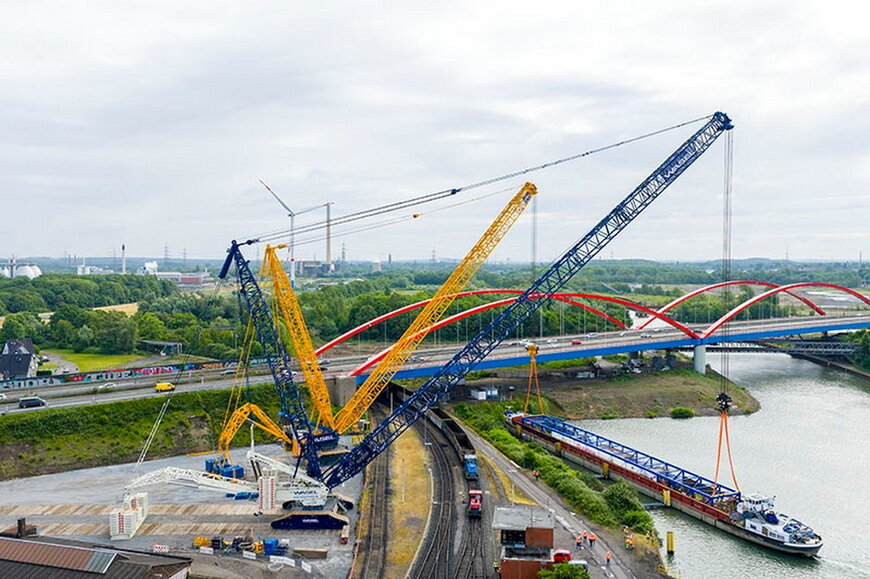
A total of seven Liebherr cranes were used on this complex project: in addition to the two 1,000-tonne crawler cranes for the bridge lifting operation, a 100-tonne mobile crane, an LTR 1220, an LTM 1230-5.1, an LTM 1250-5.1 and a 450-tonne crane were used for auxiliary and assembly work.
Ship unloading - tandem lift with a 220-tonne load
Project manager Viktor Hein from WASEL GmbH divided the project into two sections: in the first section, two new bridge segments - each weighing 220 tonnes and measuring 71 metres in length, 7 metres in width and 6 metres in height - were delivered by ship along the Rhine-Herne Canal. The two LR 11000 cranes then lifted the segments in precisely coordinated tandem lifts off the ship and placed them on a prepared pre-assembly area. The particular challenge with the first segment was to guide it between the two LR 11000s with centimetre precision in order to place it in the intended position. For the second segment, it was sufficient to set the crawler cranes back around ten metres and place the component directly in front of the crawler cranes with pinpoint accuracy.
The LR 11000 models used were built in the SL11DBV setup configuration with 96 and 84-metre boom lengths. The worked with 130 tonnes of central ballast, 250 tonnes of turntable ballast and 450 or 340 tonnes of derrick ballast.
Break-up of the old and installation of the new in a narrow timeframe
In the second section, the existing pipe bridge was dismantled and the new steel bridge slotted into place. To do this, one of the two LR 11000 cranes was dismantled at the pre-assembly area, transported around 1,000 metres via the A42 and re-assembled on the motorway with a 72-metre main boom. When it came to dismantling the old pipe bridge, which comprised four concrete sections, steel corsets were used to avoid structural damage during the lifting operations. At the same time, the new bridge segments were transported on SPMT travel gear via the closed-off A42 to the installation site - ready for direct lifting and insertion.
“The two 1000-tonners impressed throughout the entire mission with their high lifting capacity, but also with their agility. The operator and assembly-friendly design meant that we were able to relocate one of the two in the shortest possible time from the pre-assembly area to the assembly area via the motorway. The fact that the cranes were able to lift loads of up to 240 tonnes precisely and safely, even without any ballast pallet, significantly accelerated the speed of the project. The project was completed two days earlier than the five days that had been planned,” said Viktor Hein.
The new bridge segments were manufactured by Schone & Bruns GmbH und Co. KG in Meppen and transported by ship via various waterways to the construction site. Project manager Günther Lohaus highlights the importance of early planning: “The aim was to close off the motorway for as short a time as possible. The close cooperation with WASEL, a detailed logistics and assembly concept and reliable Liebherr cranes meant that we were actually able to beat the planned time window.”
www.liebherr.com
Powered by
Induportals Media Publishing