Next-Generation Grade Control for Motor Graders
John Deere introduces P-Tier motor graders with integrated digital grade control and advanced safety systems to improve accuracy, automation, and operator awareness in construction applications. www.deere.com John Deere has expanded its motor grader portfolio with new P-Tier models featuring integrated grade control, automation functions, and redesigned operator environments. The 620, 622, 670, 672, 722, 770, 870 and 872 models target road construction, site preparation, and infrastructure projects where grading precision, uptime, and operator efficiency are critical. Integrated Smart Grade Control Architecture The updated SmartGrade system is embedded directly into the machine architecture rather than relying solely on aftermarket add-ons. The system operates via a 10.1-inch G5 touchscreen interface and supports both 2D and 3D grade control configurations. Operators can switch between these modes depending on project complexity, enabling applications ranging from basic slope work to complex digital terrain modeling. The platform is compatible with Topcon and Leica positioning technologies, allowing contractors to align with existing site-control ecosystems. Accuracy is maintained regardless of blade angle or machine position, including configurations outside the center saddle position. This flexibility is particularly relevant for contractors working within a broader digital supply chain, where interoperability between surveying, design, and machine control systems reduces rework and data fragmentation. Remote troubleshooting is supported through wireless data transfer and Remote Display Access integrated with the John Deere Operations Center. This enables service teams to diagnose issues without immediate on-site intervention, potentially reducing downtime on active construction sites. Automation Enhancements for Productivity All P-Tier models include automation features designed to standardize blade control and reduce operator workload. These include blade flip, auto articulation, and machine presets. A new function, cutting edge wear monitoring, allows operators to establish a baseline blade reference on a level surface and periodically validate wear levels. By quantifying blade degradation, crews can plan replacement intervals rather than relying solely on visual inspection, improving maintenance predictability. Additional automation packages include Machine Damage Avoidance and Auto Pass. Two newly introduced features—intelligent blade control and SmartSaddle—further automate blade positioning. Intelligent blade control maintains a level blade across grading operations, while SmartSaddle automatically positions the blade in an optimal saddle configuration at the push of a button. Cross slope control supports both target and joystick modes, enabling adaptation to different operator preferences and jobsite conditions. Operator Interface and Cab Redesign The cab has been redesigned to improve ergonomics and situational clarity. A next-generation 8-inch primary touchscreen display centralizes key machine data, while six-wheel-drive controls have been simplified and switches centralized for more intuitive operation. The seating system includes optional heating and ventilation, along with adjustable armrests. Improvements in climate control, storage, and control layout aim to reduce fatigue during extended grading operations, particularly in large-scale infrastructure or earthmoving projects. Advanced Vision and Jobsite Safety The optional Advanced Vision System and Advanced Vision System with Dual Front Alley Cam introduce additional in-cab camera displays. These systems provide expanded visibility in confined or high-traffic jobsites, where graders often operate alongside haul trucks, compactors, and ground personnel. a Dedicated in-cab displays reduce reliance on mirrors alone, supporting improved situational awareness. In applications such as urban road construction or warehouse-adjacent grading, enhanced visibility can mitigate collision risk and support compliance with site safety protocols. Positioning Within the Construction Equipment Market Integrated grade control systems are increasingly standard in the construction equipment sector, particularly for contractors managing connected jobsite workflows. Compared with retrofit-only systems, factory-integrated grade control offers tighter integration with machine hydraulics and onboard diagnostics, potentially improving calibration stability and reducing installation variability. By combining embedded 2D/3D control, automation features, and remote diagnostics, the new P-Tier graders align with broader industry trends toward connected equipment and data-driven site management. Application Scope The new lineup is suited for: Road and highway construction Site preparation and land development Infrastructure grading Forestry road maintenance Through expanded automation, digital integration, and safety visibility systems, the P-Tier motor g
 machineryasia
John Deere introduces P-Tier motor graders with integrated digital grade control and advanced safety systems to improve accuracy, automation, and operator awareness in construction applications.
www.deere.com
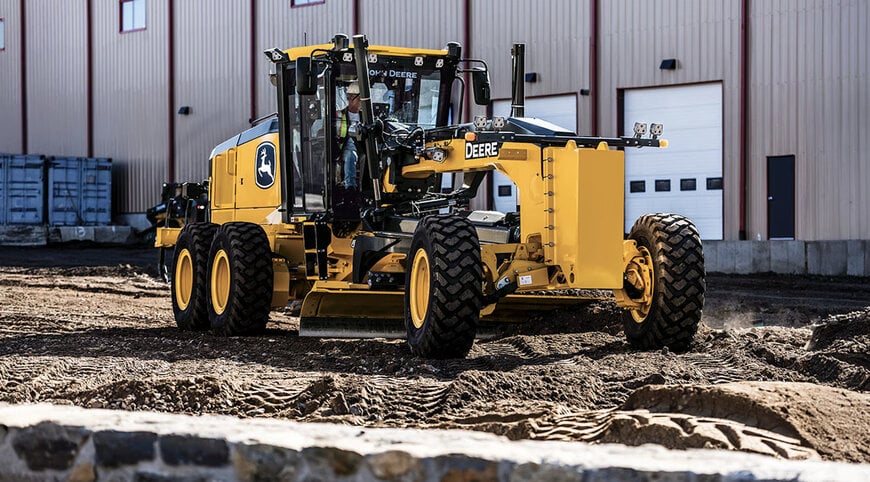
John Deere has expanded its motor grader portfolio with new P-Tier models featuring integrated grade control, automation functions, and redesigned operator environments. The 620, 622, 670, 672, 722, 770, 870 and 872 models target road construction, site preparation, and infrastructure projects where grading precision, uptime, and operator efficiency are critical.
Integrated Smart Grade Control Architecture
The updated SmartGrade system is embedded directly into the machine architecture rather than relying solely on aftermarket add-ons. The system operates via a 10.1-inch G5 touchscreen interface and supports both 2D and 3D grade control configurations. Operators can switch between these modes depending on project complexity, enabling applications ranging from basic slope work to complex digital terrain modeling.
The platform is compatible with Topcon and Leica positioning technologies, allowing contractors to align with existing site-control ecosystems. Accuracy is maintained regardless of blade angle or machine position, including configurations outside the center saddle position. This flexibility is particularly relevant for contractors working within a broader digital supply chain, where interoperability between surveying, design, and machine control systems reduces rework and data fragmentation.
Remote troubleshooting is supported through wireless data transfer and Remote Display Access integrated with the John Deere Operations Center. This enables service teams to diagnose issues without immediate on-site intervention, potentially reducing downtime on active construction sites.
Automation Enhancements for Productivity
All P-Tier models include automation features designed to standardize blade control and reduce operator workload. These include blade flip, auto articulation, and machine presets.
A new function, cutting edge wear monitoring, allows operators to establish a baseline blade reference on a level surface and periodically validate wear levels. By quantifying blade degradation, crews can plan replacement intervals rather than relying solely on visual inspection, improving maintenance predictability.
Additional automation packages include Machine Damage Avoidance and Auto Pass. Two newly introduced features—intelligent blade control and SmartSaddle—further automate blade positioning. Intelligent blade control maintains a level blade across grading operations, while SmartSaddle automatically positions the blade in an optimal saddle configuration at the push of a button. Cross slope control supports both target and joystick modes, enabling adaptation to different operator preferences and jobsite conditions.
Operator Interface and Cab Redesign
The cab has been redesigned to improve ergonomics and situational clarity. A next-generation 8-inch primary touchscreen display centralizes key machine data, while six-wheel-drive controls have been simplified and switches centralized for more intuitive operation.
The seating system includes optional heating and ventilation, along with adjustable armrests. Improvements in climate control, storage, and control layout aim to reduce fatigue during extended grading operations, particularly in large-scale infrastructure or earthmoving projects.
Advanced Vision and Jobsite Safety
The optional Advanced Vision System and Advanced Vision System with Dual Front Alley Cam introduce additional in-cab camera displays. These systems provide expanded visibility in confined or high-traffic jobsites, where graders often operate alongside haul trucks, compactors, and ground personnel. a
Dedicated in-cab displays reduce reliance on mirrors alone, supporting improved situational awareness. In applications such as urban road construction or warehouse-adjacent grading, enhanced visibility can mitigate collision risk and support compliance with site safety protocols.
Positioning Within the Construction Equipment Market
Integrated grade control systems are increasingly standard in the construction equipment sector, particularly for contractors managing connected jobsite workflows. Compared with retrofit-only systems, factory-integrated grade control offers tighter integration with machine hydraulics and onboard diagnostics, potentially improving calibration stability and reducing installation variability.
By combining embedded 2D/3D control, automation features, and remote diagnostics, the new P-Tier graders align with broader industry trends toward connected equipment and data-driven site management.
Application Scope
The new lineup is suited for:
- Road and highway construction
- Site preparation and land development
- Infrastructure grading
- Forestry road maintenance
Through expanded automation, digital integration, and safety visibility systems, the P-Tier motor graders aim to increase grading accuracy, reduce operator workload, and support machine uptime in high-demand construction environments.
www.deere.com
www.deere.com
Powered by
Induportals Media Publishing