Liebherr Cranes Support Ulm Bridge Replacement Project
Seven Liebherr tower cranes are facilitating the complex replacement of the Wallstraßenbrücke over active traffic and rail lines. www.liebherr.com Seven Liebherr tower cranes are supporting ARGE B10 in the multi-year replacement of one of Ulm’s most important transport arteries. The ARGE B10 consortium, comprising Matthäus Schmid Bauunternehmung and LEONHARD WEISS, has partnered with Nagel Mietservice to deploy seven Liebherr tower cranes for the multi-year replacement of the Wallstraßenbrücke in Ulm. As a vital transport artery dating back to the late 1960s, the bridge is being entirely rebuilt in two sections while maintaining traffic flow. Set for full reopening in summer 2029, the project requires cranes to lift heavy structural and reinforced concrete components with millimeter precision between live rail tracks and a major federal highway. Fibre Technology and Flexible Lifting Two Liebherr 520 EC-B 20 Fibre cranes serve as the backbone of the site's heavy lifting operations. These flat-top cranes utilize high-performance fibre ropes instead of conventional steel, significantly reducing hoist rope weight and increasing load capacity by up to 40% compared to equivalent steel-rope models. One unit, featuring an 80-meter jib, covers the main construction area, while a second unit with a 60-meter jib focuses on faster handling in denser zones. A Liebherr 202 EC-B flat-top crane handles formwork and reinforcement, while four self-erecting cranes (one 81 K and three 81 K.1 models) manage rapid material distribution and logistical support within confined spaces. The site’s location between live rail and traffic routes places high demands on precision, load capacity and safety. Additional Context This section provides technological and operational background not explicitly detailed in the original release. Urban infrastructure renewal projects increasingly demand high-capacity lifting solutions that minimize disruption to existing, heavily trafficked corridors. Operating directly above 14 live railway tracks and a B10 highway that accommodates 86,000 vehicles daily introduces severe safety constraints. The transition from steel to high-tensile synthetic fibre ropes in tower cranes is a significant industry advancement; it eliminates the need for routine lubrication, reduces maintenance downtime, and makes the hook block significantly lighter for riggers to maneuver safely. Furthermore, operating multiple overlapping cranes in high-risk zones typically relies on advanced digital anti-collision and working-range limitation systems to ensure heavy loads never inadvertently swing over active traffic or electrified rail lines. Edited by Lekshman Ramdas, Induportals editor – adapted by AI. www.liebherr.com Powered by Induportals Media Publishing
 machineryasia
Seven Liebherr tower cranes are facilitating the complex replacement of the Wallstraßenbrücke over active traffic and rail lines.
www.liebherr.com
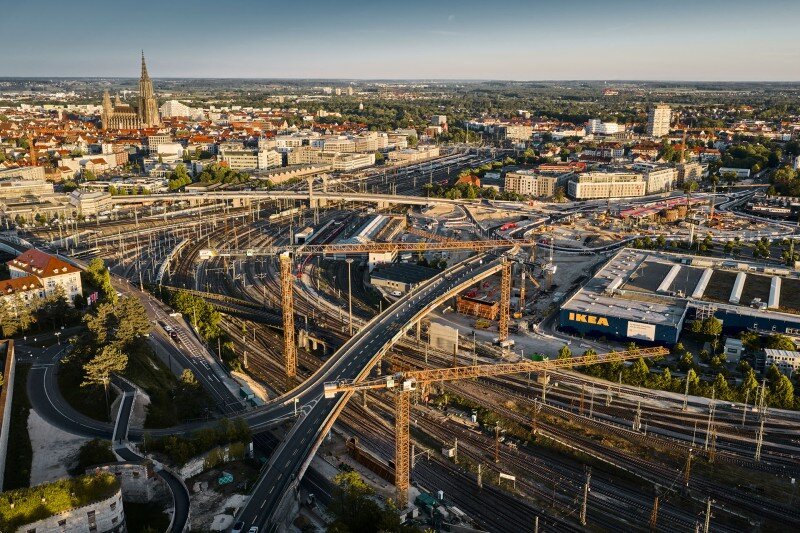
Seven Liebherr tower cranes are supporting ARGE B10 in the multi-year replacement of one of Ulm’s most important transport arteries.
The ARGE B10 consortium, comprising Matthäus Schmid Bauunternehmung and LEONHARD WEISS, has partnered with Nagel Mietservice to deploy seven Liebherr tower cranes for the multi-year replacement of the Wallstraßenbrücke in Ulm. As a vital transport artery dating back to the late 1960s, the bridge is being entirely rebuilt in two sections while maintaining traffic flow. Set for full reopening in summer 2029, the project requires cranes to lift heavy structural and reinforced concrete components with millimeter precision between live rail tracks and a major federal highway.
Fibre Technology and Flexible Lifting
Two Liebherr 520 EC-B 20 Fibre cranes serve as the backbone of the site's heavy lifting operations. These flat-top cranes utilize high-performance fibre ropes instead of conventional steel, significantly reducing hoist rope weight and increasing load capacity by up to 40% compared to equivalent steel-rope models. One unit, featuring an 80-meter jib, covers the main construction area, while a second unit with a 60-meter jib focuses on faster handling in denser zones. A Liebherr 202 EC-B flat-top crane handles formwork and reinforcement, while four self-erecting cranes (one 81 K and three 81 K.1 models) manage rapid material distribution and logistical support within confined spaces.
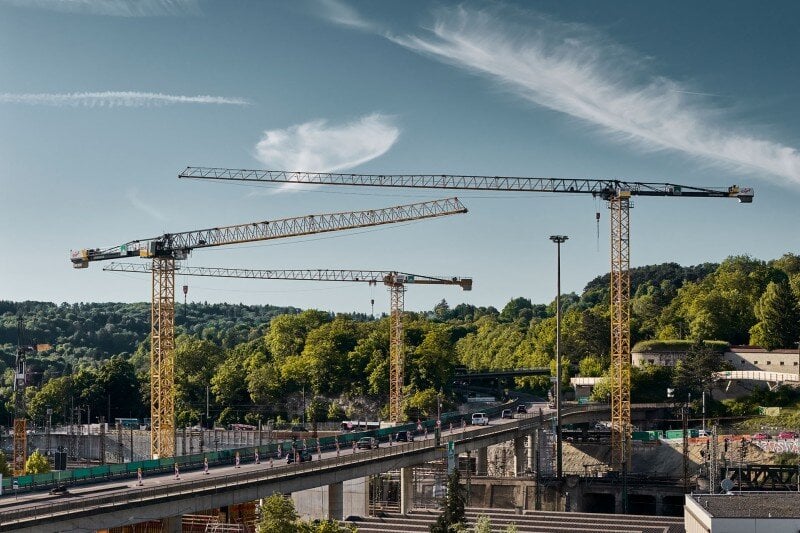
The site’s location between live rail and traffic routes places high demands on precision, load capacity and safety.
Additional Context
This section provides technological and operational background not explicitly detailed in the original release.
Urban infrastructure renewal projects increasingly demand high-capacity lifting solutions that minimize disruption to existing, heavily trafficked corridors. Operating directly above 14 live railway tracks and a B10 highway that accommodates 86,000 vehicles daily introduces severe safety constraints. The transition from steel to high-tensile synthetic fibre ropes in tower cranes is a significant industry advancement; it eliminates the need for routine lubrication, reduces maintenance downtime, and makes the hook block significantly lighter for riggers to maneuver safely. Furthermore, operating multiple overlapping cranes in high-risk zones typically relies on advanced digital anti-collision and working-range limitation systems to ensure heavy loads never inadvertently swing over active traffic or electrified rail lines.
Edited by Lekshman Ramdas, Induportals editor – adapted by AI.
www.liebherr.com
The ARGE B10 consortium, comprising Matthäus Schmid Bauunternehmung and LEONHARD WEISS, has partnered with Nagel Mietservice to deploy seven Liebherr tower cranes for the multi-year replacement of the Wallstraßenbrücke in Ulm. As a vital transport artery dating back to the late 1960s, the bridge is being entirely rebuilt in two sections while maintaining traffic flow. Set for full reopening in summer 2029, the project requires cranes to lift heavy structural and reinforced concrete components with millimeter precision between live rail tracks and a major federal highway.
Fibre Technology and Flexible Lifting
Two Liebherr 520 EC-B 20 Fibre cranes serve as the backbone of the site's heavy lifting operations. These flat-top cranes utilize high-performance fibre ropes instead of conventional steel, significantly reducing hoist rope weight and increasing load capacity by up to 40% compared to equivalent steel-rope models. One unit, featuring an 80-meter jib, covers the main construction area, while a second unit with a 60-meter jib focuses on faster handling in denser zones. A Liebherr 202 EC-B flat-top crane handles formwork and reinforcement, while four self-erecting cranes (one 81 K and three 81 K.1 models) manage rapid material distribution and logistical support within confined spaces.
The site’s location between live rail and traffic routes places high demands on precision, load capacity and safety.
Additional Context
This section provides technological and operational background not explicitly detailed in the original release.
Urban infrastructure renewal projects increasingly demand high-capacity lifting solutions that minimize disruption to existing, heavily trafficked corridors. Operating directly above 14 live railway tracks and a B10 highway that accommodates 86,000 vehicles daily introduces severe safety constraints. The transition from steel to high-tensile synthetic fibre ropes in tower cranes is a significant industry advancement; it eliminates the need for routine lubrication, reduces maintenance downtime, and makes the hook block significantly lighter for riggers to maneuver safely. Furthermore, operating multiple overlapping cranes in high-risk zones typically relies on advanced digital anti-collision and working-range limitation systems to ensure heavy loads never inadvertently swing over active traffic or electrified rail lines.
Edited by Lekshman Ramdas, Induportals editor – adapted by AI.
www.liebherr.com
Powered by
Induportals Media Publishing