Heavy Wheel Loaders Implement Power Split Driveline Technology
Liebherr presents power-split drivetrains and operator assistance systems for quarrying and heavy material handling applications to optimize fuel efficiency and operational safety. www.liebherr.com Equipment deployed in open-pit mining, aggregate processing, and heavy quarrying requires high breakout force alongside sustained transport efficiency under multi-shift duty cycles. Mechanical drivetrains deliver high mechanical efficiency during sustained travel, whereas hydrostatic transmissions provide precise control and high low-speed torque without clutch wear during digging cycles. To address efficiency losses inherent to single-architecture drivelines, Liebherr integrates a continuously variable power-split transmission architecture across its heavy wheel loader range. Power-Split Transmission Mechanics in Aggregate Handling The dual-path driveline dynamically modulates engine power distribution between hydrostatic and mechanical branches through an epicyclic gearbox. During bucket loading and initial penetration into blasted rock faces, the hydrostatic branch handles the predominant torque load, providing continuous tractive effort without driveline slippage or thermal overload. As vehicle speed increases during transport cycles across quarry floors or steep incline ramps, the power-split mechanism seamlessly transitions power distribution to the mechanical branch. This operational shift delivers higher transmission efficiency at intermediate and transport speeds, reducing parasitic losses and fuel consumption per tonne of moved aggregate. Structural Kinematics and Abrasion Management Material extraction workflows rely on Z-bar linkage geometry to concentrate hydraulic pressure into high breakout force at ground level, accelerating the filling cycle of rock buckets in fragmented stone. In high-abrasion applications, such as handling shot rock, ground engagement components face severe mechanical wear. Outfitting the system with reinforced rock buckets and pewag tire protection chains mitigates sidewall punctures, stabilizes contact patches on uneven quarry surfaces, and limits tire degradation during continuous shifts. Sensor-Driven Operator Assistance Systems Operational efficiency in material transport correlates with cycle precision and cycle time management. Integration of onboard payload monitoring directly into the machine control architecture enables dynamic calculation of individual bucket mass relative to target hauler capacity. The Truck Payload Assist system projects required passes, preventing road-haul overloads and reducing underfill cycle inefficiencies without secondary weighing infrastructure. Safety systems mitigate blind-spot hazards through real-time rear-zone radar and camera sensor arrays. The active personnel detection system differentiates between static obstacles and personnel in the reversing envelope. Upon target acquisition within critical distance thresholds, the automated brake assist activates service braking prior to operator reaction time, shortening overall stopping distances on low-friction loose gravel. Optical adjustments via adaptive work lighting align beam angles with lift-arm elevation and frame articulation, reducing operator glare and visual distortion during low-light aggregate loading. Ergonomic cab layouts utilize one-hand joystick steering interfaces that eliminate the steering column, providing an unobstructed sightline directly toward front attachment linkages. Additional Context This section details technical specifications and competitive benchmarking not included in the original product announcement The L 580 XPower operates in the 28-tonne to 30-tonne operating weight class, powered by an internal combustion engine rated at approximately 230 kW to 250 kW, designed for ISO bucket capacities ranging from 4.5 m³ to 6.0 m³. Its continuously variable transmission eliminates the traditional multi-speed powershift gearbox, contrasting with conventional mechanical drivelines that experience shift torque interruptions. In industrial quarry applications, the machine competes directly with the Caterpillar 980 series, the Volvo L260H, and the Komatsu WA475. While the Volvo L260H uses a fully automatic powershift transmission with OptiShift and a lock-up torque converter to reduce fuel burn during load-and-carry cycles, it maintains discrete gear ratios. Caterpillar incorporates lock-up clutch torque converters and advanced powertrain strategies across planetary transmissions to limit slippage on grades. Komatsu implements an independent hydraulic-mechanical transmission (KHMT) on the WA475 platform, mirroring power-split operating principles to decouple engine speed from travel speed. The Liebherr power-split system operates without a conventional torque converter, using the variable planetary layout to maintain engine operation within optimal brake-specific fuel consumption maps across the full operating range. Edited by Evgeny Churilov, Induportals Medi
 machineryasia
Liebherr presents power-split drivetrains and operator assistance systems for quarrying and heavy material handling applications to optimize fuel efficiency and operational safety.
www.liebherr.com
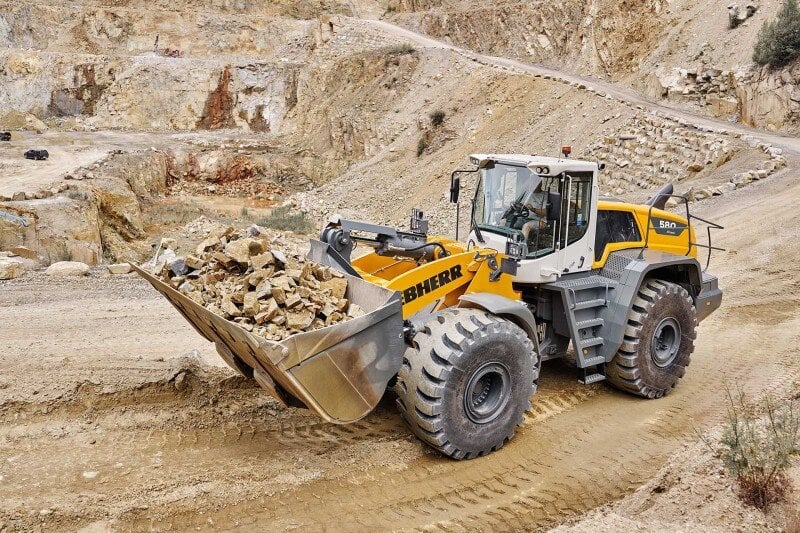
Equipment deployed in open-pit mining, aggregate processing, and heavy quarrying requires high breakout force alongside sustained transport efficiency under multi-shift duty cycles. Mechanical drivetrains deliver high mechanical efficiency during sustained travel, whereas hydrostatic transmissions provide precise control and high low-speed torque without clutch wear during digging cycles. To address efficiency losses inherent to single-architecture drivelines, Liebherr integrates a continuously variable power-split transmission architecture across its heavy wheel loader range.
Power-Split Transmission Mechanics in Aggregate Handling
The dual-path driveline dynamically modulates engine power distribution between hydrostatic and mechanical branches through an epicyclic gearbox. During bucket loading and initial penetration into blasted rock faces, the hydrostatic branch handles the predominant torque load, providing continuous tractive effort without driveline slippage or thermal overload. As vehicle speed increases during transport cycles across quarry floors or steep incline ramps, the power-split mechanism seamlessly transitions power distribution to the mechanical branch. This operational shift delivers higher transmission efficiency at intermediate and transport speeds, reducing parasitic losses and fuel consumption per tonne of moved aggregate.
Structural Kinematics and Abrasion Management
Material extraction workflows rely on Z-bar linkage geometry to concentrate hydraulic pressure into high breakout force at ground level, accelerating the filling cycle of rock buckets in fragmented stone. In high-abrasion applications, such as handling shot rock, ground engagement components face severe mechanical wear. Outfitting the system with reinforced rock buckets and pewag tire protection chains mitigates sidewall punctures, stabilizes contact patches on uneven quarry surfaces, and limits tire degradation during continuous shifts.
Sensor-Driven Operator Assistance Systems
Operational efficiency in material transport correlates with cycle precision and cycle time management. Integration of onboard payload monitoring directly into the machine control architecture enables dynamic calculation of individual bucket mass relative to target hauler capacity. The Truck Payload Assist system projects required passes, preventing road-haul overloads and reducing underfill cycle inefficiencies without secondary weighing infrastructure.
Safety systems mitigate blind-spot hazards through real-time rear-zone radar and camera sensor arrays. The active personnel detection system differentiates between static obstacles and personnel in the reversing envelope. Upon target acquisition within critical distance thresholds, the automated brake assist activates service braking prior to operator reaction time, shortening overall stopping distances on low-friction loose gravel. Optical adjustments via adaptive work lighting align beam angles with lift-arm elevation and frame articulation, reducing operator glare and visual distortion during low-light aggregate loading. Ergonomic cab layouts utilize one-hand joystick steering interfaces that eliminate the steering column, providing an unobstructed sightline directly toward front attachment linkages.
Additional Context
This section details technical specifications and competitive benchmarking not included in the original product announcement
The L 580 XPower operates in the 28-tonne to 30-tonne operating weight class, powered by an internal combustion engine rated at approximately 230 kW to 250 kW, designed for ISO bucket capacities ranging from 4.5 m³ to 6.0 m³. Its continuously variable transmission eliminates the traditional multi-speed powershift gearbox, contrasting with conventional mechanical drivelines that experience shift torque interruptions.
In industrial quarry applications, the machine competes directly with the Caterpillar 980 series, the Volvo L260H, and the Komatsu WA475. While the Volvo L260H uses a fully automatic powershift transmission with OptiShift and a lock-up torque converter to reduce fuel burn during load-and-carry cycles, it maintains discrete gear ratios. Caterpillar incorporates lock-up clutch torque converters and advanced powertrain strategies across planetary transmissions to limit slippage on grades. Komatsu implements an independent hydraulic-mechanical transmission (KHMT) on the WA475 platform, mirroring power-split operating principles to decouple engine speed from travel speed. The Liebherr power-split system operates without a conventional torque converter, using the variable planetary layout to maintain engine operation within optimal brake-specific fuel consumption maps across the full operating range.
Edited by Evgeny Churilov, Induportals Media - Adapted by AI.
www.liebherr.com
Powered by
Induportals Media Publishing