Gertzen upgrades LR 1800-1.0 crane with Liebherr X3 boom
The retrofit enables the 800-tonne crawler crane to install modern wind turbines up to 175 meters tall. www.liebherr.com Gertzen Kranlogistik has retrofitted its Liebherr LR 1800-1.0 crawler crane with the X3 boom system, significantly expanding its lifting capabilities in the wind energy sector. The structural upgrade allows the 800-metric-tonne machine to erect modern wind turbines with hub heights of up to 175 meters—heavy-duty tasks that were previously reserved for larger 1,000-tonne class machines like the Liebherr LR 11000. The retrofitted crane recently completed its maiden deployment at the Heiden wind farm in Germany, successfully installing an ENERCON E-160 EP5 turbine. Enhanced lateral stiffness and transportability The performance increase of the X3 system stems from three specialized lattice sections integrated into the lower segment of the main boom. Each section measures 12 meters in length and six meters in width, providing the enhanced lateral stiffness necessary for extreme lifting heights and long boom configurations. To maintain logistical efficiency without requiring oversized transport vehicles, these wide sections are designed as two separate halves that bolt together down the centerline. During transport, the halves are slightly offset lengthways and interlock, achieving a road-legal transport width of just 3.5 meters. Maiden deployment at Heiden wind farm During its first practical application at the Heiden wind farm, the upgraded crane erected turbines with a tower height of 166 meters. To lift the 131-tonne generator and 82-tonne nacelle, the LR 1800-1.0 was configured with a 166-meter main boom and a 12-meter fixed jib (F). The fixed jib was later extended to 24 meters to accommodate the installation of the sweeping rotor blades. According to Wolfgang Gertzen, Managing Director at Gertzen Kranlogistik, the X3 update allows the company to continuously support long-standing customers like ENERCON as they transition to taller, heavier tower variants. Additional Context: Overcoming lateral deflection in wind installations This section details technical specifications and competitive benchmarking not included in the original product announcement. In onshore wind turbine installation, hub heights have steadily increased to capture more consistent wind speeds at higher altitudes, pushing standard 800-tonne crawler cranes beyond their safe operating envelopes. When lifting components weighing over 100 tonnes to heights approaching 170 meters, the primary physical challenge is not just the raw lifting capacity, but the lateral deflection (bending) of the boom caused by wind loads and the immense leverage of the suspended load. Traditional solutions require mobilizing massive 1,000-tonne or 1,200-tonne class cranes, which incur exorbitant transport fleet requirements and assembly costs. By widening the lower boom sections to six meters, the structural moment of inertia is significantly increased, mechanically stiffening the boom against lateral forces. This modular widening allows contractors to utilize smaller, more easily mobilized cranes for next-generation multi-megawatt turbines, drastically reducing logistical costs and site preparation requirements. Edited by an industrial journalist, Lekshman Ramdas, with AI assistance. www.liebherr.com Powered by Induportals Media Publishing
 machineryasia
The retrofit enables the 800-tonne crawler crane to install modern wind turbines up to 175 meters tall.
www.liebherr.com
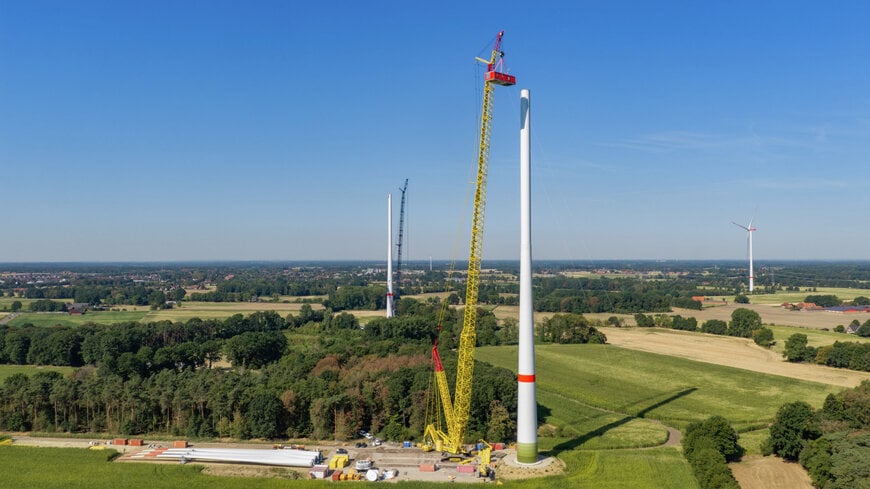
Gertzen Kranlogistik has retrofitted its Liebherr LR 1800-1.0 crawler crane with the X3 boom system, significantly expanding its lifting capabilities in the wind energy sector. The structural upgrade allows the 800-metric-tonne machine to erect modern wind turbines with hub heights of up to 175 meters—heavy-duty tasks that were previously reserved for larger 1,000-tonne class machines like the Liebherr LR 11000. The retrofitted crane recently completed its maiden deployment at the Heiden wind farm in Germany, successfully installing an ENERCON E-160 EP5 turbine.
Enhanced lateral stiffness and transportability
The performance increase of the X3 system stems from three specialized lattice sections integrated into the lower segment of the main boom. Each section measures 12 meters in length and six meters in width, providing the enhanced lateral stiffness necessary for extreme lifting heights and long boom configurations. To maintain logistical efficiency without requiring oversized transport vehicles, these wide sections are designed as two separate halves that bolt together down the centerline. During transport, the halves are slightly offset lengthways and interlock, achieving a road-legal transport width of just 3.5 meters.
Maiden deployment at Heiden wind farm
During its first practical application at the Heiden wind farm, the upgraded crane erected turbines with a tower height of 166 meters. To lift the 131-tonne generator and 82-tonne nacelle, the LR 1800-1.0 was configured with a 166-meter main boom and a 12-meter fixed jib (F). The fixed jib was later extended to 24 meters to accommodate the installation of the sweeping rotor blades. According to Wolfgang Gertzen, Managing Director at Gertzen Kranlogistik, the X3 update allows the company to continuously support long-standing customers like ENERCON as they transition to taller, heavier tower variants.
Additional Context: Overcoming lateral deflection in wind installations
This section details technical specifications and competitive benchmarking not included in the original product announcement.
In onshore wind turbine installation, hub heights have steadily increased to capture more consistent wind speeds at higher altitudes, pushing standard 800-tonne crawler cranes beyond their safe operating envelopes. When lifting components weighing over 100 tonnes to heights approaching 170 meters, the primary physical challenge is not just the raw lifting capacity, but the lateral deflection (bending) of the boom caused by wind loads and the immense leverage of the suspended load. Traditional solutions require mobilizing massive 1,000-tonne or 1,200-tonne class cranes, which incur exorbitant transport fleet requirements and assembly costs. By widening the lower boom sections to six meters, the structural moment of inertia is significantly increased, mechanically stiffening the boom against lateral forces. This modular widening allows contractors to utilize smaller, more easily mobilized cranes for next-generation multi-megawatt turbines, drastically reducing logistical costs and site preparation requirements.
Edited by an industrial journalist, Lekshman Ramdas, with AI assistance.
www.liebherr.com
Powered by
Induportals Media Publishing