Electric building demolition reduces local emissions in urban areas
Metzner Recycling GmbH uses electric construction machinery from Volvo CE for an emission-free building demolition in a municipal project. www.volvoce.com The city of Nuremberg consistently integrates emission reduction requirements into public tenders. During the demolition of a former nursery in Nuremberg's Westpark to convert it into a public green space, strict criteria existed for reducing noise, particulate matter, and nitrogen oxides, as the area directly borders a residential neighborhood. In previous construction projects, electrified approaches often required complex special infrastructures for the energy supply. The goal was to carry out a complete building demolition that integrates logistically and energetically into standardized construction site operations. Use of emission-free construction machinery To meet the strict environmental requirements, the contracted construction company implemented a machine fleet based on electric drives. The fleet includes a crawler excavator, a compact excavator, a compact wheel loader, and an electric truck with a hook lift. The regional partner Robert Aebi Nuremberg handled the technical design and support of the equipment. This machine configuration enables the complete elimination of combustion engine systems in the primary demolition and transport logistics on the construction site. Standardized energy supply and material separation The technological core of the project lies in the uncomplicated energy supply. All machines charge their battery buffers directly via the regular construction site power connection. This method eliminates the cost-intensive need for separate high-voltage grid connections or mobile buffer storage. Parallel to the mechanical dismantling, the project applies urban mining procedures. The resulting building materials are professionally separated directly on-site to ensure unmixed return to the material cycle. "For us as the executing company, it was crucial to plan the project from the very beginning in such a way that the implementation works reliably in everyday construction site operations. The demolition shows that CO₂-free construction sites are practically feasible if technology, logistics, and energy supply are considered together," explains Michael Metzner, Managing Director of Metzner Recycling GmbH. Operational results and emission control Eliminating diesel generators reduces the direct exhaust emissions of the construction site to a minimum and significantly lowers the acoustic burden for the adjacent residents. The continuous use of the standard power infrastructure confirms the system stability and everyday suitability of the deployed battery technology for heavy construction site use. By combining zero emissions and material separation, the project provides practical proof that climate-friendly electric demolition can be realized without compromising productivity. Edited by Maria Brueva, Induportals editor – adapted by AI. www.volvoce.com Powered by Induportals Media Publishing
 machineryasia
Metzner Recycling GmbH uses electric construction machinery from Volvo CE for an emission-free building demolition in a municipal project.
www.volvoce.com
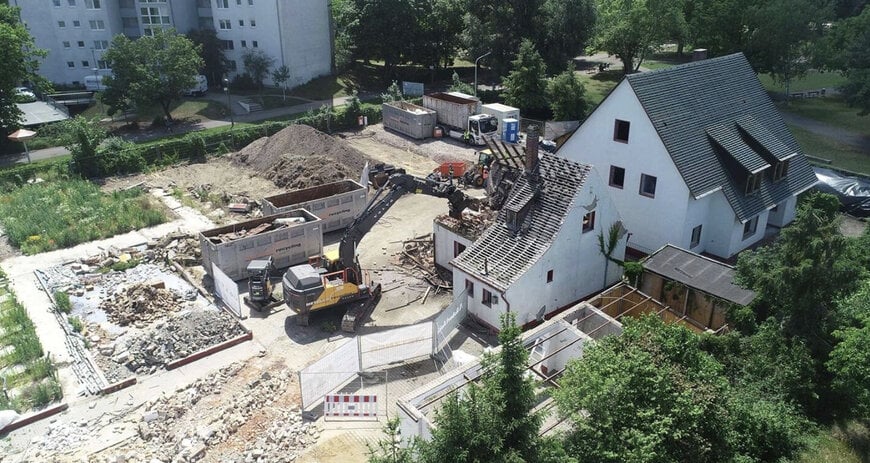
The city of Nuremberg consistently integrates emission reduction requirements into public tenders. During the demolition of a former nursery in Nuremberg's Westpark to convert it into a public green space, strict criteria existed for reducing noise, particulate matter, and nitrogen oxides, as the area directly borders a residential neighborhood. In previous construction projects, electrified approaches often required complex special infrastructures for the energy supply. The goal was to carry out a complete building demolition that integrates logistically and energetically into standardized construction site operations.
Use of emission-free construction machinery
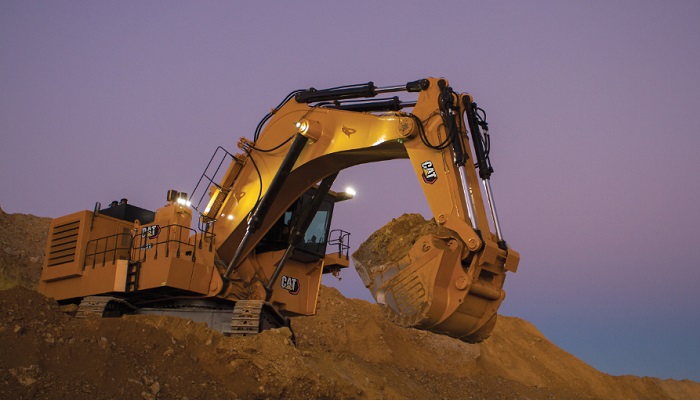
To meet the strict environmental requirements, the contracted construction company implemented a machine fleet based on electric drives. The fleet includes a crawler excavator, a compact excavator, a compact wheel loader, and an electric truck with a hook lift. The regional partner Robert Aebi Nuremberg handled the technical design and support of the equipment. This machine configuration enables the complete elimination of combustion engine systems in the primary demolition and transport logistics on the construction site.
Standardized energy supply and material separation
The technological core of the project lies in the uncomplicated energy supply. All machines charge their battery buffers directly via the regular construction site power connection. This method eliminates the cost-intensive need for separate high-voltage grid connections or mobile buffer storage. Parallel to the mechanical dismantling, the project applies urban mining procedures. The resulting building materials are professionally separated directly on-site to ensure unmixed return to the material cycle.
"For us as the executing company, it was crucial to plan the project from the very beginning in such a way that the implementation works reliably in everyday construction site operations. The demolition shows that CO₂-free construction sites are practically feasible if technology, logistics, and energy supply are considered together," explains Michael Metzner, Managing Director of Metzner Recycling GmbH.
Operational results and emission control
Eliminating diesel generators reduces the direct exhaust emissions of the construction site to a minimum and significantly lowers the acoustic burden for the adjacent residents. The continuous use of the standard power infrastructure confirms the system stability and everyday suitability of the deployed battery technology for heavy construction site use. By combining zero emissions and material separation, the project provides practical proof that climate-friendly electric demolition can be realized without compromising productivity.
Edited by Maria Brueva, Induportals editor – adapted by AI.
www.volvoce.com
Powered by
Induportals Media Publishing