Cordless Pump Speeds Central Lubrication System Refilling
Lutz Pumps and Woerner developed a drill-driven grease pump for faster bulk refilling of centralized lubrication systems in quarry and construction equipment. www.lutz-pumpen.de Lutz Pumps and Eugen Woerner have developed a portable grease-transfer pump designed to refill centralized lubrication systems directly from bulk containers. Intended for quarry, construction and other heavy-equipment maintenance applications, the system uses a standard cordless drill as its drive and can deliver NLGI 2 grease at rates of up to 2 kg/min. The companies will present the system at Steinexpo 2026, held September 2–5, 2026 in the basalt quarry at Nieder-Ofleiden, Hesse, Germany. The pump is marketed by Lutz Pumps as LubeDrive and by Woerner as Power Fill Pro and will be shown in Pavilion 1, Level D, Booth P117. Drill-driven eccentric screw pump replaces manual transfer Centralized lubrication systems automatically distribute lubricant to multiple lubrication points on machinery, but their reservoirs still need to be replenished. In quarry operations, this can involve excavators, dump trucks, screening equipment and other machines operating under high loads and in dusty environments. Common refill methods include 400 g grease cartridges and manually operated grease guns. The cartridge approach requires comparatively small lubricant packages, while manual pumping becomes increasingly time-consuming when several machines require multiple kilograms of grease. The new filling system approaches the task as a bulk grease-transfer operation. According to Lutz Pumps, it is an eccentric screw pump that can be driven by a standard cordless drill rather than a dedicated electric, pneumatic or hydraulic drive. For operation, the pump is secured to the grease container with an adjustable lid. A hose connects the pump outlet to the reservoir of the centralized lubrication system, while the cordless drill supplies the rotary drive required for pumping. This configuration allows maintenance personnel to transfer standard NLGI 2 grease directly from the source container without manually operating a grease lever. Bulk containers target lower lubricant handling costs The system can draw lubricant from containers weighing up to 180 kg. This changes the grease-management process compared with maintenance based on 400 g cartridges. For equipment fleets consuming substantial quantities of lubricant, larger containers can reduce the number of individual packages that must be purchased, stored and disposed of. Lutz Pumps estimates that procurement, storage and disposal costs can be reduced by up to 40%, depending on lubricant pricing and purchasing conditions. The figure therefore represents a potential operating-cost reduction rather than a fixed saving for every application. The bulk-container approach can be particularly relevant to quarry and construction fleets where multiple centralized lubrication reservoirs are replenished during scheduled maintenance. Grease transfer reaches 2 kg/min The pump has a stated grease delivery rate of up to 2 kg/min. This throughput is the main mechanism behind the claimed reduction in refill time. Woerner illustrates the difference using a maintenance operation involving ten machines, each requiring 2 kg of grease. At an assumed manual grease-gun delivery rate of 0.25 kg/min, transferring the required 20 kg would take approximately 80 minutes. At the pump's maximum stated delivery rate of 2 kg/min, the same quantity would require approximately 10 minutes of actual pumping time. Under those assumptions, the transfer stage is shortened by 70 minutes, or 87.5%. The companies describe the achievable time reduction more conservatively as up to 80%, since practical maintenance time can also depend on connecting hoses, repositioning equipment, changing containers and other handling operations. Reduced manual effort during quarry maintenance Grease viscosity makes manual transfer physically demanding, particularly with higher-consistency lubricants and at lower temperatures. Repeated operation of hand levers or manual grease guns places the pumping work on the operator's hands, arms and shoulders. With the drill-driven system, the cordless tool supplies the mechanical input for the eccentric screw pump. The operator therefore does not need to generate the pumping force manually. The pump can also be used as an intermediate filling system for conventional grease guns. At its full stated flow rate, Lutz Pumps and Woerner report that a standard grease gun can be refilled in approximately 10 to 15 seconds. This means the system does not necessarily require operators to replace existing manual lubrication equipment. It can instead be used to accelerate the transfer of grease from bulk containers into either centralized lubrication reservoirs or smaller service tools. Pump architecture separates transfer from lubrication The system's technical role is different from the function of the centralized lubr
 machineryasia
Lutz Pumps and Woerner developed a drill-driven grease pump for faster bulk refilling of centralized lubrication systems in quarry and construction equipment.
www.lutz-pumpen.de
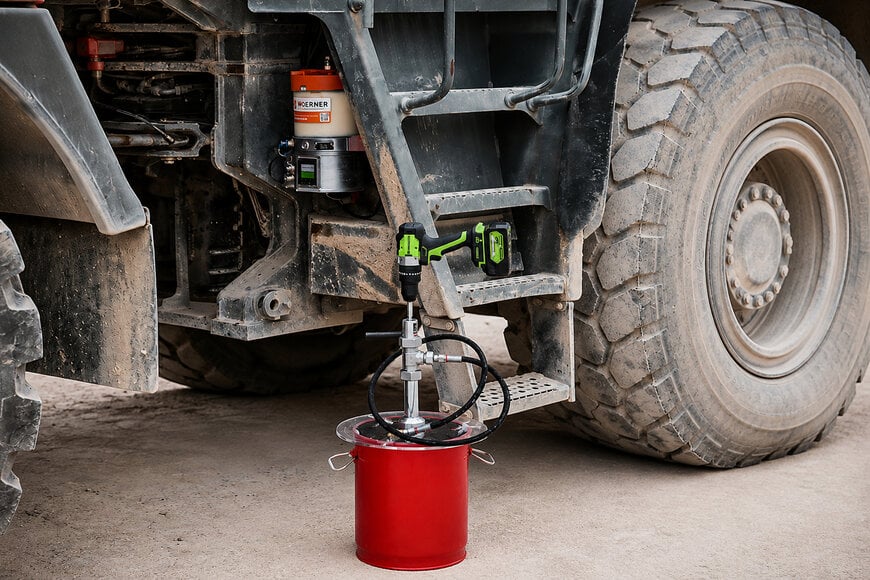
Lutz Pumps and Eugen Woerner have developed a portable grease-transfer pump designed to refill centralized lubrication systems directly from bulk containers. Intended for quarry, construction and other heavy-equipment maintenance applications, the system uses a standard cordless drill as its drive and can deliver NLGI 2 grease at rates of up to 2 kg/min.
The companies will present the system at Steinexpo 2026, held September 2–5, 2026 in the basalt quarry at Nieder-Ofleiden, Hesse, Germany. The pump is marketed by Lutz Pumps as LubeDrive and by Woerner as Power Fill Pro and will be shown in Pavilion 1, Level D, Booth P117.
Drill-driven eccentric screw pump replaces manual transfer
Centralized lubrication systems automatically distribute lubricant to multiple lubrication points on machinery, but their reservoirs still need to be replenished. In quarry operations, this can involve excavators, dump trucks, screening equipment and other machines operating under high loads and in dusty environments.
Common refill methods include 400 g grease cartridges and manually operated grease guns. The cartridge approach requires comparatively small lubricant packages, while manual pumping becomes increasingly time-consuming when several machines require multiple kilograms of grease.
The new filling system approaches the task as a bulk grease-transfer operation. According to Lutz Pumps, it is an eccentric screw pump that can be driven by a standard cordless drill rather than a dedicated electric, pneumatic or hydraulic drive.
For operation, the pump is secured to the grease container with an adjustable lid. A hose connects the pump outlet to the reservoir of the centralized lubrication system, while the cordless drill supplies the rotary drive required for pumping.
This configuration allows maintenance personnel to transfer standard NLGI 2 grease directly from the source container without manually operating a grease lever.
Bulk containers target lower lubricant handling costs
The system can draw lubricant from containers weighing up to 180 kg. This changes the grease-management process compared with maintenance based on 400 g cartridges.
For equipment fleets consuming substantial quantities of lubricant, larger containers can reduce the number of individual packages that must be purchased, stored and disposed of.
Lutz Pumps estimates that procurement, storage and disposal costs can be reduced by up to 40%, depending on lubricant pricing and purchasing conditions. The figure therefore represents a potential operating-cost reduction rather than a fixed saving for every application.
The bulk-container approach can be particularly relevant to quarry and construction fleets where multiple centralized lubrication reservoirs are replenished during scheduled maintenance.
Grease transfer reaches 2 kg/min
The pump has a stated grease delivery rate of up to 2 kg/min. This throughput is the main mechanism behind the claimed reduction in refill time.
Woerner illustrates the difference using a maintenance operation involving ten machines, each requiring 2 kg of grease. At an assumed manual grease-gun delivery rate of 0.25 kg/min, transferring the required 20 kg would take approximately 80 minutes.
At the pump's maximum stated delivery rate of 2 kg/min, the same quantity would require approximately 10 minutes of actual pumping time. Under those assumptions, the transfer stage is shortened by 70 minutes, or 87.5%.
The companies describe the achievable time reduction more conservatively as up to 80%, since practical maintenance time can also depend on connecting hoses, repositioning equipment, changing containers and other handling operations.
Reduced manual effort during quarry maintenance
Grease viscosity makes manual transfer physically demanding, particularly with higher-consistency lubricants and at lower temperatures. Repeated operation of hand levers or manual grease guns places the pumping work on the operator's hands, arms and shoulders.
With the drill-driven system, the cordless tool supplies the mechanical input for the eccentric screw pump. The operator therefore does not need to generate the pumping force manually.
The pump can also be used as an intermediate filling system for conventional grease guns. At its full stated flow rate, Lutz Pumps and Woerner report that a standard grease gun can be refilled in approximately 10 to 15 seconds.
This means the system does not necessarily require operators to replace existing manual lubrication equipment. It can instead be used to accelerate the transfer of grease from bulk containers into either centralized lubrication reservoirs or smaller service tools.
Pump architecture separates transfer from lubrication
The system's technical role is different from the function of the centralized lubrication system itself. The centralized system meters and distributes lubricant to individual machine lubrication points, while the new pump handles the upstream task of transferring grease from the supply container into the system reservoir.
Woerner contributes its experience in automatic centralized lubrication equipment, while Lutz Pumps provides the pumping technology. Both companies are based in Wertheim, Germany.
The resulting design is intended to provide a portable alternative between fully manual grease transfer and filling equipment that requires its own dedicated powered drive.
Additional Context:
This section details technical specifications and competitive benchmarking not included in the original product announcement
Powered grease-handling equipment already exists for industrial and mobile machinery, including battery-powered grease guns and electrically driven centralized lubrication pumps. However, these technologies address different stages of the lubrication process.
For example, Lincoln PowerLuber battery grease guns are positive-displacement tools intended to deliver grease directly to lubrication points. Published specifications for an earlier 12 V PowerLuber configuration indicate compatibility with grease up to NLGI 2, a maximum operating pressure of 413 bar and an output of approximately 76.3 cm³/min at 69 bar.
Industrial centralized lubrication pumps provide another comparison. Graco's G1 series supports grease up to NLGI 2 and uses an electric piston-pump architecture. Published G1 specifications include working pressures up to approximately 35.1 MPa, or 351.6 bar, depending on configuration. These pumps are designed as components of automatic lubrication systems rather than portable bulk-container refill tools.
The Lutz Pumps and Woerner design occupies a different functional category. Its stated maximum transfer rate of 2 kg/min emphasizes bulk grease movement rather than the high-pressure, relatively low-volume dispensing required at individual lubrication points. Its other distinguishing feature is the use of an external standard cordless drill as the pump drive instead of integrating a dedicated electric motor or battery system.
Direct performance comparisons should therefore account for application, pressure, grease consistency and pumping architecture rather than flow rate alone. The 2 kg/min specification describes reservoir-filling capability and should not be interpreted as directly equivalent to the output specification of a high-pressure grease gun or an automatic lubrication-system pump.
Edited by Sucithra Mani, Induportals editor – adapted by AI.
www.lutz-jesco.com
Powered by
Induportals Media Publishing