Calcined Clay Concrete Advances Low-Carbon Construction
Boral Limited completes Australian-first development of calcined clay concrete to reduce cement-related emissions in infrastructure and building applications. www.boral.com.au Boral Limited has completed product development of a low-carbon concrete incorporating Australian calcined clay as a supplementary cementitious material (SCM). The development follows laboratory validation and large-scale field trials, confirming the technical feasibility of calcined clay blends for structural and infrastructure applications. Reducing Clinker Content Through Supplementary Materials Cement production is a primary source of embodied carbon in concrete due to the calcination of limestone and the energy intensity of clinker manufacture. One established pathway to reduce emissions is partial substitution of clinker with SCMs. Calcined clay, produced by thermally activating kaolinitic clays, reacts pozzolanically with calcium hydroxide to form additional calcium silicate hydrates, contributing to strength development and durability. The newly developed mixes comprise binary- and triple-blend formulations, integrating calcined clay alongside conventional cementitious components. According to Boral, these formulations demonstrated workability and performance characteristics comparable to existing low-carbon concrete mixes during controlled laboratory testing and full-scale field pours. From Laboratory Validation to Field Trials Technical feasibility studies began in 2024 in partnership with the University of Technology Sydney, Transport for NSW and Calix, supported by SmartCrete CRC through industry funding and an Australian Commonwealth Government grant. These activities built on preliminary investigations conducted jointly by Boral and UTS between 2020 and 2024. Large-scale validation was undertaken at Boral’s cement operations in Maldon, New South Wales. Test pours assessed placement behaviour, finishing characteristics and early-age performance under operational conditions. The company reports that the calcined clay concrete exhibited handling and visual properties consistent with conventional mixes. Customer-facing trials were also conducted in collaboration with the North East Link project in Victoria and the University of Melbourne. A test slab incorporated clay recycled from excavated soil at the same infrastructure site, demonstrating a potential circular pathway within the construction supply chain. Implications for the Digital Supply Chain and Infrastructure Decarbonisation The integration of locally sourced calcined clay into concrete production provides an additional SCM option for reducing embodied carbon in transport, road and building projects. By diversifying SCM inputs, producers may mitigate supply constraints associated with traditional materials such as fly ash and slag. For asset owners and contractors operating within an increasingly data-driven procurement environment, verified performance data from field trials supports specification decisions within the broader digital supply chain. Demonstrated comparability in workability and performance is critical to ensuring compatibility with established placement practices and structural design standards. Positioning Within Low-Carbon Concrete Development Calcined clay-based systems have been studied internationally, particularly in limestone–calcined clay cement (LC³) formulations. The Australian development reflects adaptation to locally available clay resources and regulatory frameworks. While performance benchmarks depend on mix design and curing conditions, the reported trials indicate technical viability at operational scale. Boral states that industry interest has emerged for additional trials and collaborative deployments, suggesting potential for wider uptake in civil infrastructure and commercial construction where embodied carbon metrics are increasingly specified. Company Profile Boral operates more than 360 sites across Australia, including quarrying, cement, asphalt, recycling and concrete batching facilities. The company employs approximately 7,500 staff and contractors and supplies materials to road, bridge, tunnel and building projects nationwide. www.boral.com Powered by Induportals Media Publishing
 machineryasia
Boral Limited completes Australian-first development of calcined clay concrete to reduce cement-related emissions in infrastructure and building applications.
www.boral.com.au
Boral Limited has completed product development of a low-carbon concrete incorporating Australian calcined clay as a supplementary cementitious material (SCM). The development follows laboratory validation and large-scale field trials, confirming the technical feasibility of calcined clay blends for structural and infrastructure applications.
Reducing Clinker Content Through Supplementary Materials
Cement production is a primary source of embodied carbon in concrete due to the calcination of limestone and the energy intensity of clinker manufacture. One established pathway to reduce emissions is partial substitution of clinker with SCMs. Calcined clay, produced by thermally activating kaolinitic clays, reacts pozzolanically with calcium hydroxide to form additional calcium silicate hydrates, contributing to strength development and durability.
The newly developed mixes comprise binary- and triple-blend formulations, integrating calcined clay alongside conventional cementitious components. According to Boral, these formulations demonstrated workability and performance characteristics comparable to existing low-carbon concrete mixes during controlled laboratory testing and full-scale field pours.
From Laboratory Validation to Field Trials
Technical feasibility studies began in 2024 in partnership with the University of Technology Sydney, Transport for NSW and Calix, supported by SmartCrete CRC through industry funding and an Australian Commonwealth Government grant. These activities built on preliminary investigations conducted jointly by Boral and UTS between 2020 and 2024.
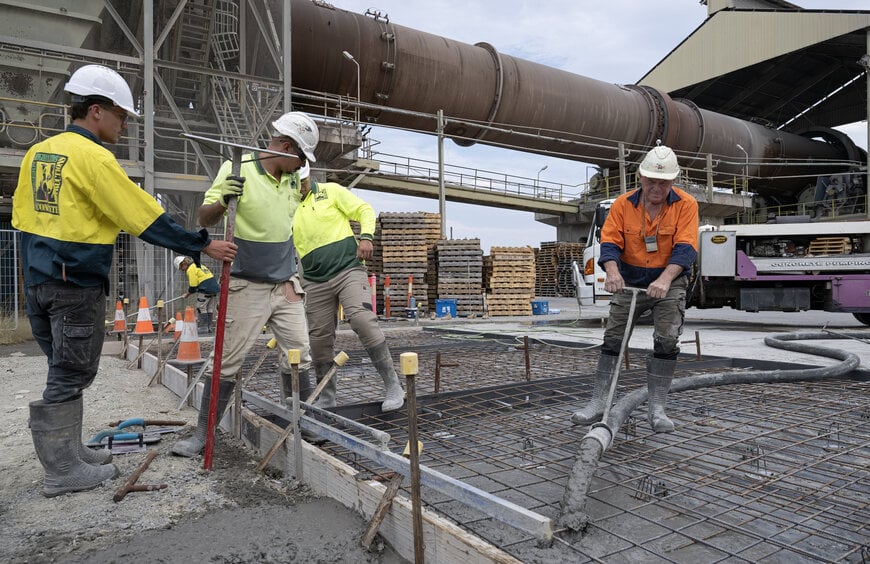
Large-scale validation was undertaken at Boral’s cement operations in Maldon, New South Wales. Test pours assessed placement behaviour, finishing characteristics and early-age performance under operational conditions. The company reports that the calcined clay concrete exhibited handling and visual properties consistent with conventional mixes.
Customer-facing trials were also conducted in collaboration with the North East Link project in Victoria and the University of Melbourne. A test slab incorporated clay recycled from excavated soil at the same infrastructure site, demonstrating a potential circular pathway within the construction supply chain.
Implications for the Digital Supply Chain and Infrastructure Decarbonisation
The integration of locally sourced calcined clay into concrete production provides an additional SCM option for reducing embodied carbon in transport, road and building projects. By diversifying SCM inputs, producers may mitigate supply constraints associated with traditional materials such as fly ash and slag.
For asset owners and contractors operating within an increasingly data-driven procurement environment, verified performance data from field trials supports specification decisions within the broader digital supply chain. Demonstrated comparability in workability and performance is critical to ensuring compatibility with established placement practices and structural design standards.
Positioning Within Low-Carbon Concrete Development
Calcined clay-based systems have been studied internationally, particularly in limestone–calcined clay cement (LC³) formulations. The Australian development reflects adaptation to locally available clay resources and regulatory frameworks. While performance benchmarks depend on mix design and curing conditions, the reported trials indicate technical viability at operational scale.
Boral states that industry interest has emerged for additional trials and collaborative deployments, suggesting potential for wider uptake in civil infrastructure and commercial construction where embodied carbon metrics are increasingly specified.
Company Profile
Boral operates more than 360 sites across Australia, including quarrying, cement, asphalt, recycling and concrete batching facilities. The company employs approximately 7,500 staff and contractors and supplies materials to road, bridge, tunnel and building projects nationwide.
www.boral.com
Powered by
Induportals Media Publishing