Autonomous Asphalt Paving Deployment in Desert Road Infrastructure
XCMG implements an AI-driven fleet for autonomous road compaction and paving to address extreme temperature and sandstorm conditions in infrastructure development projects. www.xcmg.com The Oman Ministry of Transport, Communications and Information Technology and Galfar Engineering & Contracting are utilizing a centralized AI-powered fleet for autonomous asphalt paving. This digital supply chain integration addresses specific road infrastructure construction requirements within extreme desert environments. Digital Supply Chain Integration and Fleet Collaborative Control The deployment took place on the Sultan Said bin Taimur Road Dualisation Project, focusing on upgrading regional road connectivity. Following regular operations that commenced in April 2026, a public technology demonstration was executed on May 20, 2026. A fleet of seven intelligent construction machines completed full-process autonomous asphalt paving and compaction on a 12-meter-wide road section. This system relies on a local private network communication infrastructure and real-time machine interaction to maintain continuous construction data monitoring across the entire fleet without relying on external cellular grids. Environmental Adaptability and System Optimization The operating conditions in Oman present high ambient temperatures and frequent sandstorms, variables that directly impact equipment reliability and multi-machine coordination accuracy. Technical teams optimized the intelligent construction system for these specific climatic variables following prior site surveys and technical assessments. The automated system mitigates the impact of volatile site conditions by automating routine machinery navigation and material deposition. This standardizes the construction operations and reduces reliance on manual coordination in harsh climates, ensuring uninterrupted operation despite atmospheric interference. Strategic Infrastructure Implementation and Technology Validation The underlying automotive data ecosystem utilized in this deployment was established through a two-year technical validation process, which included a review phase during the 6th XCMG International Customer Festival in 2024. The fourth package of the Sultan Said bin Taimur Road Dualisation Project functions as a benchmark for automated infrastructure modernization. By leveraging automated sensor feedback loops and closed-network data sharing, the paving fleet maintains compaction consistency and operational uptime without direct manual intervention. Additional Context: This section details technical specifications and competitive benchmarking not included in the original product announcement In the autonomous road construction sector, this technology competes with established systems such as Caterpillar Command for Compaction and BOMAG ASPHALT PRO. While Caterpillar utilizes scalable global navigation satellite systems for automated roller routing, the deployed fleet relies on a localized private network to ensure uninterrupted machine interaction in remote desert environments where satellite or commercial cellular signals frequently degrade. BOMAG provides real-time temperature monitoring and predictive pathing primarily for rollers, whereas this autonomous fleet extends automation beyond compaction to include the actual material deposition process executed by the pavers. Standard benchmark criteria for autonomous paving operations focus on continuous operation width, sensor communication latency, and deviation margins from pre-programmed routes. The automated operation on a 12-meter-wide road section indicates a multi-machine synchronization capability that aligns with established industry thresholds for wide-lane continuous paving. Edited by Natania Lyngdoh, Induportals editor, assisted by AI. www.xcmgglobal.com Powered by Induportals Media Publishing
 machineryasia
XCMG implements an AI-driven fleet for autonomous road compaction and paving to address extreme temperature and sandstorm conditions in infrastructure development projects.
www.xcmg.com
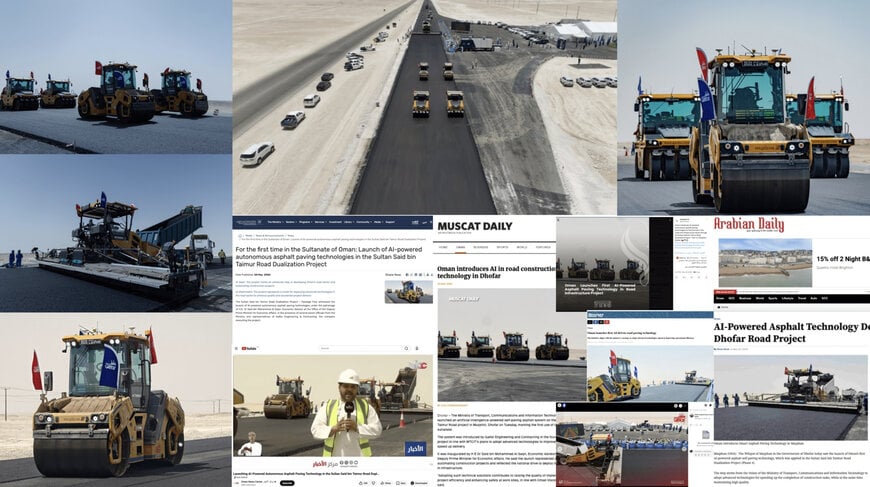
The Oman Ministry of Transport, Communications and Information Technology and Galfar Engineering & Contracting are utilizing a centralized AI-powered fleet for autonomous asphalt paving. This digital supply chain integration addresses specific road infrastructure construction requirements within extreme desert environments.
Digital Supply Chain Integration and Fleet Collaborative Control
The deployment took place on the Sultan Said bin Taimur Road Dualisation Project, focusing on upgrading regional road connectivity. Following regular operations that commenced in April 2026, a public technology demonstration was executed on May 20, 2026. A fleet of seven intelligent construction machines completed full-process autonomous asphalt paving and compaction on a 12-meter-wide road section. This system relies on a local private network communication infrastructure and real-time machine interaction to maintain continuous construction data monitoring across the entire fleet without relying on external cellular grids.
Environmental Adaptability and System Optimization
The operating conditions in Oman present high ambient temperatures and frequent sandstorms, variables that directly impact equipment reliability and multi-machine coordination accuracy. Technical teams optimized the intelligent construction system for these specific climatic variables following prior site surveys and technical assessments. The automated system mitigates the impact of volatile site conditions by automating routine machinery navigation and material deposition. This standardizes the construction operations and reduces reliance on manual coordination in harsh climates, ensuring uninterrupted operation despite atmospheric interference.
Strategic Infrastructure Implementation and Technology Validation
The underlying automotive data ecosystem utilized in this deployment was established through a two-year technical validation process, which included a review phase during the 6th XCMG International Customer Festival in 2024. The fourth package of the Sultan Said bin Taimur Road Dualisation Project functions as a benchmark for automated infrastructure modernization. By leveraging automated sensor feedback loops and closed-network data sharing, the paving fleet maintains compaction consistency and operational uptime without direct manual intervention.
Additional Context:
This section details technical specifications and competitive benchmarking not included in the original product announcement
In the autonomous road construction sector, this technology competes with established systems such as Caterpillar Command for Compaction and BOMAG ASPHALT PRO. While Caterpillar utilizes scalable global navigation satellite systems for automated roller routing, the deployed fleet relies on a localized private network to ensure uninterrupted machine interaction in remote desert environments where satellite or commercial cellular signals frequently degrade. BOMAG provides real-time temperature monitoring and predictive pathing primarily for rollers, whereas this autonomous fleet extends automation beyond compaction to include the actual material deposition process executed by the pavers. Standard benchmark criteria for autonomous paving operations focus on continuous operation width, sensor communication latency, and deviation margins from pre-programmed routes. The automated operation on a 12-meter-wide road section indicates a multi-machine synchronization capability that aligns with established industry thresholds for wide-lane continuous paving.
Edited by Natania Lyngdoh, Induportals editor, assisted by AI.
www.xcmgglobal.com
Powered by
Induportals Media Publishing