Networked Compact Earthmoving Equipment for Urban Construction Projects
Liebherr introduces generation 8 crawler excavators designed to address spatial constraints in earthmoving and utility installation. www.liebherr.com Liebherr-France SAS has released its generation 8 series of 15- to 20-tonne compact crawler excavators developed for earthmoving, road construction, and utility installation. The launch introduces networked machinery designed to operate within confined urban construction environments while maintaining high dig capabilities. Development Context and Technical Baseline Manufactured at the Liebherr-France SAS facility in Colmar, the R 915, R 917, and R 920 generation 8 models were presented at Bauma 2025. These machines target the 15- to 20-tonne weight class, addressing the specific requirements of urban construction where a digital construction ecosystem and physical space constraints dictate equipment selection. Operational Interface and Cab Architecture The operator environment is built around the Emcab and the Intusi control system. The Intusi architecture provides a programmable interface to manage primary machine functions. Electric joysticks are integrated for precise input transmission, intended to stabilize control during complex maneuvers such as heavy lifting and pipeline positioning. This setup digitizes the interaction between the operator and the machine's hydraulic system. Dimensional Specifications and Tail Swing Metrics The R 917 unit functions as an entirely new engineering platform within this series, operating between the capacities of the R 915 and R 920 models. It is built with a 1,700 mm tail swing radius, which reduces the clearance required for the upper carriage to rotate. This physical dimension facilitates safe operation in restricted zones typical of urban infrastructure development, allowing operators to position the unit close to physical barriers without collision during the rotation cycle. Powertrain and Kinematics Performance The generation 8 machines utilize internal combustion powertrains calibrated for distinct power outputs across the product tier. The baseline R 915 generates 90 kW (122 hp), the intermediate R 917 provides 100 kW (136 hp), and the R 920 delivers 110 kW (150 hp). The kinematic geometry of the boom and arm is designed to optimize digging force and torque transfer, maximizing earthmoving capability per cycle and minimizing the frequency of track repositioning during continuous trenching operations. Ground-level access to service points supports scheduled maintenance execution. Fleet Integration and Data Telematics The excavators connect to fleet management interfaces via MyLiebherr Maintenance and Performance modules. This connectivity transmits operational parameters back to fleet managers, feeding into the broader digital construction ecosystem. The electronic architecture of the generation 8 platform is open, facilitating the integration of subsequent assistance systems and sensor networks. Additional Context: This section details technical specifications and competitive benchmarking not included in the original product announcement In the 15- to 20-tonne compact crawler excavator segment, these generation 8 units compete directly with established short-radius platforms such as the Caterpillar 315 and the Komatsu PC170LC. The Caterpillar 315 operates with an 80 kW engine and a tail swing radius of 1,530 mm, prioritizing an extremely tight footprint for single-lane roadwork. The Liebherr R 915 and R 917 units offer higher gross engine outputs at 90 kW and 100 kW respectively, positioned to handle heavier lifting configurations and hydraulic attachment demands, though with a slightly larger 1,700 mm tail swing radius on the R 917. Standardized benchmark criteria for this class focus on power-to-weight ratio, swing torque, and lifting capacity at maximum reach over the side, metrics where the increased engine output of the generation 8 series provides measurable hydraulic flow advantages for multi-functional attachments. Edited by Natania Lyngdoh, Induportals editor, assisted by AI. www.liebherr.com Powered by Induportals Media Publishing
 machineryasia
Liebherr introduces generation 8 crawler excavators designed to address spatial constraints in earthmoving and utility installation.
www.liebherr.com
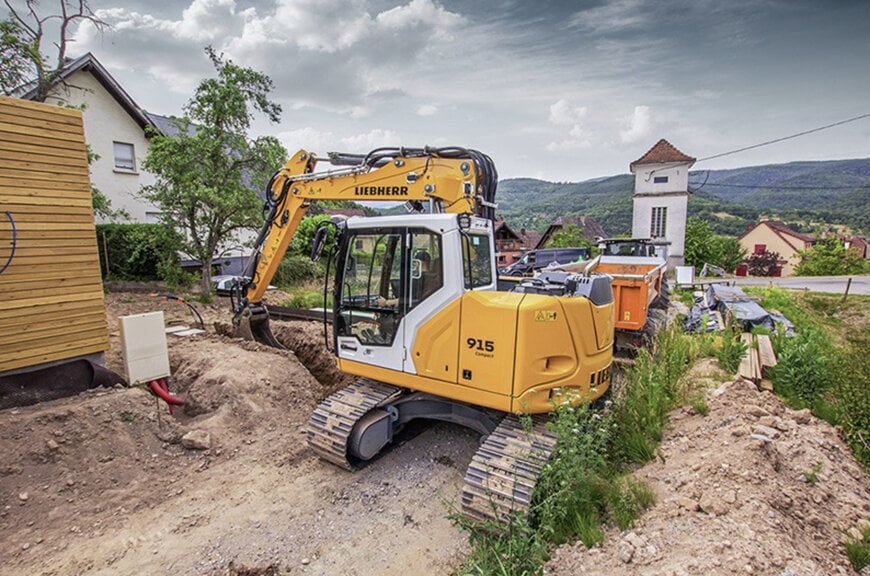
Liebherr-France SAS has released its generation 8 series of 15- to 20-tonne compact crawler excavators developed for earthmoving, road construction, and utility installation. The launch introduces networked machinery designed to operate within confined urban construction environments while maintaining high dig capabilities.
Development Context and Technical Baseline
Manufactured at the Liebherr-France SAS facility in Colmar, the R 915, R 917, and R 920 generation 8 models were presented at Bauma 2025. These machines target the 15- to 20-tonne weight class, addressing the specific requirements of urban construction where a digital construction ecosystem and physical space constraints dictate equipment selection.
Operational Interface and Cab Architecture
The operator environment is built around the Emcab and the Intusi control system. The Intusi architecture provides a programmable interface to manage primary machine functions. Electric joysticks are integrated for precise input transmission, intended to stabilize control during complex maneuvers such as heavy lifting and pipeline positioning. This setup digitizes the interaction between the operator and the machine's hydraulic system.
Dimensional Specifications and Tail Swing Metrics
The R 917 unit functions as an entirely new engineering platform within this series, operating between the capacities of the R 915 and R 920 models. It is built with a 1,700 mm tail swing radius, which reduces the clearance required for the upper carriage to rotate. This physical dimension facilitates safe operation in restricted zones typical of urban infrastructure development, allowing operators to position the unit close to physical barriers without collision during the rotation cycle.
Powertrain and Kinematics Performance
The generation 8 machines utilize internal combustion powertrains calibrated for distinct power outputs across the product tier. The baseline R 915 generates 90 kW (122 hp), the intermediate R 917 provides 100 kW (136 hp), and the R 920 delivers 110 kW (150 hp). The kinematic geometry of the boom and arm is designed to optimize digging force and torque transfer, maximizing earthmoving capability per cycle and minimizing the frequency of track repositioning during continuous trenching operations. Ground-level access to service points supports scheduled maintenance execution.
Fleet Integration and Data Telematics
The excavators connect to fleet management interfaces via MyLiebherr Maintenance and Performance modules. This connectivity transmits operational parameters back to fleet managers, feeding into the broader digital construction ecosystem. The electronic architecture of the generation 8 platform is open, facilitating the integration of subsequent assistance systems and sensor networks.
Additional Context:
This section details technical specifications and competitive benchmarking not included in the original product announcement
In the 15- to 20-tonne compact crawler excavator segment, these generation 8 units compete directly with established short-radius platforms such as the Caterpillar 315 and the Komatsu PC170LC. The Caterpillar 315 operates with an 80 kW engine and a tail swing radius of 1,530 mm, prioritizing an extremely tight footprint for single-lane roadwork. The Liebherr R 915 and R 917 units offer higher gross engine outputs at 90 kW and 100 kW respectively, positioned to handle heavier lifting configurations and hydraulic attachment demands, though with a slightly larger 1,700 mm tail swing radius on the R 917. Standardized benchmark criteria for this class focus on power-to-weight ratio, swing torque, and lifting capacity at maximum reach over the side, metrics where the increased engine output of the generation 8 series provides measurable hydraulic flow advantages for multi-functional attachments.
Edited by Natania Lyngdoh, Induportals editor, assisted by AI.
www.liebherr.com
Powered by
Induportals Media Publishing