Underwater demolition enables quay wall renewal in Antwerp
Adex Groep deployed specialized underwater demolition equipment to dismantle a submerged quay wall at Antwerp’s Europa Terminal under extreme tidal conditions. www.epiroc.com Adex Groep is a Netherlands-based specialist in complex demolition and marine engineering works. At the Europa Terminal in the Port of Antwerp, the company was contracted to dismantle an existing quay wall as part of a large-scale port expansion project. The structure to be removed extends over 1,200 meters and is supported by 49 cylindrical concrete caissons, each approximately 30 meters in diameter and height. Most of these caissons are fully submerged, filled with sand and stabilized with grout. Their presence obstructed the construction of a new quay wall and required complete removal. The project site lies in the Westerschelde estuary, where tidal variations of up to six meters impose strict operational constraints on floating equipment and underwater work. Technical challenges and project objectives The main technical challenge was to remove reinforced concrete structures at depths reaching 24–30 meters below the Belgian reference level (TAW), while maintaining precision and stability despite changing water levels. Adex Groep’s objectives included: Maintaining accurate positioning of demolition tools under water Achieving stable crane operation on a floating platform Ensuring continuous productivity despite tidal fluctuations Limiting downtime during a long-duration, high-volume demolition campaign Engineering solution: customized pontoon and crane system To meet these requirements, Adex Groep engineered a self-leveling pontoon equipped with a 320-ton demolition crane, known as Genius. The pontoon was modernized with an automatic leveling system using pressure sensors to continuously adjust load distribution as conditions changed. Additional adaptations included extended crane booms and elongated spud poles, allowing demolition tools to reach the required depths while maintaining operational control. The crane itself was built largely from reused structural components, aligning with circular construction principles while delivering the necessary lifting and cutting capacity. Underwater demolition equipment selection Central to the demolition work was a heavy-duty hydraulic breaker supplied by Epiroc through its local partner SAES International B.V.. The breaker was configured specifically for underwater operation and was capable of working reliably at depths of up to 24 meters. In addition, a concrete shear was mounted on the Genius crane to cut and remove reinforced concrete blocks of up to one cubic meter. This combination allowed Adex Groep to alternate between breaking, cutting, and vibrating concrete depending on the structure encountered. The selection of these tools was driven by their ability to withstand prolonged underwater use, deliver controlled breaking forces, and integrate with positioning and monitoring systems. Deployment and operational support Precise positioning was achieved using a GPS and laser-based guidance system supplied by CT Systems. Live positional data ensured that demolition parameters remained accurate even at significant depths. Operational continuity was supported through close coordination with SAES International, which provided spare parts availability and rapid replacement equipment when required. This approach reduced the risk of extended stoppages in a project where equipment failure under water could otherwise cause significant delays. Measured performance and productivity According to project data from Adex Groep, the demolition system is capable of removing or cutting up to 1,000 tonnes of concrete per day. Approximately six meters of caisson height can be removed before debris clearance is handed over to a second pontoon-mounted crane. In practice, several hours of active demolition generate enough material to keep cleanup operations occupied for an entire day, indicating a high demolition-to-clearance ratio and efficient use of specialized assets. Outcome Controlled demolition under extreme conditions Since mobilization began in August 2023, the project has progressed through a technically demanding startup phase involving large-scale equipment deployment and system integration. The combination of customized floating infrastructure, deep-water-capable demolition tools, and real-time positioning technology has enabled consistent progress despite tidal variability and depth-related constraints. The project demonstrates how tailored engineering solutions and coordinated technical support can enable precise, large-scale underwater demolition as part of modern port infrastructure renewal. www.epiroc.com Powered by Induportals Media Publishing
 machineryasia
Adex Groep deployed specialized underwater demolition equipment to dismantle a submerged quay wall at Antwerp’s Europa Terminal under extreme tidal conditions.
www.epiroc.com
Adex Groep is a Netherlands-based specialist in complex demolition and marine engineering works. At the Europa Terminal in the Port of Antwerp, the company was contracted to dismantle an existing quay wall as part of a large-scale port expansion project.
The structure to be removed extends over 1,200 meters and is supported by 49 cylindrical concrete caissons, each approximately 30 meters in diameter and height. Most of these caissons are fully submerged, filled with sand and stabilized with grout. Their presence obstructed the construction of a new quay wall and required complete removal.
The project site lies in the Westerschelde estuary, where tidal variations of up to six meters impose strict operational constraints on floating equipment and underwater work.
Technical challenges and project objectives
The main technical challenge was to remove reinforced concrete structures at depths reaching 24–30 meters below the Belgian reference level (TAW), while maintaining precision and stability despite changing water levels.
Adex Groep’s objectives included:
- Maintaining accurate positioning of demolition tools under water
- Achieving stable crane operation on a floating platform
- Ensuring continuous productivity despite tidal fluctuations
- Limiting downtime during a long-duration, high-volume demolition campaign
Engineering solution: customized pontoon and crane system
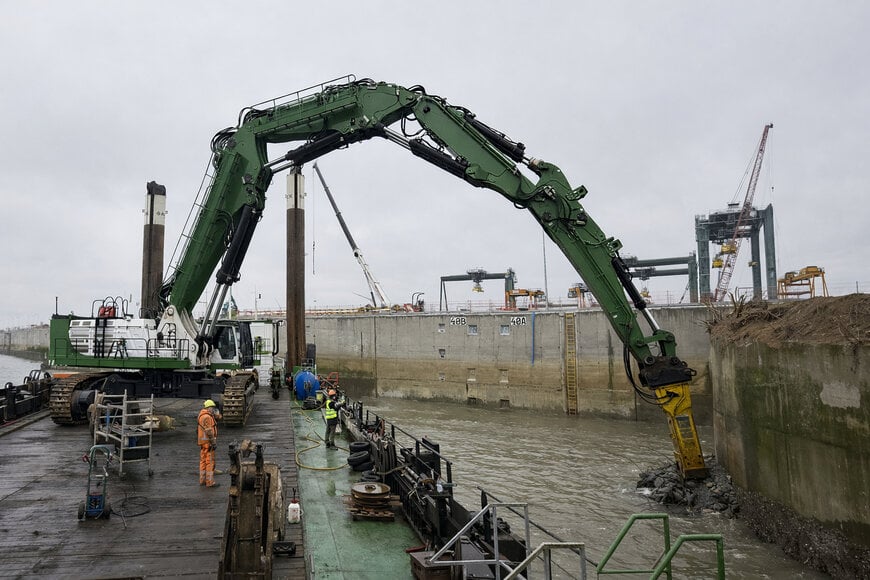
To meet these requirements, Adex Groep engineered a self-leveling pontoon equipped with a 320-ton demolition crane, known as Genius. The pontoon was modernized with an automatic leveling system using pressure sensors to continuously adjust load distribution as conditions changed.
Additional adaptations included extended crane booms and elongated spud poles, allowing demolition tools to reach the required depths while maintaining operational control. The crane itself was built largely from reused structural components, aligning with circular construction principles while delivering the necessary lifting and cutting capacity.
Underwater demolition equipment selection
Central to the demolition work was a heavy-duty hydraulic breaker supplied by Epiroc through its local partner SAES International B.V.. The breaker was configured specifically for underwater operation and was capable of working reliably at depths of up to 24 meters.
In addition, a concrete shear was mounted on the Genius crane to cut and remove reinforced concrete blocks of up to one cubic meter. This combination allowed Adex Groep to alternate between breaking, cutting, and vibrating concrete depending on the structure encountered.
The selection of these tools was driven by their ability to withstand prolonged underwater use, deliver controlled breaking forces, and integrate with positioning and monitoring systems.
Deployment and operational support
Precise positioning was achieved using a GPS and laser-based guidance system supplied by CT Systems. Live positional data ensured that demolition parameters remained accurate even at significant depths.
Operational continuity was supported through close coordination with SAES International, which provided spare parts availability and rapid replacement equipment when required. This approach reduced the risk of extended stoppages in a project where equipment failure under water could otherwise cause significant delays.
Measured performance and productivity
According to project data from Adex Groep, the demolition system is capable of removing or cutting up to 1,000 tonnes of concrete per day. Approximately six meters of caisson height can be removed before debris clearance is handed over to a second pontoon-mounted crane.
In practice, several hours of active demolition generate enough material to keep cleanup operations occupied for an entire day, indicating a high demolition-to-clearance ratio and efficient use of specialized assets.
Outcome Controlled demolition under extreme conditions
Since mobilization began in August 2023, the project has progressed through a technically demanding startup phase involving large-scale equipment deployment and system integration. The combination of customized floating infrastructure, deep-water-capable demolition tools, and real-time positioning technology has enabled consistent progress despite tidal variability and depth-related constraints.
The project demonstrates how tailored engineering solutions and coordinated technical support can enable precise, large-scale underwater demolition as part of modern port infrastructure renewal.
www.epiroc.com
To meet these requirements, Adex Groep engineered a self-leveling pontoon equipped with a 320-ton demolition crane, known as Genius. The pontoon was modernized with an automatic leveling system using pressure sensors to continuously adjust load distribution as conditions changed.
Additional adaptations included extended crane booms and elongated spud poles, allowing demolition tools to reach the required depths while maintaining operational control. The crane itself was built largely from reused structural components, aligning with circular construction principles while delivering the necessary lifting and cutting capacity.
Underwater demolition equipment selection
Central to the demolition work was a heavy-duty hydraulic breaker supplied by Epiroc through its local partner SAES International B.V.. The breaker was configured specifically for underwater operation and was capable of working reliably at depths of up to 24 meters.
In addition, a concrete shear was mounted on the Genius crane to cut and remove reinforced concrete blocks of up to one cubic meter. This combination allowed Adex Groep to alternate between breaking, cutting, and vibrating concrete depending on the structure encountered.
The selection of these tools was driven by their ability to withstand prolonged underwater use, deliver controlled breaking forces, and integrate with positioning and monitoring systems.
Deployment and operational support
Precise positioning was achieved using a GPS and laser-based guidance system supplied by CT Systems. Live positional data ensured that demolition parameters remained accurate even at significant depths.
Operational continuity was supported through close coordination with SAES International, which provided spare parts availability and rapid replacement equipment when required. This approach reduced the risk of extended stoppages in a project where equipment failure under water could otherwise cause significant delays.
Measured performance and productivity
According to project data from Adex Groep, the demolition system is capable of removing or cutting up to 1,000 tonnes of concrete per day. Approximately six meters of caisson height can be removed before debris clearance is handed over to a second pontoon-mounted crane.
In practice, several hours of active demolition generate enough material to keep cleanup operations occupied for an entire day, indicating a high demolition-to-clearance ratio and efficient use of specialized assets.
Outcome Controlled demolition under extreme conditions
Since mobilization began in August 2023, the project has progressed through a technically demanding startup phase involving large-scale equipment deployment and system integration. The combination of customized floating infrastructure, deep-water-capable demolition tools, and real-time positioning technology has enabled consistent progress despite tidal variability and depth-related constraints.
The project demonstrates how tailored engineering solutions and coordinated technical support can enable precise, large-scale underwater demolition as part of modern port infrastructure renewal.
www.epiroc.com
Powered by
Induportals Media Publishing