Trelleborg launches Turcon SG seals for off-highway CTIS
The pressure-activated rotary seals minimise friction and extend central tyre inflation system lifespans beyond 10,000 hours. www.trelleborg.com The Turcon® SG range of specialized sealing components is engineered to optimize performance of central tire inflation systems (CTIS) in challenging off-highway environments. Trelleborg Sealing Solutions has introduced the Turcon SG, a range of specialised rotary seals engineered to optimise central tyre inflation systems (CTIS) in challenging off-highway environments. Designed for agriculture, mining, construction, and forestry vehicles, the new seals maintain system airtightness during inflation and deflation cycles. By reliably adjusting tyre pressure to match varying ground conditions, the technology helps operators reduce fuel consumption by up to 15 percent, lower carbon emissions, and minimise soil compaction while maintaining optimal traction across transitioning terrains. Pressure-activated friction reduction Maintaining a reliable seal under continuous rotary motion and pneumatic pressure typically generates significant friction and heat. To resolve this engineering challenge, the Turcon SG features a pressure-activated polytetrafluoroethylene (PTFE) sealing lip. For 90 to 95 percent of the vehicle's operating cycle, the lip remains in an unpressurised, near-zero-friction state. The seal only activates against the counter-surface when pneumatic pressure is actively applied during a tyre pressure adjustment. This targeted actuation drastically reduces mechanical wear, extending the component's service life beyond 10,000 operating hours and significantly reducing maintenance-related downtime. Modular design and axle integration The seal's all-in-one modular design simplifies installation for high-volume automated production lines. It integrates a built-in static elastomer seal and a guiding element to compensate for hardware tolerances across various axle configurations, consolidating multiple functions—including scrapers and radial shaft seals—into a single compact assembly. Trelleborg provides the Turcon SG as both an integrated internal axle solution and an external assembly. The system accommodates both trailer and driven axles across single- and dual-channel variants, optimising CTIS functionality for heavy machinery such as sprayers, combine harvesters, wheel loaders, and articulated dump trucks. Additional Context: CTIS mechanics and soil compaction In heavy-duty agricultural and off-highway applications, static tyre pressures are a compromise between high-speed road travel and low-speed field operations. Operating a heavily loaded tractor on soft soil with road-level tyre pressure drastically reduces the contact patch, driving the weight deep into the ground and leading to severe soil compaction. This compaction damages root structures, reduces water infiltration, and degrades crop yields. Central Tyre Inflation Systems (CTIS) solve this by allowing the operator to dynamically deflate the tyres in the field—lengthening the footprint to distribute vehicle weight and improve tractive effort—and reinflate them for transit. The rotary seals within the wheel hub are the most critical failure point in a CTIS, as they must transfer high-pressure air from the stationary axle to the rotating wheel without leaking. Minimising parasitic drag on these seals when the system is inactive prevents premature thermal degradation and catastrophic pressure loss. Edited by Lekshman Ramdas, InduPortals editor – adapted by AI. www.trelleborg.com Powered by Induportals Media Publishing
 machineryasia
The pressure-activated rotary seals minimise friction and extend central tyre inflation system lifespans beyond 10,000 hours.
www.trelleborg.com
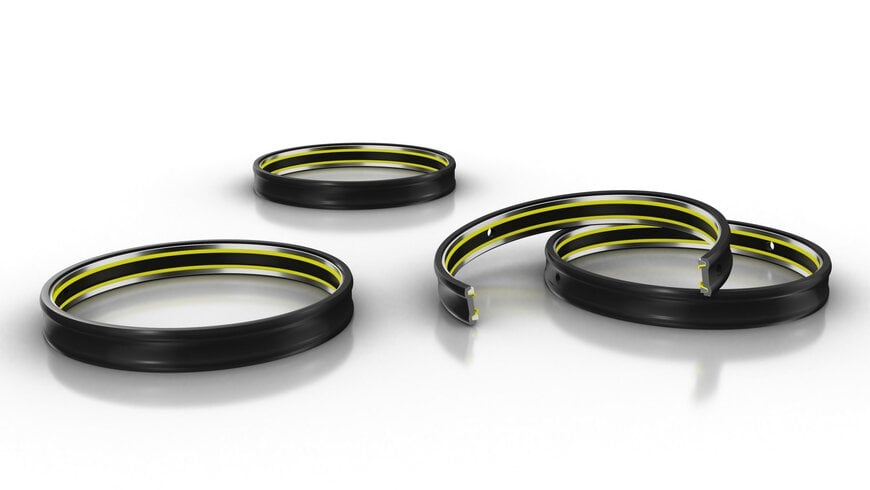
The Turcon® SG range of specialized sealing components is engineered to optimize performance of central tire inflation systems (CTIS) in challenging off-highway environments.
Trelleborg Sealing Solutions has introduced the Turcon SG, a range of specialised rotary seals engineered to optimise central tyre inflation systems (CTIS) in challenging off-highway environments. Designed for agriculture, mining, construction, and forestry vehicles, the new seals maintain system airtightness during inflation and deflation cycles. By reliably adjusting tyre pressure to match varying ground conditions, the technology helps operators reduce fuel consumption by up to 15 percent, lower carbon emissions, and minimise soil compaction while maintaining optimal traction across transitioning terrains.
Pressure-activated friction reduction
Maintaining a reliable seal under continuous rotary motion and pneumatic pressure typically generates significant friction and heat. To resolve this engineering challenge, the Turcon SG features a pressure-activated polytetrafluoroethylene (PTFE) sealing lip. For 90 to 95 percent of the vehicle's operating cycle, the lip remains in an unpressurised, near-zero-friction state. The seal only activates against the counter-surface when pneumatic pressure is actively applied during a tyre pressure adjustment. This targeted actuation drastically reduces mechanical wear, extending the component's service life beyond 10,000 operating hours and significantly reducing maintenance-related downtime.
Modular design and axle integration
The seal's all-in-one modular design simplifies installation for high-volume automated production lines. It integrates a built-in static elastomer seal and a guiding element to compensate for hardware tolerances across various axle configurations, consolidating multiple functions—including scrapers and radial shaft seals—into a single compact assembly. Trelleborg provides the Turcon SG as both an integrated internal axle solution and an external assembly. The system accommodates both trailer and driven axles across single- and dual-channel variants, optimising CTIS functionality for heavy machinery such as sprayers, combine harvesters, wheel loaders, and articulated dump trucks.
Additional Context: CTIS mechanics and soil compaction
In heavy-duty agricultural and off-highway applications, static tyre pressures are a compromise between high-speed road travel and low-speed field operations. Operating a heavily loaded tractor on soft soil with road-level tyre pressure drastically reduces the contact patch, driving the weight deep into the ground and leading to severe soil compaction. This compaction damages root structures, reduces water infiltration, and degrades crop yields. Central Tyre Inflation Systems (CTIS) solve this by allowing the operator to dynamically deflate the tyres in the field—lengthening the footprint to distribute vehicle weight and improve tractive effort—and reinflate them for transit. The rotary seals within the wheel hub are the most critical failure point in a CTIS, as they must transfer high-pressure air from the stationary axle to the rotating wheel without leaking. Minimising parasitic drag on these seals when the system is inactive prevents premature thermal degradation and catastrophic pressure loss.
Edited by Lekshman Ramdas, InduPortals editor – adapted by AI.
www.trelleborg.com
Trelleborg Sealing Solutions has introduced the Turcon SG, a range of specialised rotary seals engineered to optimise central tyre inflation systems (CTIS) in challenging off-highway environments. Designed for agriculture, mining, construction, and forestry vehicles, the new seals maintain system airtightness during inflation and deflation cycles. By reliably adjusting tyre pressure to match varying ground conditions, the technology helps operators reduce fuel consumption by up to 15 percent, lower carbon emissions, and minimise soil compaction while maintaining optimal traction across transitioning terrains.
Pressure-activated friction reduction
Maintaining a reliable seal under continuous rotary motion and pneumatic pressure typically generates significant friction and heat. To resolve this engineering challenge, the Turcon SG features a pressure-activated polytetrafluoroethylene (PTFE) sealing lip. For 90 to 95 percent of the vehicle's operating cycle, the lip remains in an unpressurised, near-zero-friction state. The seal only activates against the counter-surface when pneumatic pressure is actively applied during a tyre pressure adjustment. This targeted actuation drastically reduces mechanical wear, extending the component's service life beyond 10,000 operating hours and significantly reducing maintenance-related downtime.
Modular design and axle integration
The seal's all-in-one modular design simplifies installation for high-volume automated production lines. It integrates a built-in static elastomer seal and a guiding element to compensate for hardware tolerances across various axle configurations, consolidating multiple functions—including scrapers and radial shaft seals—into a single compact assembly. Trelleborg provides the Turcon SG as both an integrated internal axle solution and an external assembly. The system accommodates both trailer and driven axles across single- and dual-channel variants, optimising CTIS functionality for heavy machinery such as sprayers, combine harvesters, wheel loaders, and articulated dump trucks.
Additional Context: CTIS mechanics and soil compaction
In heavy-duty agricultural and off-highway applications, static tyre pressures are a compromise between high-speed road travel and low-speed field operations. Operating a heavily loaded tractor on soft soil with road-level tyre pressure drastically reduces the contact patch, driving the weight deep into the ground and leading to severe soil compaction. This compaction damages root structures, reduces water infiltration, and degrades crop yields. Central Tyre Inflation Systems (CTIS) solve this by allowing the operator to dynamically deflate the tyres in the field—lengthening the footprint to distribute vehicle weight and improve tractive effort—and reinflate them for transit. The rotary seals within the wheel hub are the most critical failure point in a CTIS, as they must transfer high-pressure air from the stationary axle to the rotating wheel without leaking. Minimising parasitic drag on these seals when the system is inactive prevents premature thermal degradation and catastrophic pressure loss.
Edited by Lekshman Ramdas, InduPortals editor – adapted by AI.
www.trelleborg.com
Powered by
Induportals Media Publishing