“The Scoopmobile!” — Dr. Seuss-Like Wheel Loader an Odd, Rare Sight (Video)
The contraption was popular with road departments 75 years ago — with its arch-shaped steering rod, tricycle layout and rope-control...
 machineryasia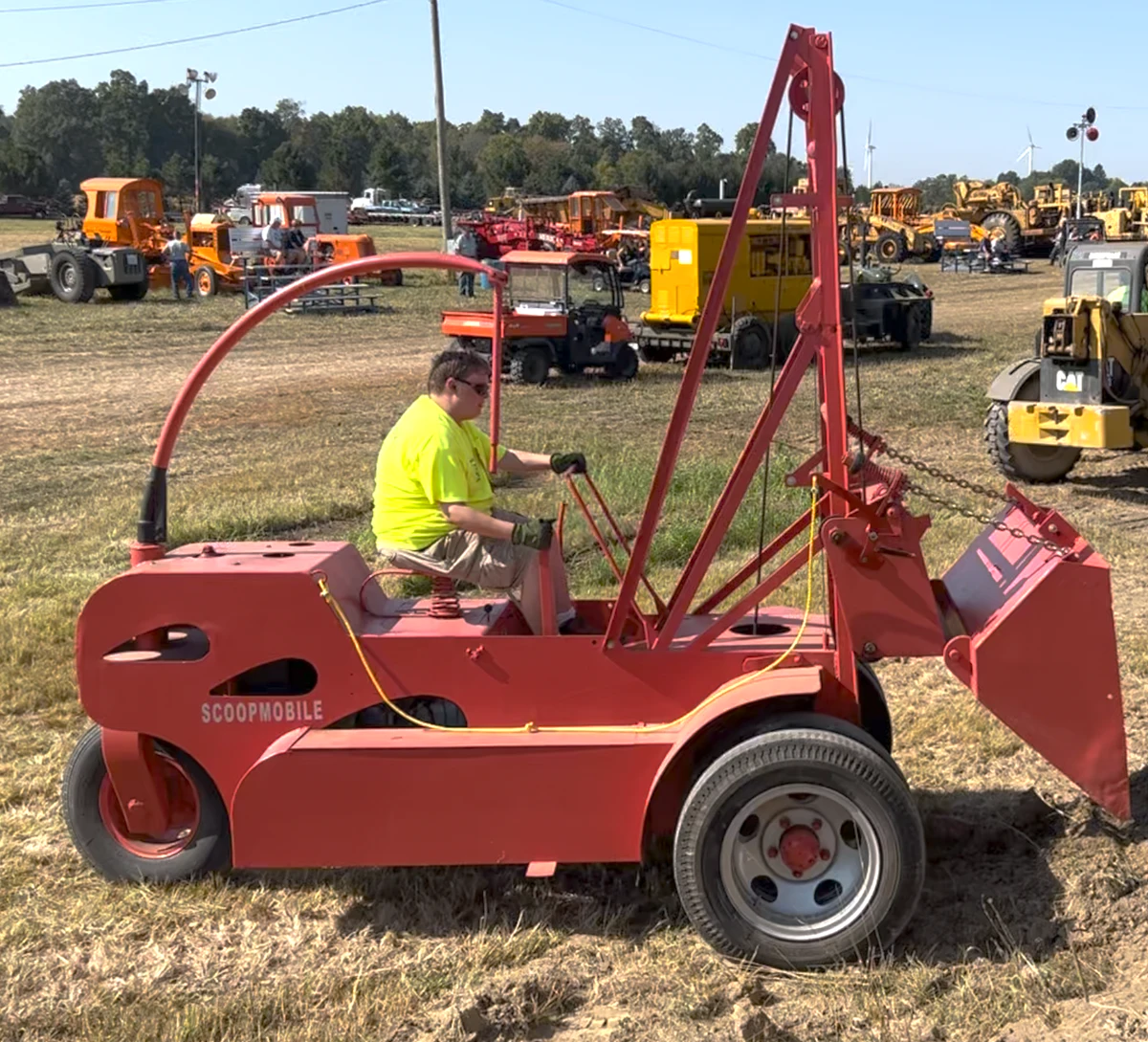
Though it looks like — and its name sounds like — something out of a Dr. Seuss book, the Scoopmobile was a popular wheel loader around 75 years ago for local road departments and concrete construction companies, especially in the Western U.S.
It was painted an orangish-red with four wheels up front and one in the back. A rudder-like handle arched over the operator’s head for steering. A bucket moved straight up and down in front by cable and was tripped by a rope for unloading.
The strange-looking contraption was innovative for its time, as it could be hauled easily by a dump truck, turning a two-man loading job into a solo operation.
Those attending the Historical Construction Equipment Association’s annual convention in November got to see one in action — a very rare sight. (You can watch it, too, in our video at the end of this story.)
Dave Geiss of Seward, Nebraska, who owns about 100 pieces of vintage equipment, bought the Scoopmobile from a collector in Iowa about 15 years ago.
He likes to focus on odd and rare machines, and the rudder-steered Scoopmobile fit the bill.
It had been used at a gravel pit for material handling, and the collector who acquired it had restored it to top condition, including new tires.
“I started it up and drove it on the truck,” Geiss says of his purchase.
Geiss later decided to donate the Scoopmobile to the HCEA’s National Construction Equipment Museum in Bowling Green, Ohio. It was too difficult for Geiss to haul to shows because of its height and the single rear-wheel configuration. It’s also a rare specimen that he believes deserves to be out on public display.
“It's the only rudder-steering one I've ever seen,” he says. “It's the only one I've ever known of.”
 The arch-shaped rod over the seat on the Scoopmobile was used like a boat tiller for steering the late-1940s wheel loader.Equipment World
Geiss’ Scoopmobile is a Model B believed to have been produced in the late 1940s. The company later manufactured larger four-wheeled articulated models, and the Scoopmobile name extended into the decades with larger, more modern loaders.
By today’s standards, the rudder-steer model is an impractical machine. But before the modern wheel loader, it served a handy purpose for loading trucks from stockpiles of gravel, rock, coal and other materials.
It had a towbar on the rear that could link up to a truck and had large truck tires for handling highway speeds.
“It would follow like a trailer, and then he could use it and load,” Geiss says. “It required one person instead of two people. … That was kind of an innovative design at that time.”
In the photo below, you can see one on a snow-clearing operation in Portland in 1950:
 A Scoopmobile can be seen in the background loading a truck with snow in Portland, Oregon, on February 2, 1950. Portland City Auditor Archives & Records Management
Though not a viable machine for modern material handling, Geiss says, it’s fun to operate. But he had to make one adjustment.
“The person that evidently ran that at the gravel pit was short,” he says. “The rudder handle had been cut and lowered so that he could reach it, and it kept hitting me in the head. So I raised it back up.”
All in all, it’s simple to operate, he says. It has a manual transmission. With one hand, the operator steers with the rudder, leaving the other hand free to operate the cable works. He estimates it will go up to 20 mph.
“When you're moving, it's very easy to steer,” he says, “and it was really kind of fun to run.”
 The bucket on the Scoopmobile is raised and lowered by cable and pulley and tripped open for unloading by yanking a rope. Equipment World
“The bucket was way narrower than the tractor,” Geiss says. “It was really only useful for digging out of a stockpile. You couldn't dig ditches with it.”
Geiss says he was aware of the Scoopmobile before he saw the collector’s for-sale ad. A junkyard near his home was using later models with forks in the 1960s and 1970s.
“I've always kind of been drawn toward the unusual or odd or rare pieces,” he says. “I've got several machines there is only one of. So that was probably the magnet that drew me to that machine, knowing that it was rare, and it's completely restored, had brand-new tires on and everything. And it was very cheap to buy.”
“Nobody would buy it to use it,” he adds. “It was just basically a collector's item.”
And now it’s available for all to see at the HCEA's museum and shows for many years to come.
Watch the Scoopmobile in Action
Watch it in operation at the 2025 HCEA show in our video below:
More Photos of the Scoopmobile
 The Scoopmobile once had a towbar on the back that could be hooked to a dump truck and driven like a trailer at highway speeds, thanks to its four front truck tires.Equipment World