Smart Connectivity for Off-Highway Vehicles
FORVIA presents integrated vehicle architecture and sensing solutions at CONEXPO-CON/AGG 2026 to improve safety, efficiency and ergonomics in construction and mining applications. www.hella.com Manufacturers of construction and mining equipment face growing demands regarding operator safety, machine uptime, digital connectivity and electrification. Modern off-highway vehicles integrate multiple lighting systems, sensors, cameras and electronic components, while operators are exposed to long working hours under harsh environmental conditions. In parallel, the transition toward electric off-highway vehicles requires new thermal management concepts and efficient system integration. Equipment manufacturers therefore seek solutions that simplify vehicle architecture, enhance safety and ensure long-term reliability under demanding conditions. At CONEXPO-CON/AGG, held from March 3 to 7, 2026, in Las Vegas, FORVIA presented a portfolio designed to address these technical and operational challenges. Expanding into Ergonomic Seating for Off-Highway Vehicles For the first time, FORVIA introduced seating systems specifically engineered for off-highway applications. Construction machinery operators often work extended shifts under vibration-intensive conditions, making ergonomics and safety critical factors. Drawing on long-standing expertise in safety- and comfort-oriented seating design, the company adapted its automotive know-how to industrial vehicles. The objective is to improve operator posture, reduce fatigue and contribute to safer machine handling. Christian Beer, Sales and Programs Vice President at FORVIA Faurecia Seating, explained that expanding the seating portfolio allows equipment manufacturers to optimize safety and ergonomics while integrating seating systems into broader vehicle architectures. Smart Link Concept: Simplifying Vehicle Architecture A central element of the presentation was the Smart Link Concept, a modular platform developed by FORVIA HELLA. The system connects lighting and electronic components into a coordinated architecture, supporting digital connectivity in construction and mining equipment. By integrating sensors, cameras, work lights and signal lights into a unified system, the platform reduces architectural complexity and enables future technology upgrades. According to Dr. Fabian Utermöhlen, Vice President Sales & Marketing in the Business Group Lifecycle Solutions, the system is designed to simplify vehicle architecture and facilitate the integration of future technologies. From a technical standpoint, the coordinated interaction between sensing and lighting systems improves operational visibility, enhances workflow precision and reduces downtime caused by system incompatibilities. This directly contributes to greater machine efficiency and improved jobsite safety. Magnet-Free Sensor Technology for Sustainable Design FORVIA HELLA also presented its Universal Angular Sensor (UAS), based on Contactless Inductive Position Sensor (CIPOS) technology. Unlike conventional magnetic systems, CIPOS operates without magnetic components or rare earth materials and is resistant to external magnetic fields. For construction and mining equipment operating in environments with strong electromagnetic interference, this design improves measurement reliability and long-term precision. The technology enables accurate position sensing in applications such as pedal sensors for commercial and industrial vehicles. By eliminating rare earth materials, the solution also supports sustainability objectives and reduces dependency on critical raw materials, an increasingly relevant factor for global equipment manufacturers. Enhancing Safety and Electrification Live demonstrations at the exhibition booth showed how radar sensors can enhance safety around work vehicles by monitoring surroundings and detecting obstacles. Such systems support collision avoidance in complex and dynamic jobsite environments. In addition, FORVIA HELLA presented thermal management components including the Media Pump MPx and the eVA Electronic Valve Actuator. These systems are specifically designed for electric off-highway vehicles and support efficient temperature control of battery and drivetrain components, contributing to reliability and energy efficiency. Integrated Portfolio for Construction and Mining By combining ergonomic seating systems, smart vehicle architecture and advanced sensor technology, FORVIA addressed key requirements of the construction and mining industries: safety, digital connectivity, sustainability and system simplification. The presentation at CONEXPO-CON/AGG 2026 marked the first joint showcase of the combined capabilities of FORVIA Faurecia and FORVIA HELLA for off-highway applications, reflecting the group’s strategy to transfer automotive technologies into industrial mobility solutions. www.hella.com Powered by Induportals Media Publishing
 machineryasia
FORVIA presents integrated vehicle architecture and sensing solutions at CONEXPO-CON/AGG 2026 to improve safety, efficiency and ergonomics in construction and mining applications.
www.hella.com
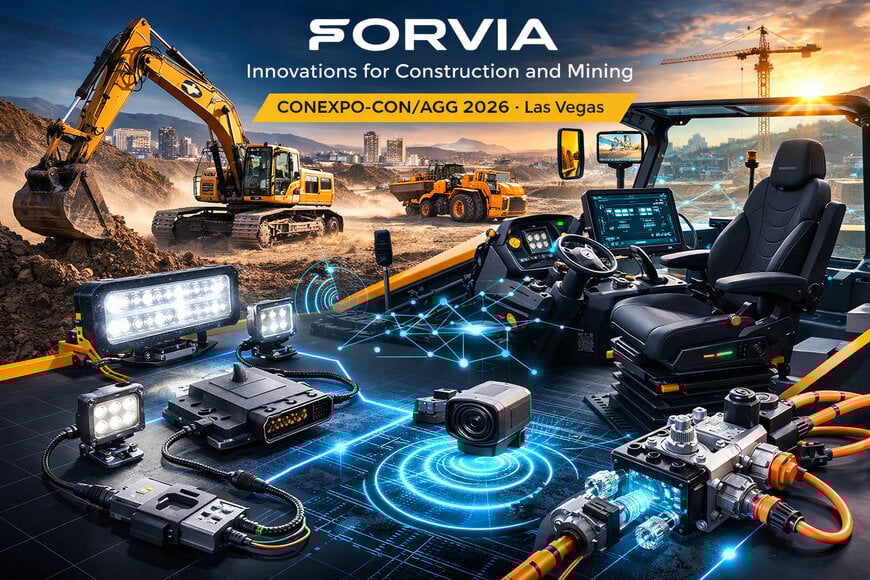
Manufacturers of construction and mining equipment face growing demands regarding operator safety, machine uptime, digital connectivity and electrification. Modern off-highway vehicles integrate multiple lighting systems, sensors, cameras and electronic components, while operators are exposed to long working hours under harsh environmental conditions.
In parallel, the transition toward electric off-highway vehicles requires new thermal management concepts and efficient system integration. Equipment manufacturers therefore seek solutions that simplify vehicle architecture, enhance safety and ensure long-term reliability under demanding conditions.
At CONEXPO-CON/AGG, held from March 3 to 7, 2026, in Las Vegas, FORVIA presented a portfolio designed to address these technical and operational challenges.
Expanding into Ergonomic Seating for Off-Highway Vehicles
For the first time, FORVIA introduced seating systems specifically engineered for off-highway applications. Construction machinery operators often work extended shifts under vibration-intensive conditions, making ergonomics and safety critical factors.
Drawing on long-standing expertise in safety- and comfort-oriented seating design, the company adapted its automotive know-how to industrial vehicles. The objective is to improve operator posture, reduce fatigue and contribute to safer machine handling.
Christian Beer, Sales and Programs Vice President at FORVIA Faurecia Seating, explained that expanding the seating portfolio allows equipment manufacturers to optimize safety and ergonomics while integrating seating systems into broader vehicle architectures.
Smart Link Concept: Simplifying Vehicle Architecture
A central element of the presentation was the Smart Link Concept, a modular platform developed by FORVIA HELLA. The system connects lighting and electronic components into a coordinated architecture, supporting digital connectivity in construction and mining equipment.
By integrating sensors, cameras, work lights and signal lights into a unified system, the platform reduces architectural complexity and enables future technology upgrades. According to Dr. Fabian Utermöhlen, Vice President Sales & Marketing in the Business Group Lifecycle Solutions, the system is designed to simplify vehicle architecture and facilitate the integration of future technologies.
From a technical standpoint, the coordinated interaction between sensing and lighting systems improves operational visibility, enhances workflow precision and reduces downtime caused by system incompatibilities. This directly contributes to greater machine efficiency and improved jobsite safety.
Magnet-Free Sensor Technology for Sustainable Design
FORVIA HELLA also presented its Universal Angular Sensor (UAS), based on Contactless Inductive Position Sensor (CIPOS) technology. Unlike conventional magnetic systems, CIPOS operates without magnetic components or rare earth materials and is resistant to external magnetic fields.
For construction and mining equipment operating in environments with strong electromagnetic interference, this design improves measurement reliability and long-term precision. The technology enables accurate position sensing in applications such as pedal sensors for commercial and industrial vehicles.
By eliminating rare earth materials, the solution also supports sustainability objectives and reduces dependency on critical raw materials, an increasingly relevant factor for global equipment manufacturers.
Enhancing Safety and Electrification
Live demonstrations at the exhibition booth showed how radar sensors can enhance safety around work vehicles by monitoring surroundings and detecting obstacles. Such systems support collision avoidance in complex and dynamic jobsite environments.
In addition, FORVIA HELLA presented thermal management components including the Media Pump MPx and the eVA Electronic Valve Actuator. These systems are specifically designed for electric off-highway vehicles and support efficient temperature control of battery and drivetrain components, contributing to reliability and energy efficiency.
Integrated Portfolio for Construction and Mining
By combining ergonomic seating systems, smart vehicle architecture and advanced sensor technology, FORVIA addressed key requirements of the construction and mining industries: safety, digital connectivity, sustainability and system simplification.
The presentation at CONEXPO-CON/AGG 2026 marked the first joint showcase of the combined capabilities of FORVIA Faurecia and FORVIA HELLA for off-highway applications, reflecting the group’s strategy to transfer automotive technologies into industrial mobility solutions.
www.hella.com
Powered by
Induportals Media Publishing