Schlamann-Autokrane Expands Fleet with Liebherr LTM 1055-3.3
The permit-free 55-tonne mobile crane offers rapid setup and intelligent safety systems for industrial assembly. www.liebherr.com Schlamann-Autokrane GmbH has continued the modernization of its fleet with the addition of the new Liebherr LTM 1055-3.3. As the lightest 3-axle all-terrain crane currently on the market, the 55-tonne machine traveled directly from Liebherr’s Ehingen plant to Nienburg, Lower Saxony, without requiring any complex heavy-transport authorization procedures. Engineered specifically for lightweight construction, the crane relies on low axle loads to secure permanent driving permits across multiple countries, drastically improving response times for customer deployments. To maximize operational flexibility, Schlamann ordered the crane with a specialized ballast trailer. In this configuration, the crane travels with its full 11-tonne counterweight towed behind it. The total weight of the combination sits at 41.8 tonnes, while the critical axle loads remain below 9.5 tonnes. This keeps the crane well within the limits for a general permanent permit in Germany. Upon arriving at a site—often for industrial assembly or pipeline construction—the crane can lift and place the entire 11-tonne counterweight onto its slewing platform in a single motion, eliminating the need for a secondary transport vehicle and ensuring rapid setup. The LTM 1055-3.3 is the first crane in Schlamann’s fleet to feature Liebherr's advanced LICCON3 control system, alongside a redesigned cabin and modern livery. Operator comfort and site safety are heavily emphasized through the integration of the Blind Spot Information System (BSIS) and the Moving Off Information System (MOIS), which actively protect pedestrians and cyclists. Furthermore, the inclusion of RemoteDrive allows operators to maneuver the crane via remote control from outside the cab, providing precise positioning in tight industrial spaces. Additional Context This section provides technological and logistical background not explicitly detailed in the original release. The heavy transport and crane industry in Europe—particularly in Germany—faces severe logistical bottlenecks due to deteriorating infrastructure and highly restrictive bridge load limits. Traditionally, a 3-axle mobile crane operates with a 12-tonne axle load (36 tonnes total). However, driving a 12-tonne axle load vehicle requires route-specific permits (via systems like VEMAGS in Germany), which involve structural bridge assessments that can take weeks to process. By utilizing high-tensile steel and stripping the base weight of the LTM 1055-3.3, Liebherr has fundamentally altered the logistics of crane deployment. Shifting the heavy counterweight to a separate towed trailer reduces the crane's axle load to under 10 tonnes (specifically
 machineryasia
The permit-free 55-tonne mobile crane offers rapid setup and intelligent safety systems for industrial assembly.
www.liebherr.com
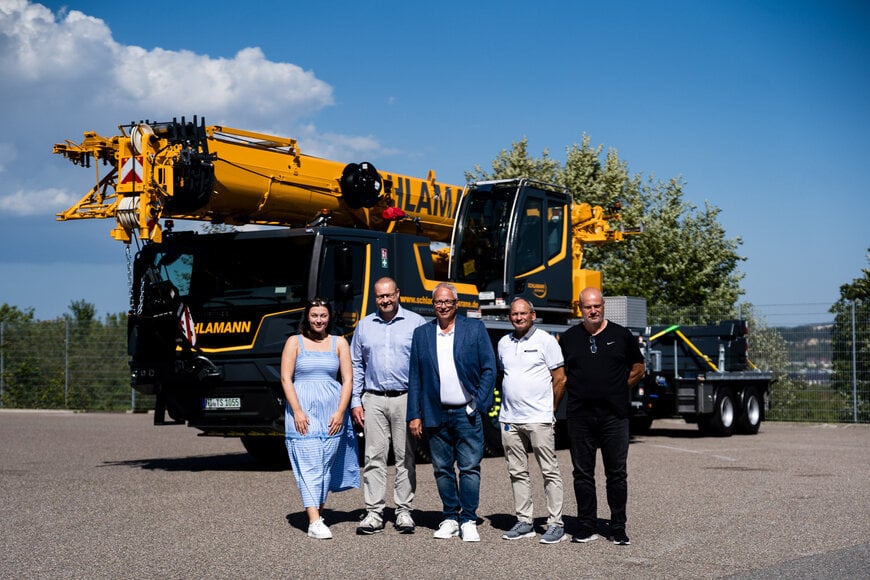
Schlamann-Autokrane GmbH has continued the modernization of its fleet with the addition of the new Liebherr LTM 1055-3.3. As the lightest 3-axle all-terrain crane currently on the market, the 55-tonne machine traveled directly from Liebherr’s Ehingen plant to Nienburg, Lower Saxony, without requiring any complex heavy-transport authorization procedures. Engineered specifically for lightweight construction, the crane relies on low axle loads to secure permanent driving permits across multiple countries, drastically improving response times for customer deployments.
To maximize operational flexibility, Schlamann ordered the crane with a specialized ballast trailer. In this configuration, the crane travels with its full 11-tonne counterweight towed behind it. The total weight of the combination sits at 41.8 tonnes, while the critical axle loads remain below 9.5 tonnes. This keeps the crane well within the limits for a general permanent permit in Germany. Upon arriving at a site—often for industrial assembly or pipeline construction—the crane can lift and place the entire 11-tonne counterweight onto its slewing platform in a single motion, eliminating the need for a secondary transport vehicle and ensuring rapid setup.
The LTM 1055-3.3 is the first crane in Schlamann’s fleet to feature Liebherr's advanced LICCON3 control system, alongside a redesigned cabin and modern livery. Operator comfort and site safety are heavily emphasized through the integration of the Blind Spot Information System (BSIS) and the Moving Off Information System (MOIS), which actively protect pedestrians and cyclists. Furthermore, the inclusion of RemoteDrive allows operators to maneuver the crane via remote control from outside the cab, providing precise positioning in tight industrial spaces.
Additional Context
This section provides technological and logistical background not explicitly detailed in the original release.
The heavy transport and crane industry in Europe—particularly in Germany—faces severe logistical bottlenecks due to deteriorating infrastructure and highly restrictive bridge load limits. Traditionally, a 3-axle mobile crane operates with a 12-tonne axle load (36 tonnes total). However, driving a 12-tonne axle load vehicle requires route-specific permits (via systems like VEMAGS in Germany), which involve structural bridge assessments that can take weeks to process.
By utilizing high-tensile steel and stripping the base weight of the LTM 1055-3.3, Liebherr has fundamentally altered the logistics of crane deployment. Shifting the heavy counterweight to a separate towed trailer reduces the crane's axle load to under 10 tonnes (specifically <9.5 tonnes). This drops the vehicle out of the heavy-transport classification for most jurisdictions, granting it a "Dauergenehmigung" (permanent driving permit). For a crane hire company like Schlamann, this means they can dispatch a 55-tonne capacity crane to an emergency pipeline repair or a sudden industrial assembly job instantly, operating it with the logistical freedom of a standard commercial truck.
Edited by an industrial journalist, Lekshman Ramdas, with AI assistance.
www.liebherr.com
Powered by
Induportals Media Publishing