Portable Centrifugal Trash Pumps for Industrial Fluid Management
Atlas Copco expands its portfolio with petrol-powered dewatering equipment designed to handle abrasive solids in construction and mining environments. www.atlascopco.com Atlas Copco has released the Emergency Trash Pump (ETP) series, a new line of petrol-powered centrifugal units intended to enhance industrial dewatering systems. This equipment is specifically engineered for rapid deployment in construction, mining, and quarrying sectors to manage unexpected fluid accumulation, stream diversion, and stormwater runoff. Fluid Management Under Abrasive Conditions The ETP series addresses the operational challenge of transferring water that contains high concentrations of suspended solids, such as sand, organic matter, and small stones. Standard centrifugal pumps often experience clogging or mechanical failure when processing abrasive materials. By utilizing specialized internal geometries and durable materials, the ETP series allows site operators to clear flooded zones, clean industrial systems, and remove sediment without interrupting primary operations or causing mechanical downtime. Performance Parameters for Specialized Pumping The product line consists of seven distinct models divided between clean water and wastewater applications to suit varying fluid densities. The clean water units are constructed with lightweight aluminum components and are optimized for water transfer and tank filling. These models achieve flow rates of up to 1,600 liters per minute (432 USgpm) and a maximum dynamic head of 60 meters (197 feet), with a suction lift capacity of 7 meters (22.9 feet). They can process suspended solids up to 8 millimeters (0.32 inches) in diameter. Conversely, the wastewater models are designed for heavy-duty dewatering tasks involving contaminated fluid. Constructed with heavy cast iron frames and impellers to withstand abrasive wear, these units pass solid debris up to 29 millimeters (1.1 inches) in diameter. The wastewater pumps deliver maximum flow rates of 1,300 liters per minute (343 USgpm) and a maximum head of 30 meters (98 feet), while maintaining the standard 7-meter maximum suction lift limit. Structural Design and Maintenance Accessibility To facilitate rapid deployment during time-critical flooding events, the ETP series utilizes a compact, open-frame architecture. This structural layout provides immediate mechanical access to critical pump components, simplifying on-site maintenance, inspection, and clearing procedures. The units integrate lifting handles directly into the frame to support manual positioning across difficult terrain where heavier, vehicle-mounted pumps cannot reach. Niccolo Tivelli, Product Application Manager at Atlas Copco, noted that the equipment is engineered specifically to manage fluid accumulation containing abrasive debris, prioritizing mechanical serviceability and stable performance during unpredictable industrial flooding. The design incorporates safety features such as exhaust protection and robust mechanical seals to maximize hardware longevity under continuous operation. Additional Context This section details technical specifications and competitive benchmarking not included in the original news release. In the industrial dewatering market, petrol-powered trash pumps are frequently evaluated against established benchmark models from manufacturers such as Honda, Multiquip, and Tsurumi. Standard 3-inch and 4-inch centrifugal trash pumps typically feature cast iron volutes and conical cast iron impellers to handle solids ranging from 25 to 30 millimeters in diameter. The Atlas Copco ETP wastewater models align with these industry standards by offering 29-millimeter solid handling and cast-iron internal construction. However, standardizing on a 7-meter maximum suction lift requires site engineers to position the pump relatively close to the fluid source, a common fluid dynamics constraint for non-submersible, engine-driven centrifugal pumps that rely on atmospheric pressure for priming. Edited by Aishwarya Mambet, Induportals Editor, with AI assistance. www.atlascopcogroup.com Powered by Induportals Media Publishing
 machineryasia
Atlas Copco expands its portfolio with petrol-powered dewatering equipment designed to handle abrasive solids in construction and mining environments.
www.atlascopco.com
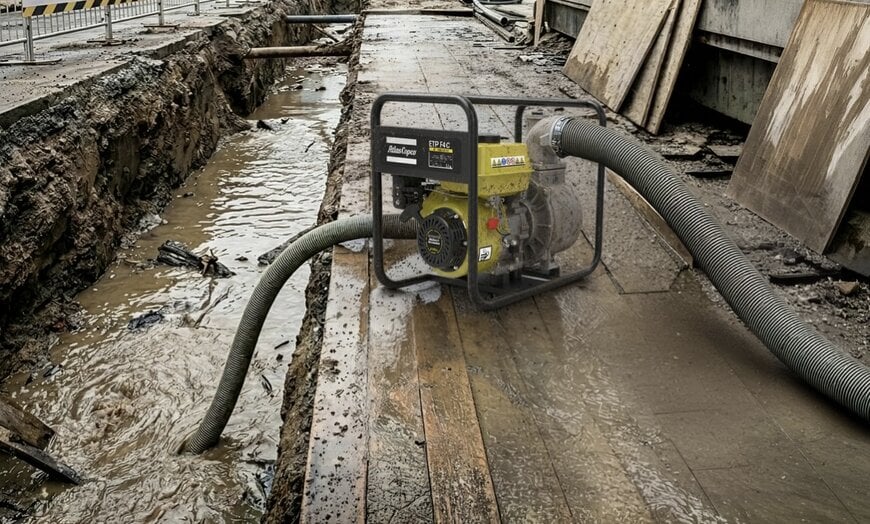
Atlas Copco has released the Emergency Trash Pump (ETP) series, a new line of petrol-powered centrifugal units intended to enhance industrial dewatering systems. This equipment is specifically engineered for rapid deployment in construction, mining, and quarrying sectors to manage unexpected fluid accumulation, stream diversion, and stormwater runoff.
Fluid Management Under Abrasive Conditions
The ETP series addresses the operational challenge of transferring water that contains high concentrations of suspended solids, such as sand, organic matter, and small stones. Standard centrifugal pumps often experience clogging or mechanical failure when processing abrasive materials. By utilizing specialized internal geometries and durable materials, the ETP series allows site operators to clear flooded zones, clean industrial systems, and remove sediment without interrupting primary operations or causing mechanical downtime.
Performance Parameters for Specialized Pumping
The product line consists of seven distinct models divided between clean water and wastewater applications to suit varying fluid densities. The clean water units are constructed with lightweight aluminum components and are optimized for water transfer and tank filling. These models achieve flow rates of up to 1,600 liters per minute (432 USgpm) and a maximum dynamic head of 60 meters (197 feet), with a suction lift capacity of 7 meters (22.9 feet). They can process suspended solids up to 8 millimeters (0.32 inches) in diameter.
Conversely, the wastewater models are designed for heavy-duty dewatering tasks involving contaminated fluid. Constructed with heavy cast iron frames and impellers to withstand abrasive wear, these units pass solid debris up to 29 millimeters (1.1 inches) in diameter. The wastewater pumps deliver maximum flow rates of 1,300 liters per minute (343 USgpm) and a maximum head of 30 meters (98 feet), while maintaining the standard 7-meter maximum suction lift limit.
Structural Design and Maintenance Accessibility
To facilitate rapid deployment during time-critical flooding events, the ETP series utilizes a compact, open-frame architecture. This structural layout provides immediate mechanical access to critical pump components, simplifying on-site maintenance, inspection, and clearing procedures. The units integrate lifting handles directly into the frame to support manual positioning across difficult terrain where heavier, vehicle-mounted pumps cannot reach.
Niccolo Tivelli, Product Application Manager at Atlas Copco, noted that the equipment is engineered specifically to manage fluid accumulation containing abrasive debris, prioritizing mechanical serviceability and stable performance during unpredictable industrial flooding. The design incorporates safety features such as exhaust protection and robust mechanical seals to maximize hardware longevity under continuous operation.
Additional Context
This section details technical specifications and competitive benchmarking not included in the original news release.
In the industrial dewatering market, petrol-powered trash pumps are frequently evaluated against established benchmark models from manufacturers such as Honda, Multiquip, and Tsurumi. Standard 3-inch and 4-inch centrifugal trash pumps typically feature cast iron volutes and conical cast iron impellers to handle solids ranging from 25 to 30 millimeters in diameter. The Atlas Copco ETP wastewater models align with these industry standards by offering 29-millimeter solid handling and cast-iron internal construction. However, standardizing on a 7-meter maximum suction lift requires site engineers to position the pump relatively close to the fluid source, a common fluid dynamics constraint for non-submersible, engine-driven centrifugal pumps that rely on atmospheric pressure for priming.
Edited by Aishwarya Mambet, Induportals Editor, with AI assistance.
www.atlascopcogroup.com
Powered by
Induportals Media Publishing