A Bona Fide Blockbuster, Shot on American-Made Kodak Film
Headed to the movies this weekend for Christopher Nolan’s newest film, The Odyssey? Good news – you’ll be watching American manufacturing at work.
 machineryasia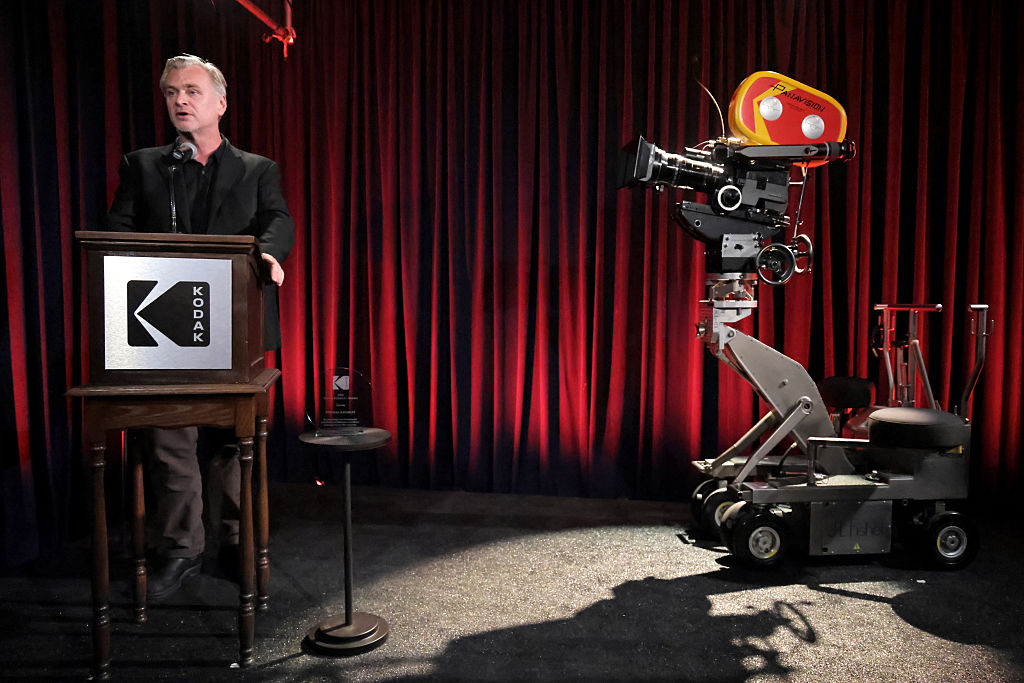
Headed to the movies this weekend for Christopher Nolan’s newest film, The Odyssey? Good news – you’ll be watching American manufacturing at work.
If you thought there was no chance of a connection between Greek epics and American-made products, think again.
Academy-award winning director Christopher Nolan, known for his mind-bending dramas such as Interstellar and Inception, released The Odyssey last week to critical acclaim. A retelling of Homer’s Greek epic by the same name, Nolan’s adaptation began filming in early 2025 with a key element never executed in cinema history: It was shot entirely with IMAX film cameras.
But what does this have to do with American manufacturing? Well, it’s not the cameras we’re focusing on. The film that was used within them is the real star of the show.
To film the entire two hour and 52-minute movie, Nolan loaded his cameras with 65mm KODAK film made in Rochester, New York. This means that the very fiber of The Odyssey’s existence – each scene, still and iconic shot than only Nolan could capture – is American-made.
The Eastman Kodak Company, more commonly known as Kodak, is an icon of film photography and videography and has been headquartered in Rochester since the late 1800s. However, George Eastman, Kodak’s founder, wasn’t always a photographic entrepreneur. Before becoming a figurehead of modern film photography, he was a high school dropout trying to make ends meet for his widowed mother and two siblings in upstate New York.
Yeats later, Eastman had planned to take a trip to the Caribbean and was encouraged to buy the latest camera technology to document the vacation. He never ended up setting out for his destination but became enthralled with photography and started experimenting on his own. Eastman soon perfected a new way to develop photos: a “dry plate” formula that greatly simplified the entire process. Not only did he discover the formula, but he also invented and patented a machine that would coat the plates in the proper chemicals.
Confident in the future success of his discoveries, Eastman moved operations to a building in Rochester and started manufacturing dry plates to be sold. In 1881, he became business partners with a man named Henry A. Strong and founded the Eastman Dry Plate Company – the first version of what would later become Kodak in 1888.
Eastman frequently expressed his desire for photography to become a more accessible pastime, and in 1889, released the first commercial transparent roll film for purchase. Only one year later, the Kodak Brownie camera brought photography to consumers at just one dollar a pop, with film rolls selling at 15 cents each. Over the next several decades, Kodak continued to develop new and accessible photographic and videographic technologies. They became ingrained in industries such as copying & printing, publishing, motion picture, and medical and space imaging. Without Kodak, it’s safe to say that photography and even movies as we know them today wouldn’t be quite the same.
Christopher Nolan definitely thinks so. On X last week, Kodak proudly announced their involvement in The Odyssey, highlighting the over 2 million feet of Rochester-made KODAK 65mm Motion Picture Film Nolan used to shoot the movie. They also made the print film for The Odyssey’s 35mm, 70mm 5-perf (“perf” meaning the number of perforations along the sides of the film per each frame) and IMAX 70mm theatrical releases.
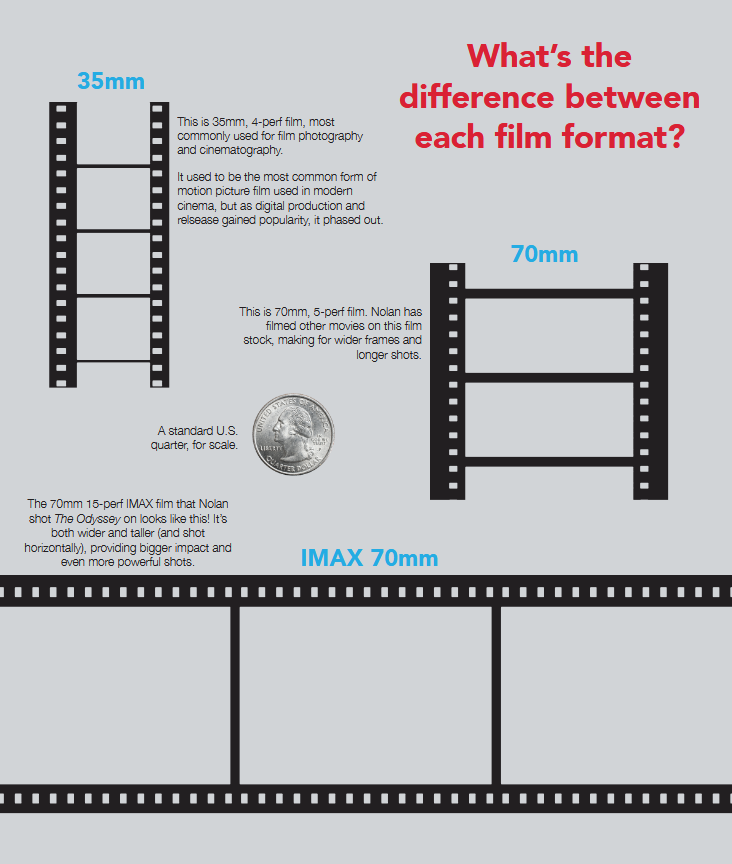
What’s the difference? Well, the ‘millimeters’ (mm) refers to the width of the film stock, so a 70mm roll of film tends to be 3.5 times larger than 35mm motion picture film. Before digital production and projection took over modern cinema, 35mm film was the most common format used for shooting movies and then playing them in theatres. The IMAX film is even bigger, flipped horizontally from regular 70mm film and has 15 perforations per frame.
Even if you’re not interested in the intricacies of motion picture film, you can’t ignore that the very fiber of The Odyssey’s existence comes from an American-made product. Kodak’s Rochester-made film isn’t just reserved for the cinema elite, either – if you’ve got your own film camera, you can purchase Kodak’s consumer-oriented film stock at most photography stores and film developers across the United States. Although the exact film Nolan used isn’t easily accessible, some distributors will buy the large reels and cut them down into more affordable amounts, making it easier for amateur cinematographers to follow in Nolan’s footsteps.
So, if you haven’t yet made the trek to an IMAX theatre (or your nearest standard cinema) to see The Odyssey, what are you waiting for? AAM’s very own president, Scott Paul, gave his review after seeing the film in IMAX last night.
“It’s epic in every sense of the word,” Paul said. “I hope everybody has a chance to see it and also to appreciate the amazing cinematography captured, in part, by American products and ingenuity.”