Perry Crane Services tackles complex tree removals with National Crane NTC45-2
The 45 USt boom truck with a 127 ft boom gives the Massachusetts company the reach, capacity and compact footprint needed for constrained and hazardous removals. www.manitowoc.com Perry Crane Services, based in West Bridgewater, Massachusetts, uses a National Crane NTC45-2 boom truck for complex tree removal operations that require precision lifting and dependable equipment. According to owner and operator Travis Perry, most of the company's work involves extremely difficult removals where access is constrained, the terrain is too steep or other equipment cannot reach the tree. Many of these trees are dead, structurally compromised or positioned over homes and buildings, making them very dangerous to remove by hand. Perry says the NTC45-2 provides the reach, capacity and compact footprint needed to complete these jobs safely and efficiently. An operator's choice Perry has 20 years of experience specialising in tree removal, including 15 years as a crane operator. Before launching Perry Crane Services in 2023, he operated a previous-generation National Crane model and closely followed the development of the NTC45-2. When it came time to purchase a crane for his new company, he wanted a machine that combined strong lifting performance with a compact package. He cites the longer outrigger stroke, super-compact configuration, counterweight design and overall versatility as key reasons for his choice, describing the NTC45-2 as the perfect crane for this niche and adding that he has not had a day off since putting the licence plates on it. Reach and capacity for large trees The NTC45-2 purchased by Perry is equipped with a 127 ft boom, providing the reach needed to work around structures and other obstacles while maintaining strong load charts at longer radii, which is a crucial advantage in tree removal. With a capacity of 45 USt, the boom truck is frequently used to remove large tree sections weighing between 3,000 lb and 5,000 lb, as well as larger base logs weighing nearly 18,000 lb. This combination of reach and lifting capacity makes the crane well suited to the large trees commonly found throughout the region. Compact design and roadside work The crane's truck-mounted design measures just under 38 ft in overall length, and its short-wheelbase configuration allows access to confined jobsites where larger cranes can struggle to manoeuvre. Unlike larger cranes that may face travel restrictions because of their size and weight, the NTC45-2 can move efficiently between jobsites, helping crews mobilise rapidly after severe weather events. The design also helps when working alongside active roadways, where maintaining traffic flow is critical. By using the crane's compact footprint and features of the National Truck Crane (NTC) Performance Package, such as four-position outriggers and a two-camera system, Perry's team can often keep one lane open while completing lifts that would otherwise require a full road closure. Reliable support Perry credits dealer Shawmut Equipment for helping make the purchase a success as he launched his new company. Shawmut guided him through the purchasing process and has remained a partner from contract signing and delivery through ongoing service and maintenance. The dealer performs the annual inspections on his NTC45-2, handling everything from software updates to routine repairs and component replacements, helping to maximise uptime throughout the year. According to Joe Vergoni, VP at Shawmut Equipment, the crane's combination of reach, lifting performance, mobility and compact dimensions makes it particularly well suited to demanding tree care applications. Additional Context: This section explains general principles of crane-assisted tree removal not included in the original press release. In crane-assisted tree removal, a tree is taken down in sections rather than felled in one piece. Each section is rigged to the crane's hook before it is cut, and the crane operator takes up the weight so that the piece is supported as soon as the cut is completed. The section is then lifted clear of buildings, power lines or other obstacles and lowered to a safe landing area, where it can be processed on the ground. Because the weight of a tree section can only be estimated before it is cut, operators typically plan each pick with a margin against the crane's rated capacity at the working radius. The capacity of any crane falls as the radius increases, so the load chart at long reach, rather than the maximum rated capacity, usually determines how large each section can be. How far the outriggers can be extended also affects the capacity available, which is why outrigger options and setup space are important considerations on constrained sites. Edited by an industrial journalist, Lekshman Ramdas, with AI assistance. www.manitowoc.com Powered by Induportals Media Publishing
 machineryasia
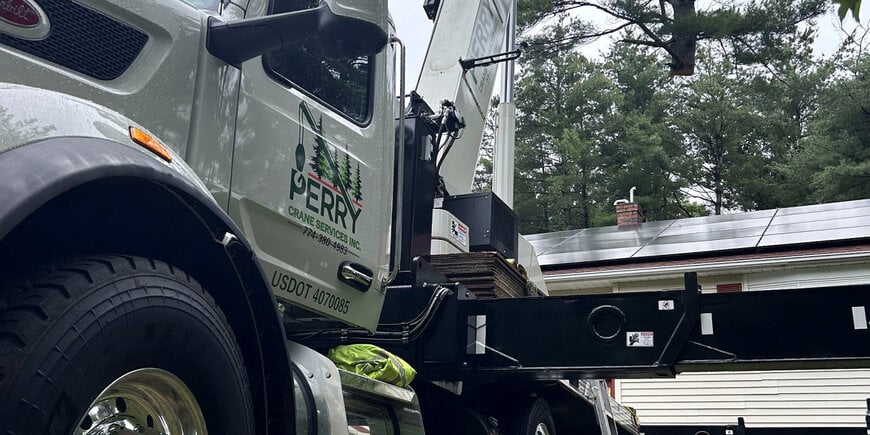
The 45 USt boom truck with a 127 ft boom gives the Massachusetts company the reach, capacity and compact footprint needed for constrained and hazardous removals.
www.manitowoc.com
Perry Crane Services, based in West Bridgewater, Massachusetts, uses a National Crane NTC45-2 boom truck for complex tree removal operations that require precision lifting and dependable equipment. According to owner and operator Travis Perry, most of the company's work involves extremely difficult removals where access is constrained, the terrain is too steep or other equipment cannot reach the tree. Many of these trees are dead, structurally compromised or positioned over homes and buildings, making them very dangerous to remove by hand. Perry says the NTC45-2 provides the reach, capacity and compact footprint needed to complete these jobs safely and efficiently.
An operator's choice
Perry has 20 years of experience specialising in tree removal, including 15 years as a crane operator. Before launching Perry Crane Services in 2023, he operated a previous-generation National Crane model and closely followed the development of the NTC45-2. When it came time to purchase a crane for his new company, he wanted a machine that combined strong lifting performance with a compact package. He cites the longer outrigger stroke, super-compact configuration, counterweight design and overall versatility as key reasons for his choice, describing the NTC45-2 as the perfect crane for this niche and adding that he has not had a day off since putting the licence plates on it.
Reach and capacity for large trees
The NTC45-2 purchased by Perry is equipped with a 127 ft boom, providing the reach needed to work around structures and other obstacles while maintaining strong load charts at longer radii, which is a crucial advantage in tree removal. With a capacity of 45 USt, the boom truck is frequently used to remove large tree sections weighing between 3,000 lb and 5,000 lb, as well as larger base logs weighing nearly 18,000 lb. This combination of reach and lifting capacity makes the crane well suited to the large trees commonly found throughout the region.
Compact design and roadside work
The crane's truck-mounted design measures just under 38 ft in overall length, and its short-wheelbase configuration allows access to confined jobsites where larger cranes can struggle to manoeuvre. Unlike larger cranes that may face travel restrictions because of their size and weight, the NTC45-2 can move efficiently between jobsites, helping crews mobilise rapidly after severe weather events. The design also helps when working alongside active roadways, where maintaining traffic flow is critical. By using the crane's compact footprint and features of the National Truck Crane (NTC) Performance Package, such as four-position outriggers and a two-camera system, Perry's team can often keep one lane open while completing lifts that would otherwise require a full road closure.
Reliable support
Perry credits dealer Shawmut Equipment for helping make the purchase a success as he launched his new company. Shawmut guided him through the purchasing process and has remained a partner from contract signing and delivery through ongoing service and maintenance. The dealer performs the annual inspections on his NTC45-2, handling everything from software updates to routine repairs and component replacements, helping to maximise uptime throughout the year. According to Joe Vergoni, VP at Shawmut Equipment, the crane's combination of reach, lifting performance, mobility and compact dimensions makes it particularly well suited to demanding tree care applications.
Additional Context:
This section explains general principles of crane-assisted tree removal not included in the original press release.
In crane-assisted tree removal, a tree is taken down in sections rather than felled in one piece. Each section is rigged to the crane's hook before it is cut, and the crane operator takes up the weight so that the piece is supported as soon as the cut is completed. The section is then lifted clear of buildings, power lines or other obstacles and lowered to a safe landing area, where it can be processed on the ground.
Because the weight of a tree section can only be estimated before it is cut, operators typically plan each pick with a margin against the crane's rated capacity at the working radius. The capacity of any crane falls as the radius increases, so the load chart at long reach, rather than the maximum rated capacity, usually determines how large each section can be. How far the outriggers can be extended also affects the capacity available, which is why outrigger options and setup space are important considerations on constrained sites.
Edited by an industrial journalist, Lekshman Ramdas, with AI assistance.
www.manitowoc.com
Powered by
Induportals Media Publishing