Mobile Construction Crane Axle Configuration for Global Transport Permitting
Liebherr introduces the MK 88-4.2E mobile construction crane with modular ballast systems to meet international axle weight regulations. www.liebherr.com Construction equipment fleet operators face strict gross vehicle weight and per-axle transport limits across global jurisdictions, complicating cross-border deployment of high-reach lifting machinery without costly transit permits. Liebherr resolves these logistics restrictions with the MK 88-4.2E mobile construction crane, incorporating a modular chassis and removable counterweight architecture that lowers transit axle loading below 9.2 tonnes and total vehicle weight under 36.3 tonnes. Modular Chassis Engineering for Global Road Permitting International highway regulations governing heavy goods vehicles diverge significantly between regional jurisdictions, often enforcing weight thresholds far stricter than European road standards. Standard mobile cranes often require escort vehicles, specialized routing, or multi-day permit review cycles before moving between urban project sites. The MK 88-4.2E four-axle carrier accommodates these restrictions by supporting transit configurations with axle loads below 9.2 tonnes, alongside operational modes calibrated for 10-tonne and 12-tonne regional axle thresholds. To achieve this weight distribution, Liebherr re-engineered the lower carriage and ballast mounting interfaces. The counterweight system is divided into modular, removable sections, and the outrigger beam assemblies detach to shed transit weight. Wider 445/75 R22.5 tyres mounted on aluminium wheel rims expand the footprint, reducing ground pressure to comply with transport infrastructure limits across North America, Australia, and Northern Europe. Series deliveries are scheduled to begin in the second quarter of 2027. Integrated Self-Ballasting and Zero-Emission Setup On-site crane assembly frequently demands support machinery to position counterweights, introducing logistical complexity in restricted urban job sites. The MK 88-4.2E integrates ballast hydraulic cylinders directly into the carrier frame, enabling self-ballasting without an auxiliary mobile crane. Monitored through onboard control systems, the crane places its own ballast sections onto the carrier in two to three hoisting cycles. An electro-hydraulic setup configuration allows operators to deploy outrigger supports and mount ballast using electrical energy, eliminating localized carbon emissions during rig-in. The carrier incorporates standard 32-Ampere and 63-Ampere site power connections, alongside a 16-Ampere mains input that supports electro-hydraulic operations on low-voltage municipal feeds at adjusted operating speeds. When shore power is unavailable, the hybrid drive connects to external battery systems, such as the Liebherr Liduro Power Port, or runs via an onboard diesel generator. Kinematics and Urban Site Operations The upper carriage retains the telescopic tower and folding boom architecture established on the MK 88-4.1E, providing a maximum hook radius of 45 metres with a tip lifting capacity of 2,200 kilograms. Maximum hoisting capacity reaches eight tonnes, with the automated Load-Plus electronic control system providing selective capacity increases up to ten per cent depending on boom angle and stabilization geometry. All-wheel steering delivers an inner turning circle of 11.88 metres, allowing the 8x6x8 vehicle to navigate congested industrial yards and metropolitan construction projects. Additional Context: This section details technical specifications and competitive benchmarking not included in the original product announcement. Mobile construction cranes, or mobile self-erecting tower cranes, operate under European standard EN 14439, combining the transit speed of an all-terrain carrier with the vertical clearance and over-obstacle reach of a traditional tower crane. The MK 88-4.2E achieves a maximum hook height of 59.10 metres when luffed to 45 degrees, matching high-tier class benchmarks such as the Spierings SK597-AT4 eLift four-axle mobile tower crane, which offers a 48-metre jib radius and 1,700-kilogram tip capacity. Unlike conventional all-terrain telescopic cranes that require continuous engine idling to maintain hydraulic pressure, modern electric-drive self-erecting cranes draw between 16 and 63 Amperes of grid power, reducing operating sound levels below 70 dB(A) for nighttime metropolitan operation while eliminating diesel fuel consumption during lifting cycles. Edited by Natania Lyngdoh, Induportals editor, with AI assistance. www.liebherr.com Powered by Induportals Media Publishing
 machineryasia
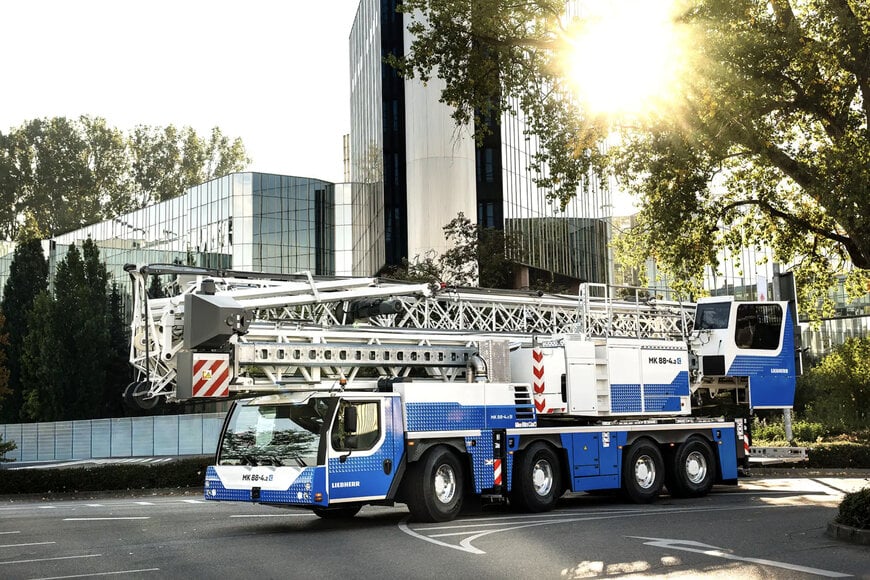
Liebherr introduces the MK 88-4.2E mobile construction crane with modular ballast systems to meet international axle weight regulations.
www.liebherr.com
Construction equipment fleet operators face strict gross vehicle weight and per-axle transport limits across global jurisdictions, complicating cross-border deployment of high-reach lifting machinery without costly transit permits. Liebherr resolves these logistics restrictions with the MK 88-4.2E mobile construction crane, incorporating a modular chassis and removable counterweight architecture that lowers transit axle loading below 9.2 tonnes and total vehicle weight under 36.3 tonnes.
Modular Chassis Engineering for Global Road Permitting
International highway regulations governing heavy goods vehicles diverge significantly between regional jurisdictions, often enforcing weight thresholds far stricter than European road standards. Standard mobile cranes often require escort vehicles, specialized routing, or multi-day permit review cycles before moving between urban project sites. The MK 88-4.2E four-axle carrier accommodates these restrictions by supporting transit configurations with axle loads below 9.2 tonnes, alongside operational modes calibrated for 10-tonne and 12-tonne regional axle thresholds.
To achieve this weight distribution, Liebherr re-engineered the lower carriage and ballast mounting interfaces. The counterweight system is divided into modular, removable sections, and the outrigger beam assemblies detach to shed transit weight. Wider 445/75 R22.5 tyres mounted on aluminium wheel rims expand the footprint, reducing ground pressure to comply with transport infrastructure limits across North America, Australia, and Northern Europe. Series deliveries are scheduled to begin in the second quarter of 2027.
Integrated Self-Ballasting and Zero-Emission Setup
On-site crane assembly frequently demands support machinery to position counterweights, introducing logistical complexity in restricted urban job sites. The MK 88-4.2E integrates ballast hydraulic cylinders directly into the carrier frame, enabling self-ballasting without an auxiliary mobile crane. Monitored through onboard control systems, the crane places its own ballast sections onto the carrier in two to three hoisting cycles.
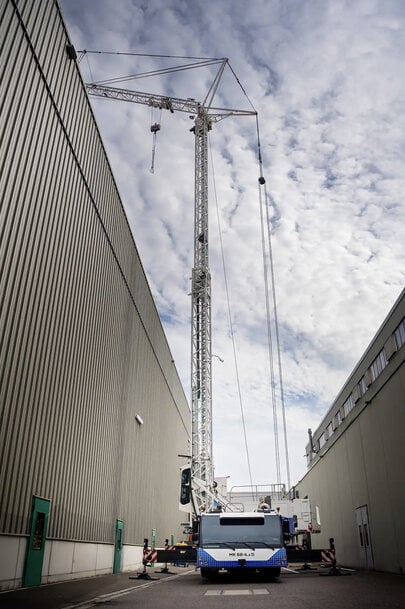
An electro-hydraulic setup configuration allows operators to deploy outrigger supports and mount ballast using electrical energy, eliminating localized carbon emissions during rig-in. The carrier incorporates standard 32-Ampere and 63-Ampere site power connections, alongside a 16-Ampere mains input that supports electro-hydraulic operations on low-voltage municipal feeds at adjusted operating speeds. When shore power is unavailable, the hybrid drive connects to external battery systems, such as the Liebherr Liduro Power Port, or runs via an onboard diesel generator.
Kinematics and Urban Site Operations
The upper carriage retains the telescopic tower and folding boom architecture established on the MK 88-4.1E, providing a maximum hook radius of 45 metres with a tip lifting capacity of 2,200 kilograms. Maximum hoisting capacity reaches eight tonnes, with the automated Load-Plus electronic control system providing selective capacity increases up to ten per cent depending on boom angle and stabilization geometry. All-wheel steering delivers an inner turning circle of 11.88 metres, allowing the 8x6x8 vehicle to navigate congested industrial yards and metropolitan construction projects.
Additional Context:
This section details technical specifications and competitive benchmarking not included in the original product announcement.
Mobile construction cranes, or mobile self-erecting tower cranes, operate under European standard EN 14439, combining the transit speed of an all-terrain carrier with the vertical clearance and over-obstacle reach of a traditional tower crane. The MK 88-4.2E achieves a maximum hook height of 59.10 metres when luffed to 45 degrees, matching high-tier class benchmarks such as the Spierings SK597-AT4 eLift four-axle mobile tower crane, which offers a 48-metre jib radius and 1,700-kilogram tip capacity. Unlike conventional all-terrain telescopic cranes that require continuous engine idling to maintain hydraulic pressure, modern electric-drive self-erecting cranes draw between 16 and 63 Amperes of grid power, reducing operating sound levels below 70 dB(A) for nighttime metropolitan operation while eliminating diesel fuel consumption during lifting cycles.
Edited by Natania Lyngdoh, Induportals editor, with AI assistance.
www.liebherr.com
Powered by
Induportals Media Publishing