Mobile Construction Crane Architecture Optimizes High-Altitude Inner-City Lifting
The industrial relocation specialist Hess GmbH deployed a vertical-tower mobile construction crane to execute complex building services installations within narrow urban parameters. www.liebherr.comApplication area: Heavy lifting and urban building services installation Industry sector: Industrial assembly, machinery relocation, and construction logistics The industrial relocation and assembly specialist Hess GmbH has expanded its lifting machinery fleet by introducing its first mobile construction crane. This fleet integration targets complex material handling requirements in tightly constrained urban environments and industrial building projects. By deploying a five-axle crane featuring a vertical tower design and a horizontal trolley jib, the company aims to bypass physical obstacles, eliminate machinery repositioning on site, and optimize workflow efficiency across specialized installation sectors such as heating, ventilation, air conditioning, and structural steel assembly. Kinematic Limitations of Telescopic Jibs in Dense Urban Footprints Executing heavy lifting operations within historical city centers, dense commercial districts, and narrow inner courtyards presents severe spatial challenges. Traditional telescopic all-terrain cranes operate via a linear boom trajectory that originates from a low pivot point. To clear tall buildings or perimeter walls, a telescopic crane requires a substantial horizontal setback area to maintain a safe working angle, or it must be fitted with supplementary manual lattice extensions. This configuration drastically increases setup times, requires a larger ground footprint, and often necessitates moving the entire vehicle to access multiple installation points, extending project durations and road closure windows. Vertical Mast Architecture and Trolley Jib Functionality To overcome the geometry constraints of traditional boom setups, the company selected a five-axle mobile construction crane configuration. This architectural design utilizes a vertical mast that rises perpendicular to the ground chassis, combined with a horizontal trolley jib mounted at the apex. This technical layout provides specific operational mechanics: Direct Obstacle Clearance: The vertical tower format allows the crane to be positioned directly adjacent to buildings, clearing roof edges and vertical facades without requiring an angular horizontal buffer zone. Horizontal Material Dispatch: The trolley jib moves the load parallel to the roof plane, delivering linear horizontal coverage over wide building structures while maintaining a uniform hook height. Single-Location Coverage: The combination of a long jib radius and trolley movement enables the hook to reach varied assembly points from a single stationary outrigger footprint, eliminating intermediate equipment transit. For operations under confined conditions where standard self-ballasting routines are restricted by physical obstructions like overhanging trees, the counterweights can be integrated externally via an auxiliary loading crane to ensure safe structural stabilization. Field Validation in Building Services and Communication Infrastructure The machinery demonstrated its operational advantages during initial field deployments in Germany. In Düsseldorf city center, the unit navigated a tight footprint between mature trees to hoist a 3.2-tonne industrial chiller unit over a multi-story building directly into the enclosed courtyard of the Steigenberger Parkhotel. A subsequent project in Krefeld involved dismantling telecommunication antennas. While a standard 150-tonne telescopic mobile crane would have required a manual lattice jib assembly and multiple position changes around the facility to clear the structural projections, the mobile construction crane executed all rigging phases from a single setup location, shortening the overall operational timeframe. Footprint Optimization and Reduction of Auxiliary Rigging Cost The technical integration of automatic push-button boom unfolding reduces setup labor compared to multi-part lattice jib configurations. By handling heavy components—such as the 3.2-tonne cooling unit—at extended radii without requiring structural repositioning, the crane minimizes ground-level site disruptions. This performance profile lowers overall project costs by decreasing the need for secondary support vehicles, minimizing public space blockages, and maximizing the utilization rate of the operator's specialized personnel during critical inner-city infrastructure upgrades. Edited by Sucithra Mani, Induportals editor – adapted by AI. www.liebherr.com Powered by Induportals Media Publishing
 machineryasia
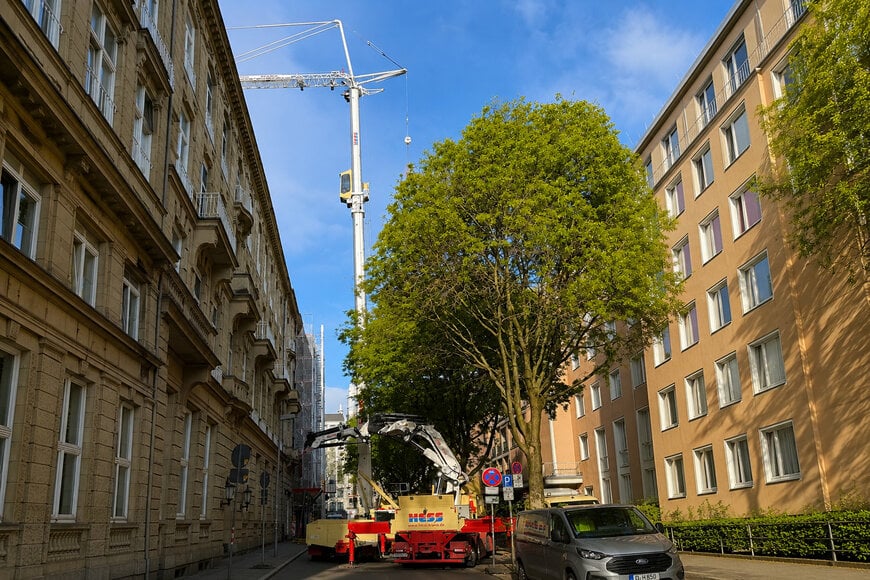
The industrial relocation specialist Hess GmbH deployed a vertical-tower mobile construction crane to execute complex building services installations within narrow urban parameters.
www.liebherr.com
Application area: Heavy lifting and urban building services installation
Industry sector: Industrial assembly, machinery relocation, and construction logistics
The industrial relocation and assembly specialist Hess GmbH has expanded its lifting machinery fleet by introducing its first mobile construction crane. This fleet integration targets complex material handling requirements in tightly constrained urban environments and industrial building projects. By deploying a five-axle crane featuring a vertical tower design and a horizontal trolley jib, the company aims to bypass physical obstacles, eliminate machinery repositioning on site, and optimize workflow efficiency across specialized installation sectors such as heating, ventilation, air conditioning, and structural steel assembly.
Kinematic Limitations of Telescopic Jibs in Dense Urban Footprints
Executing heavy lifting operations within historical city centers, dense commercial districts, and narrow inner courtyards presents severe spatial challenges. Traditional telescopic all-terrain cranes operate via a linear boom trajectory that originates from a low pivot point. To clear tall buildings or perimeter walls, a telescopic crane requires a substantial horizontal setback area to maintain a safe working angle, or it must be fitted with supplementary manual lattice extensions. This configuration drastically increases setup times, requires a larger ground footprint, and often necessitates moving the entire vehicle to access multiple installation points, extending project durations and road closure windows.
Vertical Mast Architecture and Trolley Jib Functionality
To overcome the geometry constraints of traditional boom setups, the company selected a five-axle mobile construction crane configuration. This architectural design utilizes a vertical mast that rises perpendicular to the ground chassis, combined with a horizontal trolley jib mounted at the apex. This technical layout provides specific operational mechanics:
- Direct Obstacle Clearance: The vertical tower format allows the crane to be positioned directly adjacent to buildings, clearing roof edges and vertical facades without requiring an angular horizontal buffer zone.
- Horizontal Material Dispatch: The trolley jib moves the load parallel to the roof plane, delivering linear horizontal coverage over wide building structures while maintaining a uniform hook height.
- Single-Location Coverage: The combination of a long jib radius and trolley movement enables the hook to reach varied assembly points from a single stationary outrigger footprint, eliminating intermediate equipment transit.
For operations under confined conditions where standard self-ballasting routines are restricted by physical obstructions like overhanging trees, the counterweights can be integrated externally via an auxiliary loading crane to ensure safe structural stabilization.
Field Validation in Building Services and Communication Infrastructure
The machinery demonstrated its operational advantages during initial field deployments in Germany. In Düsseldorf city center, the unit navigated a tight footprint between mature trees to hoist a 3.2-tonne industrial chiller unit over a multi-story building directly into the enclosed courtyard of the Steigenberger Parkhotel. A subsequent project in Krefeld involved dismantling telecommunication antennas. While a standard 150-tonne telescopic mobile crane would have required a manual lattice jib assembly and multiple position changes around the facility to clear the structural projections, the mobile construction crane executed all rigging phases from a single setup location, shortening the overall operational timeframe.
Footprint Optimization and Reduction of Auxiliary Rigging Cost
The technical integration of automatic push-button boom unfolding reduces setup labor compared to multi-part lattice jib configurations. By handling heavy components—such as the 3.2-tonne cooling unit—at extended radii without requiring structural repositioning, the crane minimizes ground-level site disruptions. This performance profile lowers overall project costs by decreasing the need for secondary support vehicles, minimizing public space blockages, and maximizing the utilization rate of the operator's specialized personnel during critical inner-city infrastructure upgrades.
Edited by Sucithra Mani, Induportals editor – adapted by AI.
www.liebherr.com
Powered by
Induportals Media Publishing